
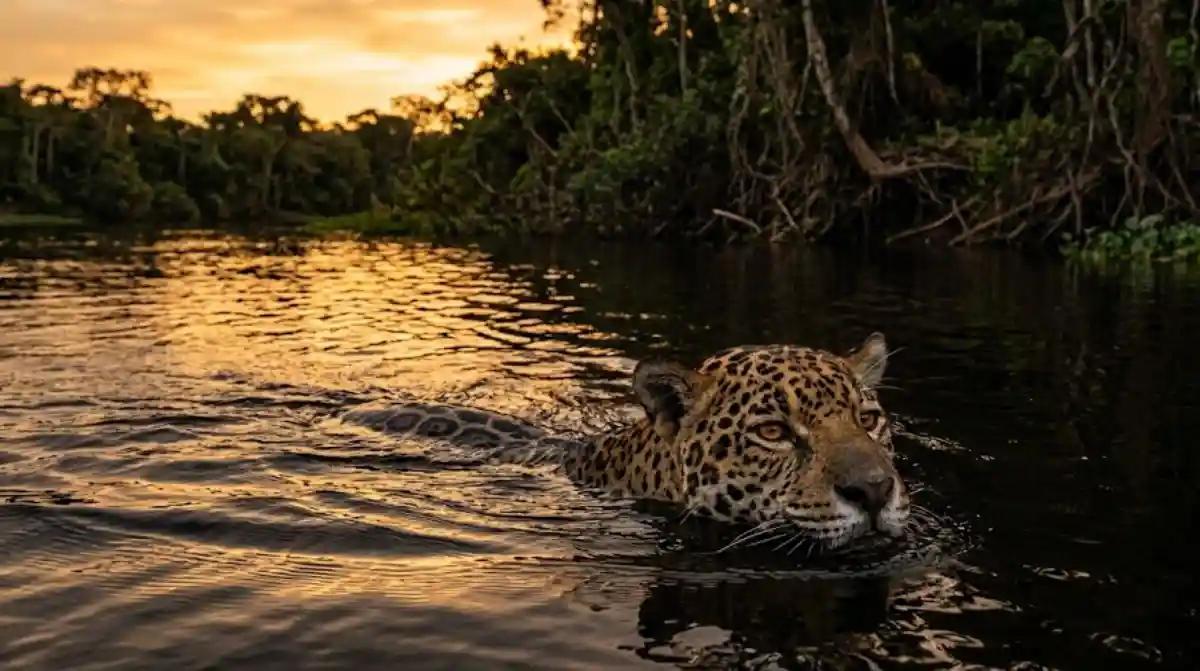
The jaguar has the most powerful bite among all the cats in the world. Its bite can pierce turtle shells and the skulls of caimans, a capacity that sets it apart from its African and Asian relatives and challenges the idea that big cats avoid the water.
In the Amazon, the Panthera onca has turned rivers into a second hunting territory. Its body allows it to swim for miles without signs of exhaustion, an adaptation that is more than a convenience. It is an essential survival strategy in a biome where solid ground and aquatic habitat merge for half the year in igapó forests.
The biology of an elite swimmer
Common assumptions about cats disliking moisture do not describe the Amazonian jaguar. The animal descends from lineages that adapted to flood-prone areas and developed a body especially suited to movement through water.
Its broad paws work like efficient paddles, while an extremely dense chest musculature provides the power needed to keep moving. Together, these traits give the jaguar remarkable hydrodynamics. It can cut through the currents of major rivers such as the Solimões and the Amazon with minimal noise, an important advantage for a predator that must approach without being detected.
Researchers from the Mamirauá Institute documented jaguars that spend entire months in treetops during the flood season. During that period, the animals move exclusively by swimming from one canopy to another, using the water as a connection between the refuges available in the flooded forest.
The jaguar’s relationship with water is also visible in its diet. Field studies show that, in some regions of the Amazon, more than 50% of the prey consumed is aquatic or semiaquatic.
That prey includes large fish such as arapaima, as well as mammals that seek refuge in the water, including capybaras. The ability to submerge completely and surprise prey from below places the jaguar at the top of the food web in two ecosystems at once, balancing the food chain in both the forest and the water.
How jaguars attack caimans and fish
One of the most impressive scenes in Amazonian nature occurs when a jaguar decides to hunt spectacled caimans or black caimans. The attack generally begins with silent observation from branches hanging over the riverbank.
After identifying its target, the cat launches into the water with surgical precision, aiming directly at the base of the reptile’s skull. This killing method is exclusive to the species. While lions and tigers typically suffocate prey through the throat, the jaguar uses its jaw power to disable the opponent’s central nervous system instantly.
The approach helps the jaguar avoid prolonged struggles that could cause serious injuries in the water. A jaguar’s bite force is estimated at about 1,500 to 2,000 pounds per square inch, or PSI. That is nearly twice the force of a lion’s bite.
This evolutionary adaptation allows the jaguar to capture prey protected by resistant armor, something no other cat can do with the same efficiency. It reinforces the animal’s position as the most resilient and adaptable predator in the tropical forests of the Americas.
The jaguar also displays refined tactical intelligence by choosing periods of strong sunlight. At those times, caimans are thermoregulating along the banks, where they become slower and more vulnerable. The encounter brings mammalian agility face to face with the prehistoric resistance of reptiles, in an evolutionary dance shaped over millions of years.
A predator that helps protect the rivers
The jaguar’s presence in watersheds goes far beyond its visual impact or its place at the top of the food chain. As an “umbrella” species, its protection helps preserve vast areas of riparian forest, the vegetation along river margins that filters sediment and helps maintain water quality.
Protecting the habitat needed by a swimming jaguar also protects springs and water flow that sustain river communities and the rainfall cycle across the South American continent. Modern science, using GPS collar monitoring and underwater camera traps, has revealed that jaguars follow preferred river routes.
These routes function almost like aquatic “highways” that the cats use to patrol their territories. This knowledge is fundamental to creating ecological corridors that connect different protected areas.
Without the ability to swim freely between riverbanks, jaguar populations would become isolated, leading to the genetic impoverishment of the species. Water connectivity, therefore, is as important to the cat as vegetation cover.
The jaguar of the waters in Amazonian culture
In the worldview of many Indigenous peoples of the Amazon, the jaguar is not simply an animal. It is a spiritual entity that moves between worlds. The cat’s ability to dive and emerge with prey is seen by many tribes as a symbol of renewal and mastery over the invisible.
According to the oral tradition of some ethnic groups in the Upper Rio Negro, the jaguar taught the first humans fishing techniques and respect for the river’s cycles. That ancestral respect is reflected today in conservation efforts led by many Indigenous communities, which see the jaguar as a guardian of flooded forests.
This cultural connection strengthens sustainable wildlife-watching tourism, which has grown exponentially in regions such as the Pantanal and in preserved parts of the Amazon. Seeing a jaguar swimming in its natural habitat creates an awareness that no book or documentary can fully reproduce.
When properly managed, this economic activity replaces the old hunting culture with appreciation for the living animal. It shows that biodiversity can drive social and economic development for local communities while keeping the forest standing and the rivers alive.
Pollution, conflict and the future
Despite its strength and versatility, the jaguar faces growing challenges linked to habitat fragmentation and the contamination of rivers by mercury and other pollutants. As a large predator that eats fish and caimans, it accumulates toxins in its body through bioaccumulation.
Protecting the swimming jaguar therefore requires close attention to the chemical health of Amazonian waters. Combating illegal mining and improving sanitation in Amazonian cities become, surprisingly, direct conservation measures for Brazil’s largest cat.
The future of Panthera onca depends on seeing the Amazon as an integrated system. Land and water are not separate spaces, but complementary ones. Improving coexistence between people and jaguars, especially in agricultural and cattle-ranching areas that border the forest, is the next major step for Brazilian sustainability.
Compensation programs for livestock losses and the use of electric fences have shown promising results. These measures allow the cat to continue performing its ecological role without entering into direct conflict with rural producers.
To reflect on a jaguar swimming through Amazon rivers is to understand that nature recognizes no rigid boundaries. It adapts, flows and finds paths where obstacles seem to be the only possibility.
If the jaguar, with all its power, learned to become part of the river in order to survive, perhaps the human role is to learn to flow with the forest, respect its rhythms and ensure that the cat’s roar continues to echo among the trees and across the water for generations to come.
Reporting: Anne Silva / Amazonia Mag

Editor, English Edition — Amazonia Mag
Anne Silva is the editor of Amazonia Mag, the English-language edition of Revista Amazônia. She curates, translates and adapts the outlet's science and environment coverage for an international audience, reporting on Amazon wildlife, flora, rivers, climate and research. Every story she edits is grounded in peer-reviewed studies, official data and on-the-ground reporting from the Revista Amazônia newsroom in Belém, Pará, Brazil. More by Anne Silva →