
Gardeners of the canopy
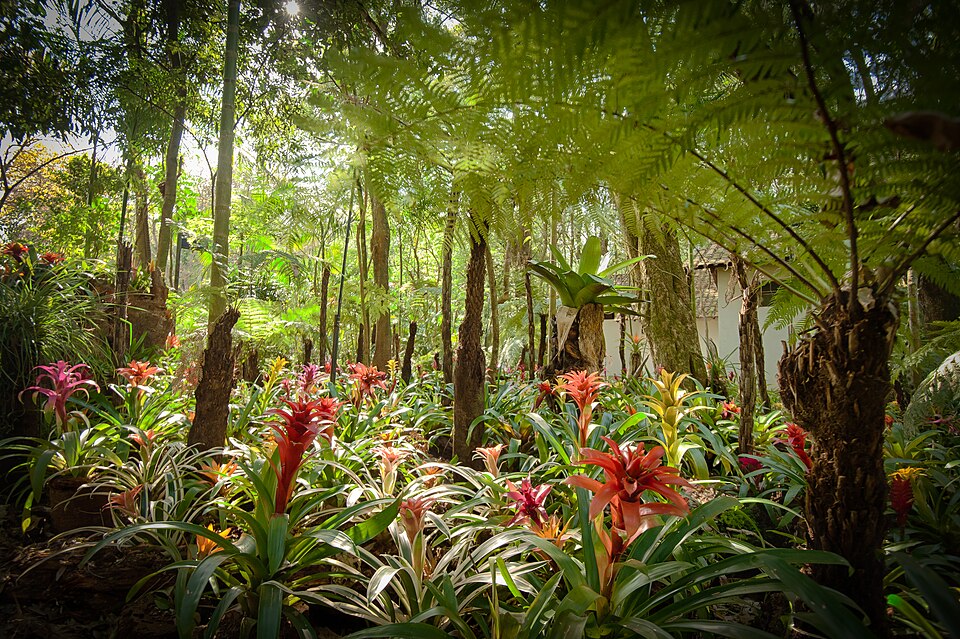
In the canopy of the Atlantic Forest, where branches interlace and the light arrives filtered, live plants that rarely catch the eye of anyone walking on the ground. Epiphytic tank bromeliads cling to trunks and limbs, anchored high above the soil, and they seem to sit at the margins of the forest’s dynamics. Yet recent research shows that these plants play a decisive role in organizing life far below the place where they grow.
A team of researchers from the State University of Campinas (Unicamp), with support from the São Paulo Research Foundation (FAPESP), found that bromeliads enrich the forest soil with essential nutrients. They create true oases of fertility in environments that are traditionally poor. The results, published in the scientific journal Plant and Soil, help explain why trees with high nutrient demands can thrive in sandy, acidic soils such as those of restinga forest, the coastal woodland that grows on sand.
These bromeliads collect rainwater between their leaves and form natural tanks suspended in the air. They are far more than simple reservoirs. Fallen leaves, insects, droppings and other organic debris settle in these tanks, and each one works as a small ecosystem of its own. What happens up there, as the scientists demonstrate, quietly changes what grows down below.
The invisible path of nutrients to the soil
When a bromeliad tank overflows, the water that spills out carries a solution rich in dissolved nutrients. Nitrogen, phosphorus, calcium, potassium, magnesium, sulfur and iron appear at concentrations much higher than those found in plain rainwater. As this mixture reaches the ground, it creates localized patches of fertility and profoundly alters the chemical conditions of the environment.
In this setting the researchers followed the growth of the caroba, also known as white jacaranda (Jacaranda puberula). It is a tree that would hardly survive on the nutrients available in the sandy soil of the restinga alone. The bromeliads growing above these areas build a kind of ecological bridge between the canopy and the forest floor.
This relationship, little explored by science until now, was described as a new type of ecological link: a remote interaction between plants. It is an indirect interaction, with no physical contact, mediated by the flow of water and nutrients. Plants separated by several yards (meters) of height directly influence each other’s growth, even though they never touch.
According to the researchers, bromeliads can accumulate up to 50,000 liters of water per hectare in tropical forests, which is about 5,300 US gallons per acre. A significant share of that volume returns to the soil enriched with nutrients, working as a natural and continuous fertilizer.
Why poor soils make the difference
The restinga soil is sandy and acidic, a combination that holds few nutrients. In such a place, a tree that demands a lot from the soil would be expected to struggle. The discovery shows that the forest has its own way of redistributing resources: the nutrients that gather in the tanks, high in the trees, are delivered to specific spots on the ground.
This is why the bromeliad is better understood as a link between two layers of the forest than as a decoration of the branches. The canopy collects water, leaves, insects and droppings. The tanks transform that material into a nutrient-rich solution. When they overflow, that solution reaches the soil and supports plants that would otherwise be unable to grow there.
Experiments that reveal the strength of bromeliad water
To isolate the effect of the bromeliad water and eliminate other environmental variables, the group carried out controlled experiments in a greenhouse on the Unicamp campus. Young caroba seedlings were irrigated with two types of water: one collected directly from the rain, and the other taken from the tanks of bromeliads in the study area.
The results were striking. The plants irrigated with bromeliad water produced almost twice as many leaves as the others. Chemical analyses revealed that their leaves contained 35% more potassium, 36% more phosphorus and 3% more iron. They also showed reduced levels of manganese, an element that can be toxic when present in excess.
To confirm where those nutrients came from, the scientists enriched some of the bromeliads with leaves marked with a rare type of nitrogen that can be traced in the laboratory. The presence of this marker in the leaves of the seedlings proved that the nutrients traveled from the debris accumulated in the tanks all the way to the tissues of the plants on the ground.
The study was carried out at Núcleo Picinguaba, in Ubatuba, in the state of São Paulo. The area is part of Serra do Mar State Park, one of the best preserved regions of the Atlantic Forest.
Diversity, adaptation and the urgency of conservation
Curiously, not every plant benefits from this pulse of nutrients. Earlier research by the same group showed that some restinga species are so adapted to scarcity that an excess of nutrients can harm their growth. Even so, these fertile patches occupy only a small fraction of the forest.
The net effect, according to the scientists, is an increase in the functional diversity of the ecosystem. Species with high nutritional demand, such as the caroba, come to coexist with those adapted to poor soil, which expands the complexity of the forest.
The work is part of projects supported by FAPESP, including the BIOTA-FAPESP Program, and is coordinated by researchers at the Institute of Biology of Unicamp. Part of the investigation also involved international collaboration, including a research internship at Pennsylvania State University, in the United States.
For the authors, the discovery broadens the understanding of the ecological role of bromeliads, plants that are often threatened by deforestation and illegal collection. The loss of these species could trigger cascading effects and compromise ecological functions that are invisible but fundamental to the maintenance of biodiversity.
By revealing that the forest is organized not only horizontally but also vertically, the research reinforces an essential idea: conserving biodiversity is not only about protecting isolated species, but about preserving the subtle relationships that keep ecosystems alive.
Reporting: Revista Amazônia newsroom / Amazonia Mag

Editor · Amazonia Mag
Anne Silva is the editor of Amazonia Mag, the English-language edition of Revista Amazônia. She curates, translates and adapts the outlet's science and environment coverage for an international audience, reporting on Amazon wildlife, flora, rivers, climate and research. Every story she edits is grounded in peer-reviewed studies, official data and on-the-ground reporting from the Revista Amazônia newsroom in Belém, Pará, Brazil. More by Anne Silva →