
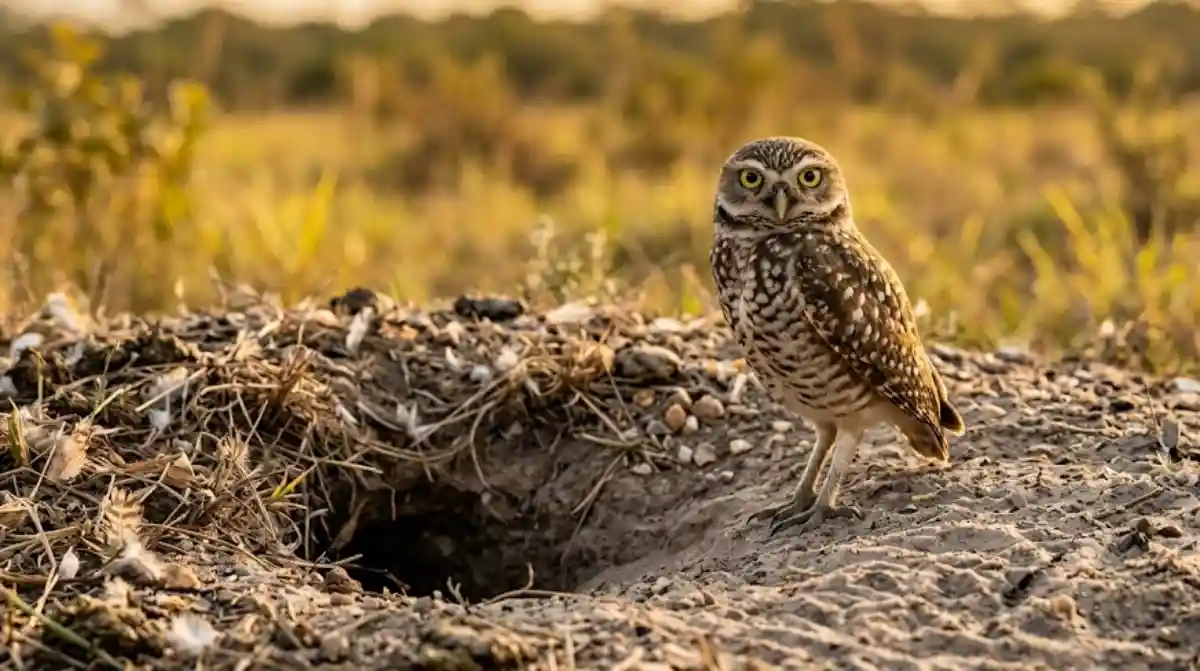
The burrowing owl, Athene cunicularia, breaks nearly every rule people tend to associate with nocturnal birds of prey. It is active during the day, lives in open areas and, unlike most of its relatives that nest in trees, prefers the safety of the ground below.
Yet the species’ most surprising and verifiable trait is not simply where it lives. It is how the bird arranges its home. Established ornithological research shows that burrowing owls carefully collect and spread mammal droppings, including manure from cattle or horses, around the entrance to their nests.
The result is an ecological fishing system. The manure attracts beetles and other dung-feeding insects, which make up a vital part of the owl’s diet and can become accessible prey for adults and hungry chicks waiting inside the burrow.
Underground architecture and a manure strategy
Contrary to popular belief, burrowing owls rarely dig their own holes from scratch. They are resourceful opportunists that prefer to occupy and renovate abandoned burrows made by digging mammals, such as nine-banded armadillos and crab-eating foxes.
Once the owls settle in, the gardening begins. Collecting manure is not random behavior or simple waste left near the entrance. It is a defined foraging strategy connected to the way the species obtains food in its surroundings.
The strong smell and nutrients in the droppings act as a beacon for a wide range of beetles, especially members of the Scarabaeidae family. The insects fly directly toward the burrow entrance, where they can become easy prey for the owl or for its hungry chicks.
A food-delivery system at the door
This strategy offers significant adaptive advantages. Instead of spending valuable energy flying long distances to hunt, the burrowing owl brings its food to the doorstep, or creates the conditions that concentrate insects there.
Scientists describe the behavior as an ecological tool. It is a rudimentary but effective form of resource management, because material produced by mammals becomes a mechanism for gathering insects close to the nest.
During the breeding season, when food demand is extremely high and chicks cannot be left alone for long periods, this delivery of protein-rich beetles is crucial to the survival rate of the brood. The strategy reduces the need for adults to travel far from the burrow while they are caring for their young.
Studies show that nests decorated with manure have a much higher density of prey than clean burrows. According to those studies, the greater availability of food results in chicks that are heavier and healthier.
The daytime sentinel of Amazonian fields
The burrowing owl is an iconic and charismatic presence in Brazil’s open landscapes. Its large yellow eyes and its habit of watching over its territory from the top of a termite mound or fence make it a species that is easy to observe and admire.
In the Amazon, burrowing owls occupy lavrado areas and savannas. There, they play an important role in controlling populations of insects and small rodents that can become agricultural pests, and their presence indicates environmental balance in these transition zones.
The owl’s behavior also shows that the ground beneath an open field is not an empty space separated from the rest of the ecosystem. Its burrow is a shelter, a breeding site and a strategic place for finding food at the same time.
Adaptation to human-shaped landscapes
The ability to use domestic-animal manure demonstrates the species’ remarkable adaptability to human-altered environments. Rather than simply being driven away by cattle, burrowing owls have learned to benefit from a condition created by that coexistence.
But nesting on the ground also makes them vulnerable. Terrestrial predators can reach their shelters, while human activity creates accidental risks, including agricultural machinery and livestock trampling near the nesting sites.
Protecting native grassland and field areas, along with respecting places where the owls nest, is essential. Conservation allows these small sentinels to continue arranging their burrows and helping maintain the balance of the region’s open ecosystems.
An acoustic defense underground
Thinking about the burrowing owl shows that intelligence in nature can appear in unexpected forms. A simple pile of manure can become the key to a brood’s survival, revealing that every element, however insignificant it may seem, can have a vital purpose in the intricate web of Amazonian biodiversity.
The species is also an impressive vocalist. When threatened inside its burrow by a predator such as a snake, it can perfectly imitate the rattling sound of a rattlesnake and use the mimicry to drive the intruder away.
This acoustic defense can be effective in the darkness of the underground refuge. The owl therefore uses its surroundings not only to attract prey, but also uses sound to try to keep away animals that could threaten its shelter and its young.
Between manure that draws beetles, reused burrows and the imitation of a rattlesnake’s warning, the burrowing owl displays a distinctive combination of behavior, opportunity and adaptation. Its life shows that survival does not always depend on strength or speed, but also on the ability to turn available surroundings into an advantage.
The strategy also changes how a familiar bird can be understood. A bird standing on a fence may appear to be merely watching the field, yet below it lies a carefully used shelter and, around its entrance, a deliberately arranged resource that helps bring food closer.
That combination of daytime vigilance, underground architecture and manure-based foraging makes the burrowing owl one of the most unusual inhabitants of open Amazonian landscapes. Its presence connects mammals, insects, birds and human-shaped environments through a behavior that is both practical and remarkably inventive.
Reporting: Anne Silva / Amazonia Mag

Editor, English Edition — Amazonia Mag
Anne Silva is the editor of Amazonia Mag, the English-language edition of Revista Amazônia. She curates, translates and adapts the outlet's science and environment coverage for an international audience, reporting on Amazon wildlife, flora, rivers, climate and research. Every story she edits is grounded in peer-reviewed studies, official data and on-the-ground reporting from the Revista Amazônia newsroom in Belém, Pará, Brazil. More by Anne Silva →