
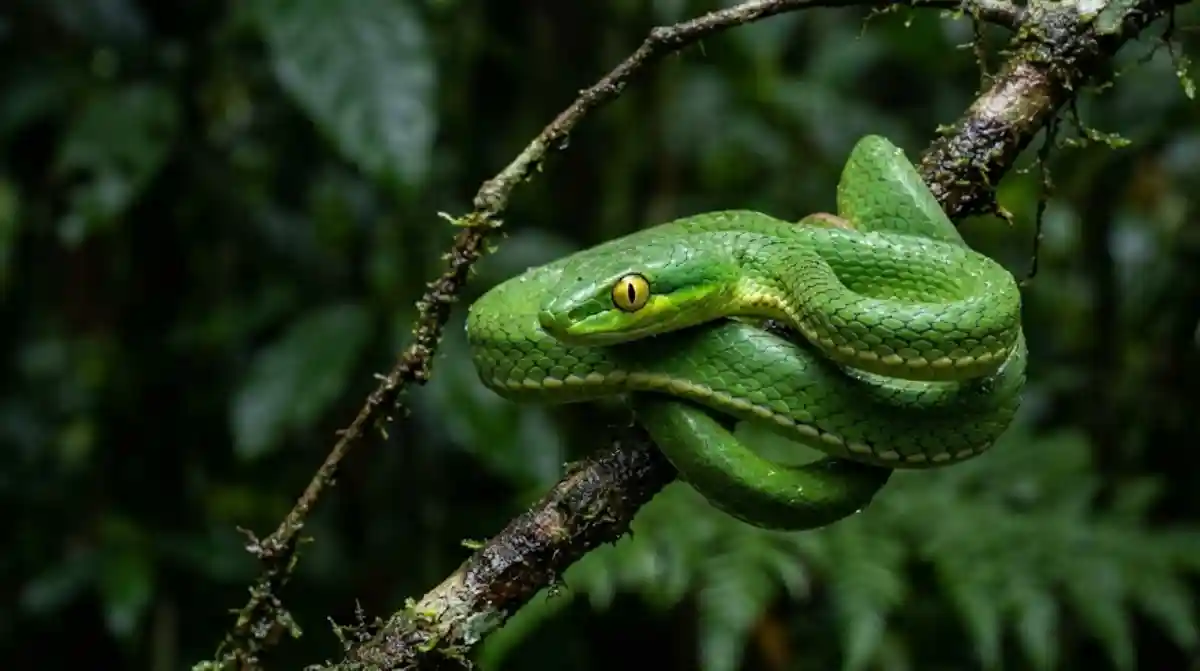
The green parrot snake, scientifically known as Corallus caninus, is one of the Amazon’s most specialized inhabitants of the treetops. Its emerald-green body blends with leaves, while its transverse white markings echo the shafts of sunlight filtering through the foliage. Suspended among branches, the species can appear to be part of the forest’s own structure.
It has some of the longest teeth among nonvenomous snakes in the world. This feature is not ornamental. The teeth are adapted to pierce the dense layer of feathers on birds and the fur of small mammals, making it possible to hold prey quickly in an environment where an animal may escape by flying or jumping into open space.
Unlike its terrestrial relatives, the species spends 100% of its life cycle suspended in vegetation. Its prehensile muscles are so powerful that it can deliver accurate strikes while anchored only by the tip of its tail. This acrobatic behavior gives the snake an exclusive ecological niche, where few predators can compete for the same resources.
A hunter that detects heat in the darkness
To survive in the near-total darkness of the Amazon understory, the green parrot snake does not rely only on conventional vision. Along its mouth are labial pits, highly specialized sensory organs that detect tiny changes in temperature around it. These receptors work like biological thermal cameras.
Even on a moonless night, the snake can detect the “heat signature” of a bird or small marsupial several meters away. Its infrared perception is integrated into the central nervous system, creating a three-dimensional mental map of the prey. Darkness therefore does not completely conceal an animal from a hunter that can remain motionless among the branches.
When the snake decides to attack, it projects its body away from the branch in a fraction of a second. Biologists call this a pendulum strike because the snake uses the swing of its body and its elevated position to reach the target. The launch takes place from a narrow platform, with no solid ground beneath it and the tail serving as an anchor.
After catching its target in midair, the snake uses gravity to help with constriction. It coils around the prey while still swinging from the branch, combining balance, strength and control. Few creatures can repeat such a maneuver in the canopy, where every movement takes place far above the forest floor.
Perfect camouflage among leaves, moss and lichen
The emerald color of Corallus caninus is a passive survival tool. The white markings crossing its back break up the outline of the body and resemble beams of sunlight passing through leaves. The result is disruptive camouflage that makes it difficult for other animals to recognize the snake’s silhouette.
To an observer on the ground, or to a hawk flying over the treetops, the snake may be virtually indistinguishable from a tangle of moss or a liana covered in lichens. This invisibility is vital because, although the species is an efficient predator, it is also targeted by large birds of prey. Staying hidden is a defense as important as its teeth.
During the day, it adopts a classic resting posture. It coils into perfect spirals on a horizontal branch and places its head at the center of the structure. This position minimizes its exposed area and also helps with thermoregulation, an essential process for a reptile that depends on external heat.
Choosing branches that receive filtered sunlight is deliberate. In those places, the snake can maintain the conditions needed to digest prey without descending to the ground, where it would be vulnerable to terrestrial predators. Among orchids and bromeliads, it remains still for long periods, protected by the microenvironment of the canopy.
Long teeth for a life without solid ground
Despite its size and imposing appearance, the green parrot snake is not venomous. Its method of killing prey is constriction. Before its body can wrap around an animal, however, it must prevent that animal from escaping in a space where there is no stable surface for a chase.
For that purpose, it has extremely long, recurved front teeth. They function as biological hooks. Once the strike has been delivered, the teeth hold the prey while the snake’s body begins the process of suffocation. This specialized dentition is particularly useful when the target tries to fly or jump from the branch.
The snake’s skull is also notable for its flexibility. Its jaws are not held together by rigid bones, but by flexible ligaments that allow it to swallow animals significantly larger than the diameter of its own head. This structure expands its feeding options without requiring a prolonged pursuit through the branches.
A single large meal can sustain the snake through weeks of immobility and silent growth. That economy of energy is fundamental to life in the trees. After feeding, it can remain among epiphytes without coming down, preserving its strategy of avoiding the ground and its dangers.
Red-toned young and a life cycle in the treetops
The green parrot snake’s reproduction reinforces its complete independence from the ground. It is ovoviviparous, meaning that the eggs develop inside the female’s body and the young are born already formed and ready for independent life in the vegetation.
Newborns do not have the green coloration of adults. They are born in reddish or orange tones, a trait researchers believe may provide camouflage among dry branches or the flowers of certain epiphytes during their first months, when they are most vulnerable.
As the young reptile grows and begins hunting larger prey, its skin undergoes an ontogenetic color change. Gradually, it develops the vibrant green that characterizes the species. This maturation process is slow, and the snake can live for many years in the Amazon canopy as long as its habitat remains intact.
Protecting large trees and the connections between treetops is therefore essential for this life cycle to continue away from human contact. A snake that spends its entire life suspended needs a network of branches, vines and vegetation to support movement, hunting and reproduction.
The middle forest layer also needs protection
The green parrot snake shows that the Amazon is organized in layers. Many people imagine the forest as one solid block of vegetation, but for Corallus caninus there are specific “avenues” and “neighborhoods” between 49 and 98 feet high (15 to 30 meters). This is where its routes, shelters and hunting territories are found.
The loss of a single large tree can destroy an animal’s hunting territory for an entire lifetime. Because these snakes move slowly and have a low metabolism, they are particularly sensitive to abrupt microclimate changes caused by selective logging. Alterations to the canopy can change the conditions they need for resting, digesting and remaining concealed.
Valuing the green parrot snake means recognizing the biological complexity above our heads. It is not merely a snake. It is also a key part of controlling bird and small-mammal populations in the canopy, helping keep the forest’s machinery in motion.
Watching the life of a green parrot snake shows that nature does not need speed to be efficient. In the silence of the treetops, patience and perfect adaptation are its true tools of power. Every living thing has an irreplaceable role in the fabric of life.
The green parrot snake is often confused with the green tree python of Australia because of their extreme similarity in color and posture. However, this is a classic case of convergent evolution: different species develop similar solutions to similar environmental challenges, even while living on different continents.
Protecting tropical forests allows this emerald jewel of the fauna to continue its acrobatic feats beneath the moonlight. It also preserves the large trees and canopy connections that make its existence possible, keeping alive the mystery and beauty of Brazil’s green heart.
Reporting: Anne Silva / Amazonia Mag

Editor, English Edition — Amazonia Mag
Anne Silva is the editor of Amazonia Mag, the English-language edition of Revista Amazônia. She curates, translates and adapts the outlet's science and environment coverage for an international audience, reporting on Amazon wildlife, flora, rivers, climate and research. Every story she edits is grounded in peer-reviewed studies, official data and on-the-ground reporting from the Revista Amazônia newsroom in Belém, Pará, Brazil. More by Anne Silva →