
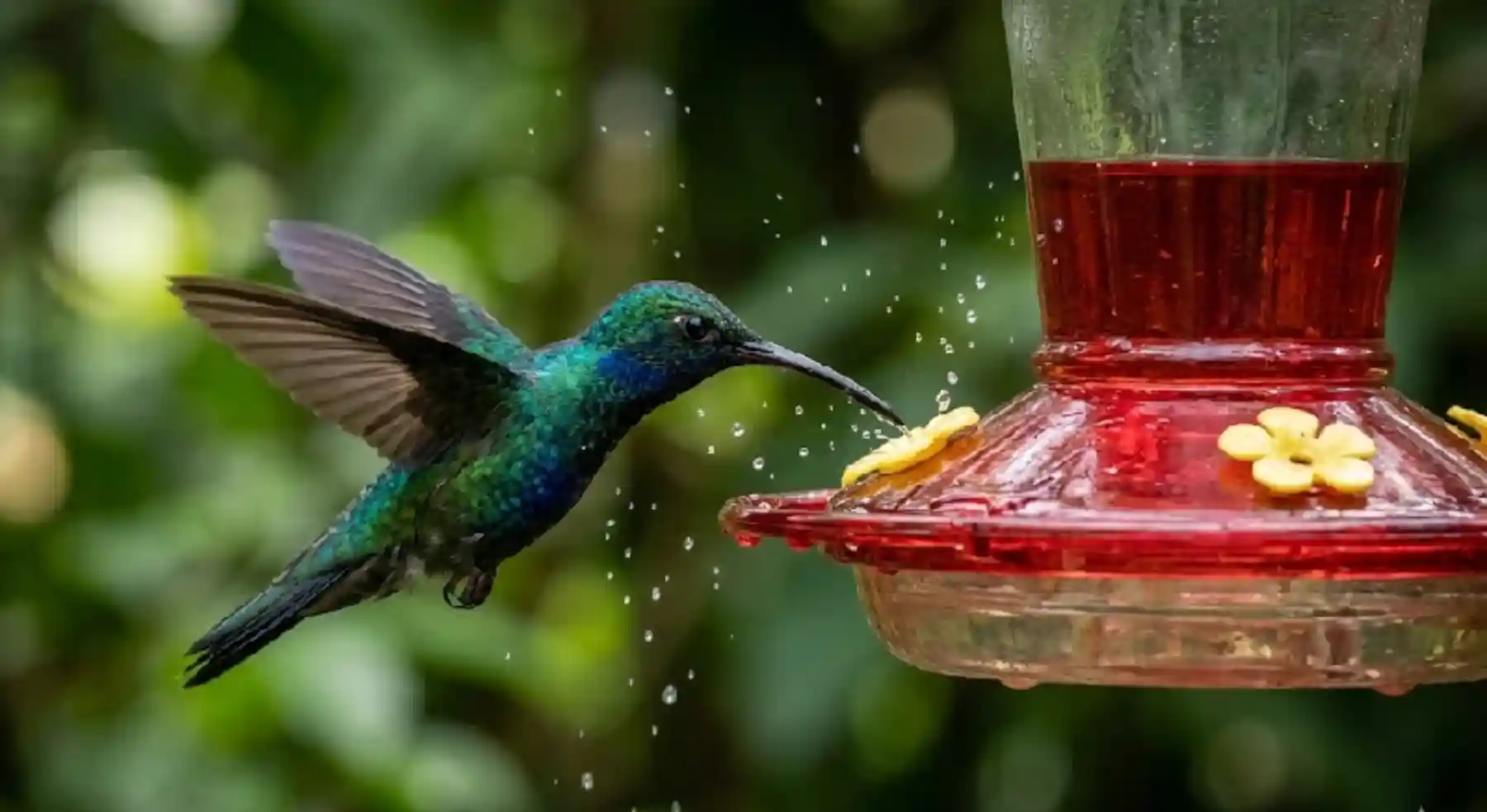
Bird metabolism is one of the most extreme feats of biological engineering in nature, and the demand becomes even steeper among the smallest pollinators. A hummingbird can beat its wings up to 80 times per second, a rate of activity that requires a proportionally massive calorie intake to keep its heart pumping at more than 1000 beats per minute. On forest edges and in expanding urban centres, the availability of water and energy becomes the line that separates survival from collapse for these populations.
That is where the backyard feeder comes in, an object many people hang for the pleasure of watching birds and which, badly managed, turns into a trap. The difference between a refuge and a disease hotspot has nothing to do with the model of the container or its price. It comes down to the ratio of the mixture and to the cleaning routine of the person who put it up.
Cities are not concrete deserts
Cities, often seen as concrete deserts, actually work as essential ecological corridors for a range of species. Installing a bird feeder is not merely adding a decorative accessory to a balcony. It establishes a strategic support point. Urbanisation alters the local microclimate and creates heat islands where natural water sources evaporate far faster than they do inside closed forest.
For birds moving between the forest and the built environment, finding clean and safe water is a constant challenge. These devices help reduce the animals’ heat stress and allow them to save the energy they would otherwise burn on long, exhausting flights in search of a stream or a leftover puddle. That support is vital for maintaining the balance of the species that carry out biological control of insects and the pollination of native plants in yards and parks.
One part sugar to four parts water
There is a recurring debate over whether sugar water makes birds dependent or discourages them from foraging in the wild. Studies indicate that birds are opportunistic and intelligent: they treat feeders as a supplement, not as an exclusive food source. The quick energy obtained from a well prepared sucrose solution can give a hummingbird the push it needs to carry on its pollination route for kilometres, visiting hundreds of flowers that would otherwise go unpollinated.
Whether that interaction helps or harms rests entirely on human management. The sugar used must always be white refined or granulated sugar, because brown sugar and honey can ferment quickly and cause fatal fungal infections on the tongues of the birds. The correct proportion is one part sugar to four parts water, a mixture that mimics the average nectar concentration found in the tropical flowers of the Amazon region and its surroundings.
There is no room for improvisation here. A more concentrated solution does not make the feeder more attractive, and the alternative ingredients that sound more natural, honey above all, are precisely the most dangerous for the animal that comes down to drink.
The instinct to make the offering richer or more wholesome is understandable, and it is exactly the instinct to resist. What reads as generosity in a kitchen becomes a hazard in a feeder, because the bird has no way of telling a safe solution from one that has already begun to spoil.
Hygiene is where the feeder saves or sickens
Keeping a feeder demands a strict commitment to cleanliness. In hot climates, the mixture of water and sugar can grow fungi and bacteria in less than 24 hours. A build up of black residue or a cloudy appearance in the water are danger signs. The recommendation from ornithology specialists is that the solution be replaced and the container washed daily, or at most every two days in shaded spots.
Using brushes that reach every corner of the reservoir and avoiding perfumed detergents is essential. Rinsing must be thorough to guarantee that no chemical residue harms the sensitive digestive system of the birds. Done properly, the feeder becomes a sanctuary. Neglected, it turns into a vector for diseases that can spread quickly through the local bird community.
A feeder does not stand alone
Although the feeder is an excellent starting point, real sustainability arrives when it is integrated into a functional garden. Attracting birds with sugar water alone is a stopgap. The ideal is to surround the feeder with native plants that offer shelter, protection from predators such as domestic cats, and natural food sources, including the small insects that live in the foliage.
Species such as mulberry (Morus), hibiscus (Hibiscus) and sage (Salvia) are excellent companions for these devices. They create a three dimensional environment in which a bird feels safe enough to come down and drink. The vegetation also helps keep the temperature around the feeder milder, preserving water quality for longer. Urban biodiversity flourishes when we build layers of support that mimic, even at a small scale, the complexity of the forest.
From the window to citizen science
Installing a feeder opens a unique window onto animal behaviour. Many nature enthusiasts use those moments to practise citizen science, logging the species that visit their yards on global monitoring platforms. This helps researchers understand migratory patterns and the health of bird populations in areas under pressure from urban development.
By noting which species appear and at what hours, a resident stops being a spectator and becomes a guardian of the local fauna. That engagement is what drives public policy on the preservation of green areas. Anyone who learns to admire the flight of a bananaquit (Coereba flaveola) or the agility of a hummingbird from their own balcony becomes a far more determined defender of the forests.
Choosing well and placing better
To begin, choose feeders that are easy to take apart and wash. Avoid models with many internal decorative details, which trap dirt in corners a brush cannot reach. Position them where birds can see them, but shielded from direct midday sun, to prevent the solution from overheating.
Encouraging birds in urban settings also brings proven psychological benefits for people. Biophilia, our innate tendency to seek connections with nature, is fed by these small everyday gestures. In Amazonian cities, where the forest is sometimes only metres away but separated by walls and asphalt, the feeder works as a constant reminder of the vibrant life around us. Involving children in cleaning the container and preparing the water teaches responsibility, respect for biological cycles and the importance of caring for the environment.
Conserving biodiversity is a mosaic of small actions. A feeder may look like very little against the scale of the challenges facing the Amazon, but for the bird that finds in it the fuel to keep flying, it is the whole world. Sustainability is not only about large government programmes. It is also about how we decide to coexist with the other species that share our space.
Reporting: Anne Silva / Amazonia Mag. Source: feeder management guidance compiled by WikiAves and the ICMBio Portal.

Editor · Amazonia Mag
Anne Silva is the editor of Amazonia Mag, the English-language edition of Revista Amazônia. She curates, translates and adapts the outlet's science and environment coverage for an international audience, reporting on Amazon wildlife, flora, rivers, climate and research. Every story she edits is grounded in peer-reviewed studies, official data and on-the-ground reporting from the Revista Amazônia newsroom in Belém, Pará, Brazil. More by Anne Silva →