
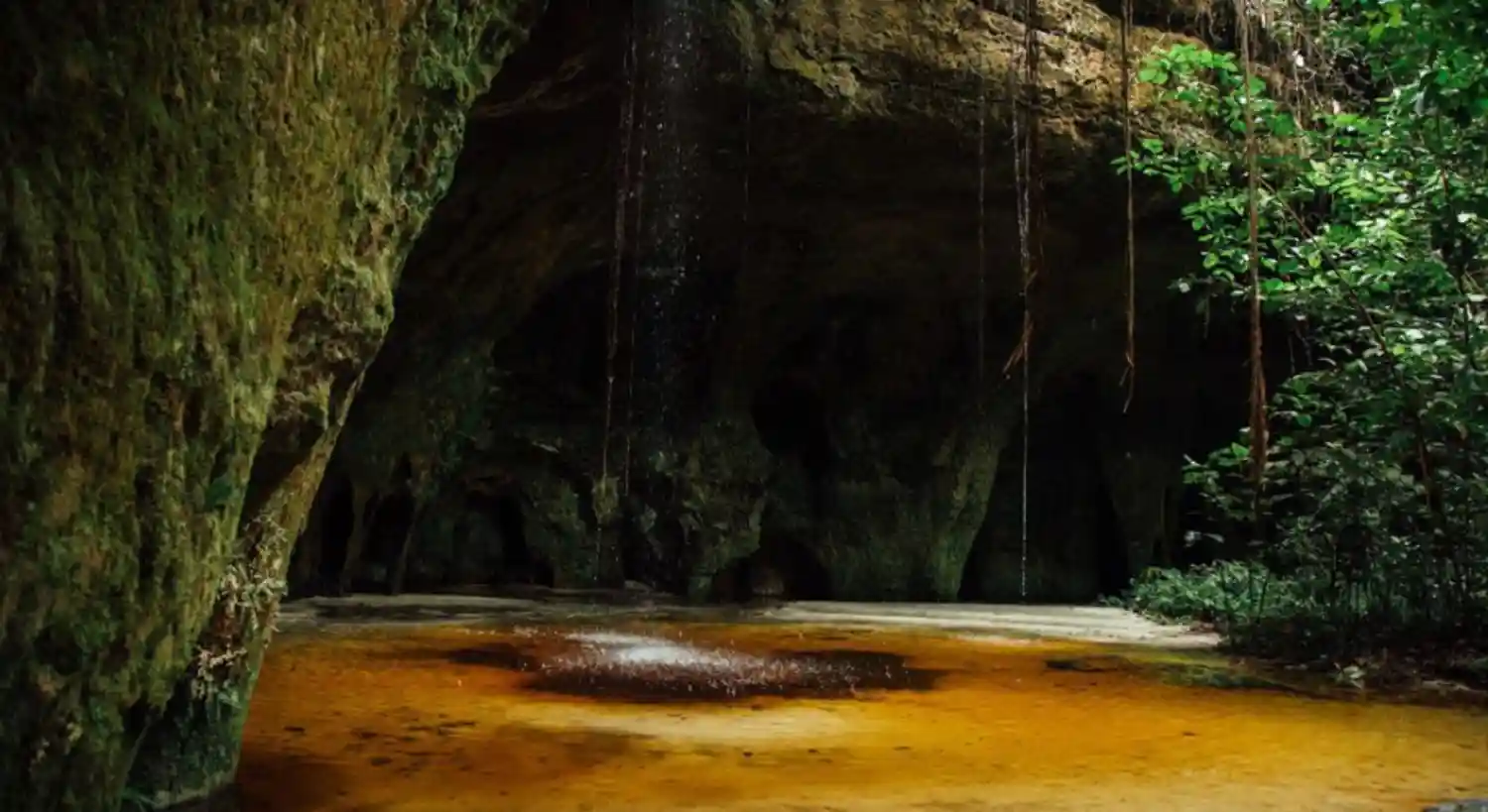
In the southeast of Pará state, in the Brazilian Amazon, the Serra dos Carajás holds a landscape almost nobody associates with tropical rainforest: a world of galleries, fissures and open chambers inside the rock, below the forest floor. This is where the planet’s largest concentration of caves in iron formations is found, a geodiversity that contradicts the common assumption that the Amazonian underground is little more than an inert base holding up the trees.
The difference begins with the rock itself. Unlike the limestone caves better known in other regions of Brazil, a large share of these cavities formed in rocks rich in iron ore, the material known in Brazil as canga. That singular mineral composition produces an underground ecosystem with chemical and physical properties of its own, where evolution followed paths distinct from those on the surface. Inside, the temperature stays constant all year round, and that stable environment works as a refuge for endemic species that have never seen sunlight.
A geological archive beneath the forest
The cave system of the Serra dos Carajás works as a preserved archive of the planet’s history. The rock formations it contains go back to geological periods measured in billions of years, and they offer clues about how the Earth’s crust took shape in South America. According to research, the genesis of these cavities is bound up with leaching and chemical erosion processes accumulated across eras, which carved galleries capable of running for hundreds of metres under the forest.
On the walls, speleologists find layers of sediment that record the climate changes of the Amazon over time. During glaciation periods in the northern hemisphere, while humidity in the forest fluctuated, the inside of the caves stayed stable and kept piling up those layers. Today the strata can be analysed to understand how the vegetation above was transformed. That stratigraphic record is essential to anticipate how the biome will react to contemporary climate change, using the past as a mirror for the future.
Fossils of a forgotten megafauna
One of the most surprising aspects of Amazonian caves is their role as paleontological sites of incalculable value. The chemistry of the underground environment, often saturated with minerals, favours the preservation of skeletal remains that would vanish quickly in the acidic, humid soil of the forest outside. Studies point to the presence of Pleistocene megafauna fossils in these cavities, among them giant sloths and armadillos of monumental proportions that inhabited the region thousands of years ago.
Finding those fossils allows scientists to reconstruct the food web and the behaviour of extinct species. The caves served both as natural shelters for those animals and as natural traps, where individuals fell in and ended up preserved by sediment. Analysis of ancient DNA recovered from such remains is helping to map the migration routes of prehistoric fauna between the Americas, consolidating the Serra dos Carajás as a critical point for global paleontology.
Life without light: the world of troglobites
Life inside the Carajás caves is adapted to extreme conditions of total darkness and scarce nutrients. The creatures that live exclusively in those environments are called troglobites, and they display striking biological adaptations, such as the loss of pigmentation and of sight, offset by an extremely sharpened sense of smell and touch. They are fish, insects and arachnids that depend entirely on the energy entering the cave through bat guano or through organic debris washed in by rainwater.
That biodiversity is exceptionally sensitive. Because caves are isolated environments, many species evolved restricted to a single cavity or a single system, which makes them unique in the world. Protecting them is a logistical and scientific challenge, since any change in internal humidity or in the vegetation cover above the cave can lead to the immediate extinction of entire populations. Constant biological monitoring is the only way to ensure that evolutionary wealth which took millions of years to stabilise is not lost in a few decades.
Human traces older than ten thousand years
Amazonian caves do not hold only natural secrets: they are also keepers of human history on the continent. Rock paintings and pottery fragments found in shelters under rock indicate that the first groups of hunters and gatherers used these spaces more than 10 thousand years ago. Those archaeological sites reveal that the relationship between people and the forest is far older and far more complex than previously imagined.
According to archaeological research, the use of these caves by ancestral peoples was linked to rituals, to protection from the weather and even to food storage. The conservation of those records is precarious, because forest humidity and uncontrolled visits can destroy pigments thousands of years old. Systematic mapping of the cavities is urgent so that the roots of human occupation in the Amazon can be understood, along with the way those populations interacted sustainably with local fauna and flora.
Mining and protection: both sides of the dilemma
The great dilemma of the Serra dos Carajás caves lies in their geographic position, frequently overlapping some of the largest iron ore deposits on the planet. Mining, the economic engine of the region, demands extremely careful management if the speleological heritage is not to be destroyed. Brazilian legislation requires rigorous environmental impact studies and the preservation of cavities considered of maximum relevance for their biological or geological attributes.
On the other side of the same board sits technology. Laser detection and mapping, known by the acronym LiDAR, makes it possible to visualise the extent of the caves before any intervention in the ground takes place. Mining companies are also required to create compensatory measures, among them conservation units meant to protect cave systems equivalent to those affected. That balance between economic development and preservation is one of the biggest challenges of modern environmental management in the Amazon.
It is a balance that has to be weighed cavity by cavity, because no two of them are alike. A gallery of a few metres may shelter a species recorded nowhere else, while a longer cave may hold nothing comparable. That is precisely why the legal category of relevance exists, and why the mapping carried out before any decision matters so much: what is not known in advance cannot be assessed, and what is not assessed tends to be lost.
Caves, aquifers and water security
Less obvious, but just as decisive, is the role caves play within the regional hydrological system. They act as natural conduits that recharge deep aquifers and filter the water that later flows into surface rivers. Preserving the physical integrity of the cavities ensures that the springs sustaining local biodiversity stay active even during dry periods.
Underground water flow carries minerals and nutrients that feed surface vegetation in an invisible way. When a cave system is compromised, the discharge regime of nearby streams, the igarapés, can be altered, harming riverside communities and aquatic fauna alike. Protecting caves is therefore a water security strategy for the whole southeast of Pará, and it reinforces the interconnection between the underground world and the exuberance of the tropical forest.
A scientific frontier still open
Thousands of caves in the Amazon remain to be discovered and charted. Every scientific expedition reveals new galleries, and with them the promise of unknown species and of unpublished data about the past of the Earth. Amazonian speleology is a frontier that demands stamina, technology and respect for nature. Valuing that hidden heritage is part of a complete view of sustainability, one that understands the forest is not only what can be seen above the ground.
Getting to know the depths of Carajás teaches something about the fragility and the resilience of life. Every stalactite that takes centuries to grow a single centimetre is a testament to the patience of nature. Ensuring that those natural temples remain intact for the next generations, as laboratories for science and monuments of Brazilian geological history, depends on decisions taken on the surface. Supporting responsible scientific tourism and the protection of natural cavities is a first step, because preserving the underground is the foundation of everything that pulses above it.
Reporting: Anne Silva / Amazonia Mag. Source: Revista Amazônia.

Editor · Amazonia Mag
Anne Silva is the editor of Amazonia Mag, the English-language edition of Revista Amazônia. She curates, translates and adapts the outlet's science and environment coverage for an international audience, reporting on Amazon wildlife, flora, rivers, climate and research. Every story she edits is grounded in peer-reviewed studies, official data and on-the-ground reporting from the Revista Amazônia newsroom in Belém, Pará, Brazil. More by Anne Silva →