
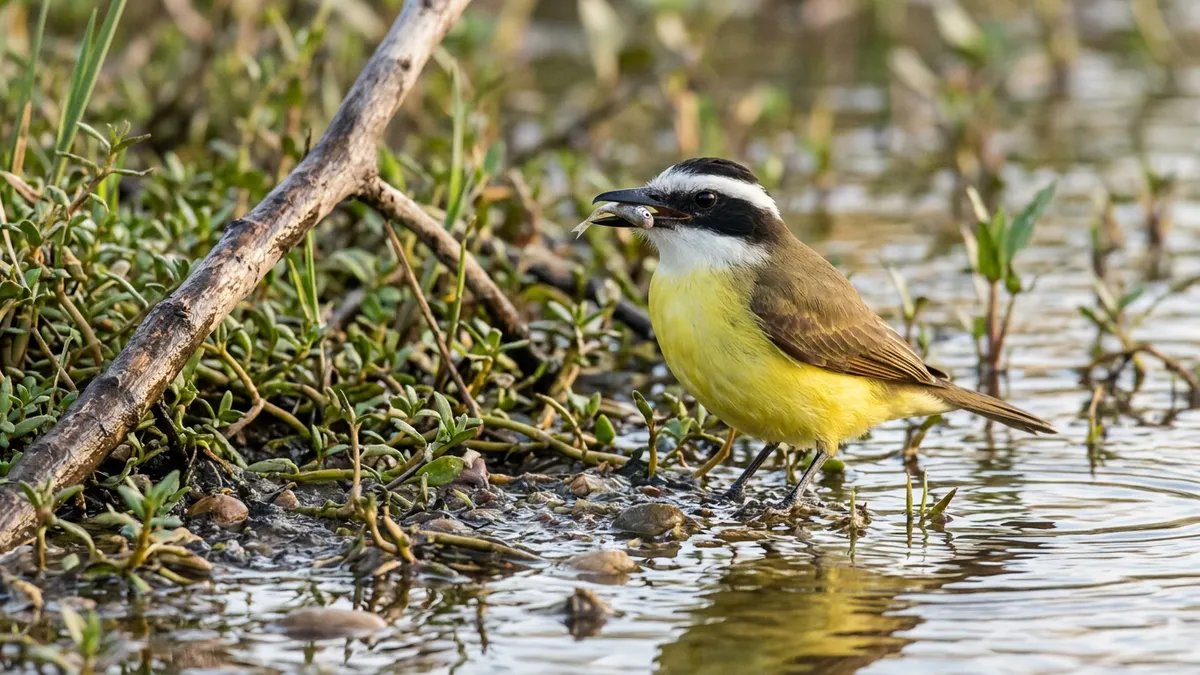
On the edge of a pond, lagoon, stream or deeper puddle, the great kiskadee (Pitangus sulphuratus, known in Brazil as bem-te-vi) can stop hunting insects and fix its attention on a small fish. The bird approaches the shallow water, watches the movement beneath the surface and uses its bill to seize the prey when an opportunity appears.
It does not depend on a single setting or on one exclusive tool. The depth of the water, the presence of vegetation, rocks, branches and other places to perch all help define how the bird positions itself and strikes. Instead of repeating a fixed routine, the kiskadee combines approach, waiting and attack according to what the shoreline offers. The behavior makes visible a central trait of the species: its diet is broad, and it can exploit different resources in the same place.
At the water’s edge, the kiskadee trades flight for fishing
Fish are only one part of the menu. The great kiskadee also catches insects, eats fruit and may include small vertebrates in its diet. This variety helps explain why the species turns up in such different places, from river banks and marshes to parks, backyards, tree-lined streets and open ground.
When insects are available, the bird can chase them or snatch them at points where they pass. When it finds fruit, it shifts its attention to the vegetation. Near water, the prey may be on the surface or in a shallow strip, and the strategy then depends on visibility and access. The mechanism is not a standardized way of fishing for every situation. It is the ability to adjust the attack to the microenvironment. The result is a bird that takes advantage of varied feeding opportunities without being tied to a single kind of resource.
A broad diet starts before the catch
The kiskadee’s body carries marks that help identify it during this search. The head has dark stripes and a white area, the back is brown, the chest and belly are yellow, and the strong bill can grip foods of very different kinds. It is a common bird across much of Brazil and is known for occupying landscapes that people have modified.
Its presence near water does not mean it is an exclusively aquatic bird. It treats the water’s edge as one more feeding space, alternating fishing with the search for insects, fruit and small vertebrates. A single observation may show a fish in the bill, but it cannot sum up the feeding behavior of the species. Fishing belongs to an opportunistic, diversified diet built from whatever is accessible in each place.
The technique also depends on where the bird can rest its body and see the prey. A low branch, a rock, a fence or the bank itself can serve as a lookout. From there the kiskadee can lean over, move toward the water or make a short strike, always on a scale suited to the fish it can handle. Dense vegetation can hide the prey and reduce visibility, while an open area makes it easier to watch the surface.
The same principle appears away from the water. A territory with insects, fruit and small animals offers alternatives, and the bird may switch from one item to another during the day as each resource becomes easier to find. Recognizing this adaptation does not require crediting the species with elaborate planning. The kiskadee responds to the conditions of the moment and takes advantage of different opportunities.
Fish feed the bird, but the nest sets the priority
The search for food happens alongside another decisive task: protecting the place where the birds breed. The kiskadee builds a bulky nest, usually tied to vegetation and structures that provide support. The nest has to be defended because it concentrates eggs or chicks and represents a point of great value to the pair.
When another bird comes near, the kiskadee can call out, fly straight at the intruder and keep up the pressure until it leaves. This territorial behavior is not limited to small birds. The species can also charge a larger bird, using fast, repeated approaches to drive it from the area.
The size of the opponent does not decide the outcome on its own. The defense depends on how close the nest is, how persistent the intruder is and how willing the resident bird is to sustain the chase.
A familiar bird with a flexible strategy
Three elements come together in this picture. First, a generalist bird that can move from insects to fruit, and from small vertebrates to fish caught in shallow water. Second, a flexible technique, adjusted to the shore, the depth, the visibility and the supports available. Third, a territory that stops being only a feeding area when it holds a bulky, well-defended nest.
These behaviors are part of the well-known natural history of the great kiskadee. They are observed in different environments through the year, with variations according to the supply of food and the breeding season.
For Brazil the connection is direct. The species is part of everyday life in cities and in rural areas, showing how a familiar bird combines dietary flexibility with an active defense of its space. The image of a fish in its bill reveals only one part of its survival strategy.
Reporting: Natália Santos / Amazonia Mag

Editor · Amazonia Mag
Anne Silva is the editor of Amazonia Mag, the English-language edition of Revista Amazônia. She curates, translates and adapts the outlet's science and environment coverage for an international audience, reporting on Amazon wildlife, flora, rivers, climate and research. Every story she edits is grounded in peer-reviewed studies, official data and on-the-ground reporting from the Revista Amazônia newsroom in Belém, Pará, Brazil. More by Anne Silva →