
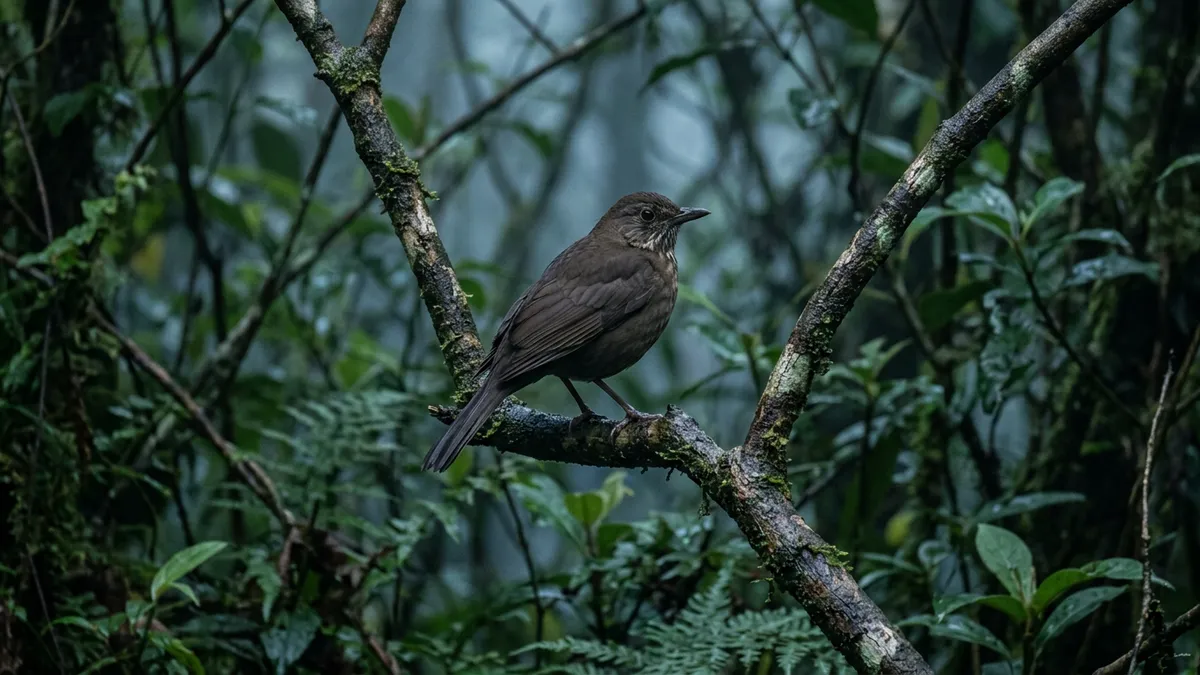
Before daylight fully reaches the forest interior, the cocoa thrush, known in Brazil as the sabiá-da-mata, can already be heard among the trees. It sings in the period before dawn, when the air tends to show less turbulence and the soundscape has not yet been filled by the loud noise of the day. For someone standing on the forest floor, the scene is noticed first by ear.
The bird itself stays barely visible among leaves and branches. Its presence spreads instead through a sequence of notes that identifies that individual and fills the space around it. The behavior does not depend on a visual display. The voice is the tool the bird uses to make contact, announce its presence and take part in exchanges with other birds living nearby, even when the vegetation blocks any direct line of sight.
The song begins while the forest is still dark
The timing has to do with the physical conditions of the atmosphere. Early in the morning, cooler and relatively still air produces less turbulent mixing than the periods heated by the sun, when rising currents and shifting winds bend and scatter sound waves. With less disturbance along the way, a song can suffer smaller losses before it reaches a listener.
That does not mean it is heard at the same distance everywhere. The density of the vegetation, humidity, terrain, wind direction and the frequencies the bird uses also affect how far a song travels. The cocoa thrush does not calculate any of these variables, but its singing falls in a part of the day whose conditions may favor the transmission of sound. The result is communication that can be more efficient in a scene that is still quiet and has less atmospheric turbulence.
The explanation should be presented with care. It is consistent with the physics of sound propagation, but the real reach of a song changes with the microclimate and the structure of the forest. Without field measurements at each location, it is not possible to give an exact distance or to claim that a song always travels farther. The hour of singing may also involve other factors, such as the bird’s daily routine, acoustic competition with other species and reproductive interactions. Calm air helps, but it does not explain the whole acoustic experience by itself.
A repertoire that individualizes the bird
The song of the cocoa thrush is not necessarily identical from one bird to the next. Each bird has an individual repertoire, built from its own combinations of notes and patterns of vocalization. That particularity allows the sounds to work as recognition signals inside the forest, where distance and dense branches make visual identification difficult.
On hearing a song, another bird can tell a familiar presence from a different one, even without seeing right away who produced it. The repertoire is also part of the social and reproductive routine of the species, because singing is a way of acting in space without leaving the perch. The most important detail is not just the beauty of the sound but the information carried in its variations. The start of the day therefore brings together a favorable atmospheric condition and a form of communication that carries the behavioral signature of each individual.
The existence of individual repertoires does not allow every note to be read as if it had a precise human translation. Animal behavior science usually identifies general functions, such as contact, defense of space and reproductive interaction, but it cannot always assign a single message to each combination of sounds. It is also necessary to separate song from the casual noise a bird makes while moving, feeding or raising an alarm.
The forest adds layers to the signal, absorbing some frequencies and reflecting others. For that reason the same repertoire can sound different depending on the position of the listener, the density of the leaves and the distance to the bird. Dawn singing is best understood as part of a communication system shaped by its environment, not as a performance aimed at human listeners.
From voice to a role in the forest
The cocoa thrush takes part in the dynamics of the forest even when it is not singing. The species is frugivorous and gets an important share of its diet from the fruit available in the vegetation. By swallowing fruit and carrying seeds to other places, the bird contributes to seed dispersal, a process that influences the regeneration and distribution of plants.
A seed can be carried away from the plant that produced the fruit, either during the animal’s movements or after passing through its digestive system, depending on the characteristics of the plant species involved. This ecological service does not happen in isolation. It adds to the work of other birds and animals that also move seeds across the landscape. The cocoa thrush thus links two different moments of the forest day. In the morning it carries information through sound. Over the course of the day it may carry the potential for new plants through its feeding.
The relationship between the bird and the plants should not be described as a guarantee that every swallowed seed will germinate. Dispersal increases the chances of reaching new places, but establishment depends on soil, moisture, light, predators, competition with other plants and the moment at which the seed arrives. Not every fruit eaten will have the same fate, and not every area visited will suit a seedling.
Even so, the movement carried out by a fruit-eating bird has ecological importance because it breaks up the concentration of seeds under the mother plant. Song and feeding reveal complementary functions. The first helps the animal maintain relationships within a territory. The second moves biological material across the landscape, contributing to the continuity of the vegetation without any conscious intention on the bird’s part.
A low nest and the limits of the explanation
For breeding, the cocoa thrush builds its nest in a low fork, the point where two branches separate, near the understory. That choice places the structure in a different layer of the forest from the one used by species that nest high in the canopy. The nest rests on the branches and blends into the surrounding vegetation, but its position does not remove the risks of the environment. Rain, falling branches, predators and the movement of other animals can all affect eggs and chicks.
Nest height also varies with the tree, the structure of the branches and local conditions, so the expression “low fork” should not be turned into a fixed measurement. The detail identifies a feature of how the species nests. It does not establish a universal distance from the ground. The routine of the species combines this specific use of space, a fruit diet, seed dispersal and a song that comes before sunrise.
In Brazil, where different forest formations vary in humidity, relief and vegetation density, caution about how far a song carries is especially important. A forest can be perceived as a network of sounds, seeds and shelters. The cocoa thrush shows that understanding this network requires listening both to the mechanism and to its limits.
Reporting: Natália Santos / Amazonia Mag

Editor · Amazonia Mag
Anne Silva is the editor of Amazonia Mag, the English-language edition of Revista Amazônia. She curates, translates and adapts the outlet's science and environment coverage for an international audience, reporting on Amazon wildlife, flora, rivers, climate and research. Every story she edits is grounded in peer-reviewed studies, official data and on-the-ground reporting from the Revista Amazônia newsroom in Belém, Pará, Brazil. More by Anne Silva →