
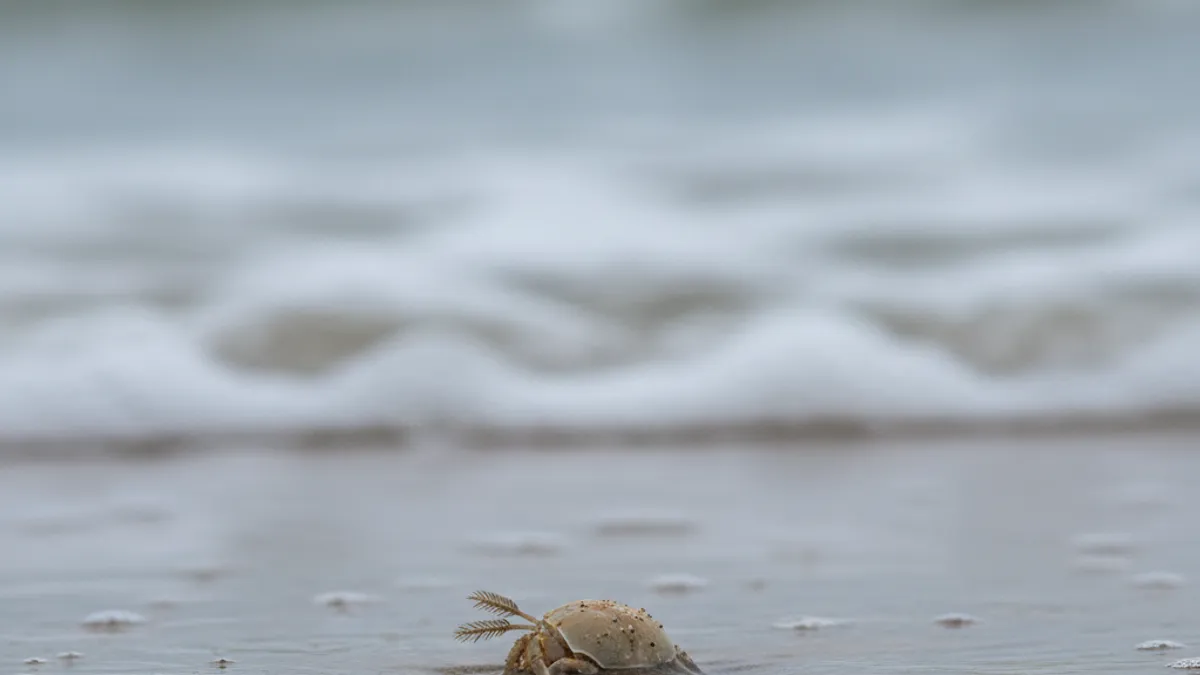
Most beachgoers never notice a mole crab. Buried in the strip of sand that the waves wet and drain again and again, this small crustacean of the genus Emerita stays hidden while people walk, swim and plant their umbrellas just above it. Yet Brazilian researchers now treat its quiet decline as a question worth chasing, because the animal’s life depends on the sand, the surf and the open ocean all at once.
The species at the center of the investigation is Emerita brasiliensis, the mole crab most frequently found along the Brazilian coast (known locally as tatuí). The study follows where the animals occur, how their life cycle unfolds and which conditions allow or prevent new generations from forming. The practical question is where the loss happens. Do the crabs stop arriving at the beach? Do they arrive and fail to survive? Or do they struggle to grow and reproduce once they are there?
A small crustacean in the swash zone
The mole crab lives in the swash zone, the stretch of beach where water advances and retreats without pause. It spends its life buried in that wet, shifting sand. The answer to the research question may differ from one species to another and from one beach to another, so the investigators examine each stretch of coast on its own terms instead of assuming that every beach works the same way.
One of the sites followed over the years is Praia de Fora, in the South Zone of Rio de Janeiro. Mole crabs have been observed there since the 1990s, but the records point to a decline over time. Rayane Abude, a researcher at the Marine Ecology Laboratory of Unirio, the Federal University of the State of Rio de Janeiro, also reviewed scientific publications on the genus Emerita. She found reports of declines in the United States, Mexico, Iran, Uruguay and Peru.
That body of observations places the fall in mole crab numbers inside a wider discussion about the changes humans are producing on the planet. The work does not, however, collapse every report into a single explanation. It tries to separate the stages of the life cycle and to identify which beaches still sustain reproduction, which receive animals without letting them develop, and which factors may be linked to that imbalance.
Thousands of eggs and a hard passage through the ocean
The cycle begins when females lay their eggs, which develop for 10 to 19 days. After hatching, the larvae are released into the water and spend between two and four months in the marine environment, passing through several developmental stages. Only after that period do they return to the beach.
Researchers are still investigating whether the young come back to the same strip of sand where they began or settle on different beaches. To trace that connection, they use genetic markers, which can compare populations and help identify where the animals arriving at each site came from. This matters because the population of one beach may depend on larvae produced somewhere else along the coast. The journey through the sea makes the cycle a shared one, so any assessment has to consider both what happens on the sand and what happens during the oceanic phase.
A systematic sample of 189 egg-bearing females, collected over one year at Praia de Fora, estimated an average fecundity of 5,300 eggs per female. That large number does not mean the same quantity of new mole crabs will reach the sand. During embryonic development, part of the viable eggs is lost in the sand. The larvae then suffer further losses while they are dispersed through the ocean and move through their stages. By the end of this journey, fewer than 1% of the eggs produce new individuals.
The animals that make it return as recruits, the name given to the young that arrive on the beach. At this point their carapace is still fragile, and they stay buried, mainly in the zone that the waves keep constantly wet. The result is a succession of natural and environmental filters that a new generation must pass before it can establish itself.
Beaches that produce and beaches that only receive
The research works with the hypothesis that beaches do not all play the same role within a population. Some could act as sources, producing new individuals and releasing larvae into the sea. Others could act as sinks, receiving mole crabs without offering the conditions they need to grow and reproduce.
This difference helps explain why the presence of animals on a beach does not, by itself, prove that the site sustains a stable population. A stretch of sand may also receive recruits that originated elsewhere while its own contribution to the overall cycle remains small. Genetic markers can help identify these connections between locations. The analysis therefore tries to reconstruct the path between females, eggs, larvae and juveniles, relating the density observed on the beach to the capacity of each environment to keep the cycle going over time.
Footsteps, filtered food and a many-stage problem
Recruits are especially exposed on heavily visited beaches. Because they live buried in the zone reached by the waves, they can be trampled or crushed when people walk across the sand. Observations indicate a higher density of animals on less accessible beaches, a difference that places the use of the sand strip among the factors the research examines.
The sea also plays a direct role in feeding. Mole crabs use their antennae to trap organic microparticles dispersed in the water and carry those nutrients to their mouthparts. The quality of the marine environment therefore affects how much food is available during a central stage of the crustacean’s life.
The combination of larval circulation, conditions in the sand, physical pressure on the young and water quality makes the apparent disappearance a problem with several stages, not necessarily a single event.
What the investigation still has to separate
The goal of the work is to tell apart mechanisms that can produce the same visible result: fewer mole crabs found on the beach. A drop in numbers can occur because fewer larvae arrive, because the young do not survive after returning, or because local conditions do not allow growth and reproduction. There may also be differences between beaches that produce larvae and beaches that merely receive individuals carried by the sea. That separation is essential to avoid applying one general explanation to the entire coastline.
The review of records from different countries shows that species of the genus Emerita face declines in more than one region, but each population is subject to local circumstances. On the Brazilian coast, following Emerita brasiliensis on beaches in Rio de Janeiro makes it possible to observe the cycle in more detail and to compare the historical presence of the animals with the current situation.
The findings were reported on March 30, 2025, by Agência Brasil, based on research conducted at the Marine Ecology Laboratory of Unirio. The study turns an animal that is almost invisible beneath the sand into an indicator of processes that link beach and ocean. The mole crab depends on a sequence that starts with eggs, passes through months of larval development at sea and ends with the return of recruits to the sand. When one of those steps loses efficiency, the number seen on the beach can fall even while females are still producing thousands of eggs.
The research shows that following coastal biodiversity means paying attention to small animals, to the periods when they stay hidden and to the relationships between beaches separated by long distances. Under the wet sand, each new mole crab is the outcome of a cycle that crosses different environments before it reappears to human eyes.
Reporting: Natália Santos / Amazonia Mag

Editor · Amazonia Mag
Anne Silva is the editor of Amazonia Mag, the English-language edition of Revista Amazônia. She curates, translates and adapts the outlet's science and environment coverage for an international audience, reporting on Amazon wildlife, flora, rivers, climate and research. Every story she edits is grounded in peer-reviewed studies, official data and on-the-ground reporting from the Revista Amazônia newsroom in Belém, Pará, Brazil. More by Anne Silva →