
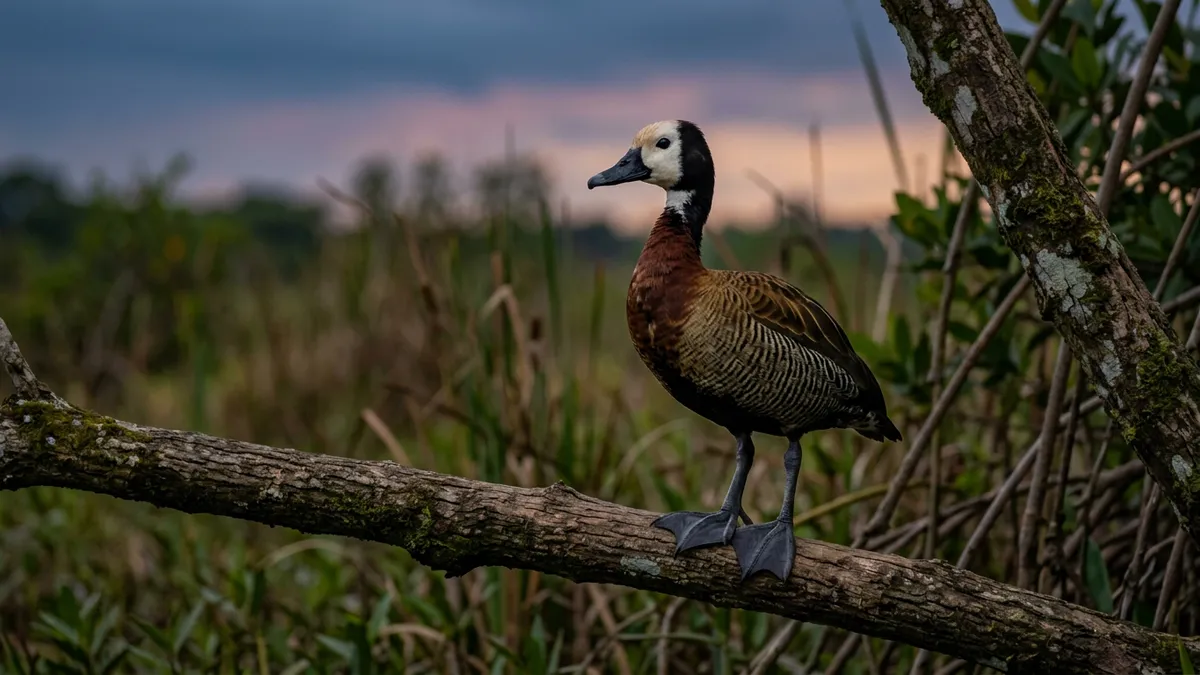
When daylight fades, the white-faced whistling duck, known in Brazil as the irerê, is often noticed by sound before shape. The flock travels in flight, and the birds give off whistles that help them stay in touch. At another moment, the same bird can drop the image of a duck that swims or walks along the shore and land on a branch.
This is unusual among the anatids, the group that includes ducks, geese, swans and whistling ducks. In the irerê, however, the body has adaptations in the tarsi and toes that favor staying on a perch. The scene joins two settings that are usually kept apart when people think about this bird: the water surface and the crowns of trees.
A duck that leaves the water to perch
The irerê, also called marreca-irerê, belongs to the genus Dendrocygna. Its popular name comes from the sharp call that carries across flooded areas, open fields and tree-lined banks. The species uses places where it can find water and vegetation, but trees add an important possibility to its routine. Instead of depending only on the ground, the water or low structures for resting, it can lean on branches.
That ability does not turn the irerê into a tree-dwelling bird, and it does not mean that every individual spends long periods in the trees. The point is the combination of anatomy and behavior, which widens the places available for rest and shelter.
Tarsus and toes help grip the perch
A perch demands a different response from the one used for swimming. In the water, the feet push the body and help steer the bird. On a branch, they must carry its weight and keep it balanced when there is wind, a slope or movement of the animal itself.
In the irerê, the tarsus and toes have features that suit this task. They let the duck settle on a branch and stay supported, something uncommon when its anatomy is compared with that of many other anatids. The adaptation should not be confused with that of birds whose toes are specialized for climbing trunks. The irerê simply has a support structure that matches its occasional use of branches.
The difference shows up best in the sequence of the behavior. The bird arrives at the branch, adjusts its body, spreads its weight over its feet and stops beating its wings. It can then stay there as part of resting or as protection for the group. The branch is not just a photogenic backdrop. It is a surface that the bird’s anatomy can use.
The whistle works as contact in flight
During nighttime movements, darkness reduces the value of sight for keeping the members of a flock close together. The irerê uses whistling calls as a signal of cohesion. The call can be given in flight and heard by other birds while the group crosses the space between feeding, resting or sheltering areas.
The function of this sound is not to announce an exact direction, nor to carry a message in the human sense. It is a mechanism of contact between individuals. By whistling, a bird helps the flock keep its unity when there is too little light, especially during trips when the visual formation is harder to see.
The sound also helps explain why the irerê can be located without being easily seen. An observer hears the sequence of whistles, recognizes that the group is passing and only then looks for the silhouettes against the dark sky. The calls do not remove the risk of separation, and they do not prove that every call is answered at once by another bird. They take part in a network of contacts that reinforces the closeness of the flock. In social species, acoustic signals are especially useful when individuals are spread out. In the irerê, the whistle gains importance because it accompanies night flight, when sound can make up for the loss of visual contact.
The same traits show up at the nest
The sequence begins with the movement of the group, passes through landing and includes the choice of places where the bird can rest or breed. At night, the irerê may fly while keeping acoustic contact with the others. On reaching a resting area, it finds in the tree vegetation an alternative to the ground and the water.
In the breeding season, the species may use a tree hollow for its nest. A cavity offers an enclosed structure compared with a nest exposed on the ground, but it does not make reproduction independent of environmental conditions. The tree must have an accessible cavity, and the availability of that resource varies with the landscape. The same type of environment that provides places to land can therefore take part in reproduction, although the use of cavities depends on suitable trees and on local conditions.
Taken together, the picture shows a duck with more possibilities than the stereotype of a purely aquatic bird suggests. It swims, flies, calls during night flights and can land on branches thanks to the features of its tarsus and toes. It is still important to respect the limits of what is known. The irerê does not whistle to show human-like intention, does not land on just any tree and should not be described as a climbing specialist.
In Brazil, where the irerê occurs in a range of wet landscapes, listening to its calls in the dark is a way of seeing how a bird can keep up its social life even when almost nothing can be seen. The species shows that a discreet adaptation can change the reading of a whole animal. Its feet allow the duck to use a branch, while its whistle keeps a bridge of sound between individuals flying in the dark. The scene does not depend on extravagant behavior, but on two precise solutions to concrete problems: finding support and not losing the group.
Reporting: Natália Santos / Amazonia Mag

Editor · Amazonia Mag
Anne Silva is the editor of Amazonia Mag, the English-language edition of Revista Amazônia. She curates, translates and adapts the outlet's science and environment coverage for an international audience, reporting on Amazon wildlife, flora, rivers, climate and research. Every story she edits is grounded in peer-reviewed studies, official data and on-the-ground reporting from the Revista Amazônia newsroom in Belém, Pará, Brazil. More by Anne Silva →