
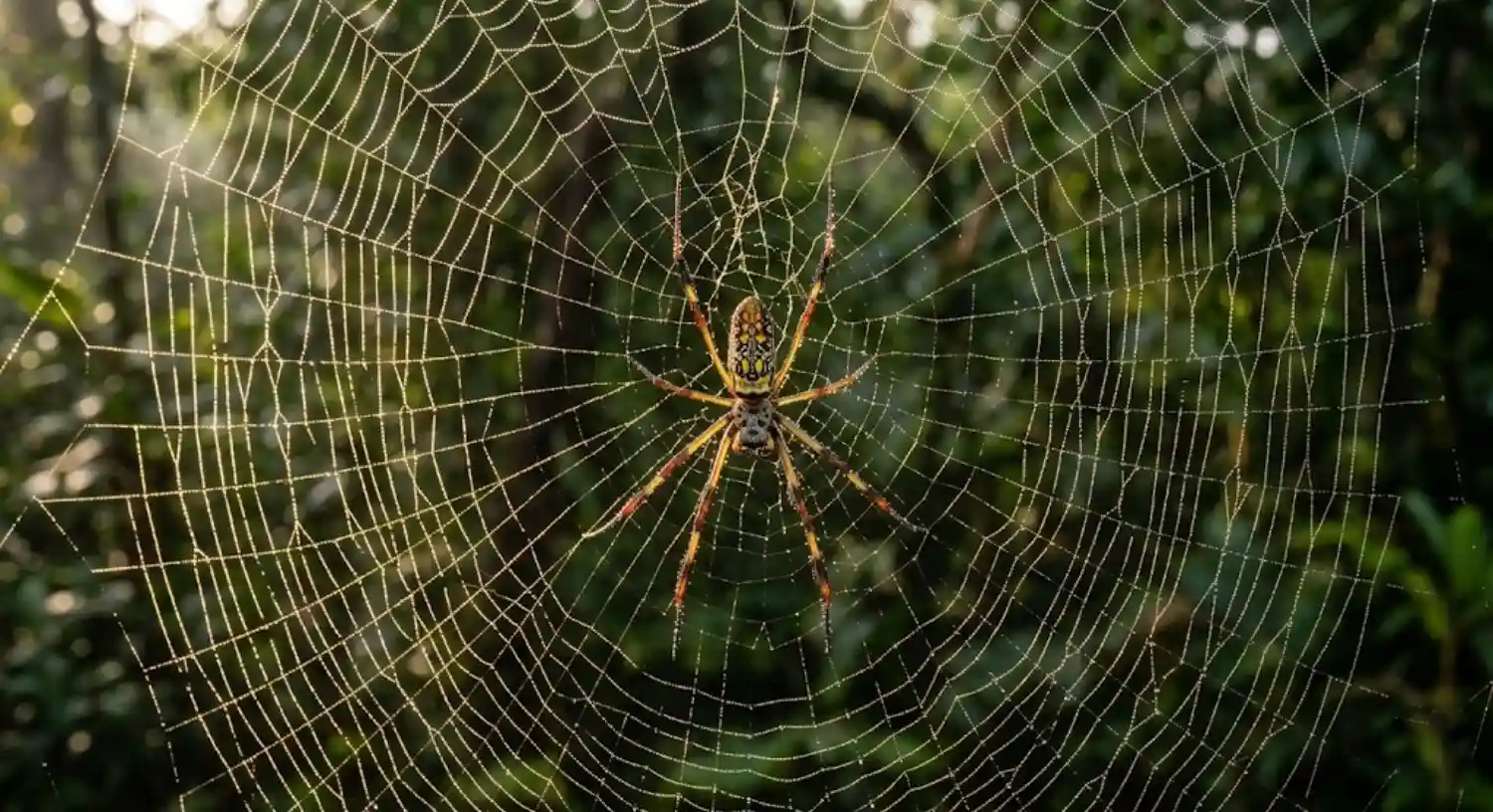
Deep in the Amazon rainforest, suspended between centuries-old trees, a masterpiece of biological engineering shines beneath filtered canopy light. It is the web of the golden silk spider, a member of the genus Nephila, an arachnid that routinely produces one of the strongest and most sophisticated materials known to humanity, without complex mathematical calculations or high-tech laboratories.
The golden thread that glows through the vegetation is more than a hunting tool. It is also evidence of the extraordinary adaptation and evolution taking place in the planet’s largest tropical biome. According to biological and materials engineering studies, Nephila silk has remarkable mechanical strength in relation to its own weight.
A natural fiber compared with Kevlar
Those studies indicate that the natural fiber is proportionally stronger than steel and matches the toughness of high-performance synthetic fibers such as Kevlar. The comparison is not based simply on the web’s striking color. It reflects the way the silk combines strength, lightness and the ability to absorb impacts.
Kevlar is a synthetic polymer known for its use in bulletproof vests and equipment that must provide extreme resistance while remaining lightweight. Nephila silk reaches an astonishing level of performance without chemical processing at high temperatures and pressures.
Inside the arachnid’s body, a complex manipulation of proteins takes place at room temperature. The result is a thread that can absorb a colossal amount of kinetic energy before breaking. That capacity allows the web to stop the flight of large insects and even small birds without collapsing, an extraordinary achievement considering the tiny diameter of each individual strand.
A biological factory with several production lines
The production of this remarkable fiber is not a uniform process. The golden silk spider is essentially a multipurpose biological factory. Contrary to what many people imagine, a web is not made from a single type of silk.
Nephila has a set of distinct glands located in its abdomen. Together, they can synthesize up to six different types of silk, each with specific mechanical properties and biological functions.
One type forms the web’s main structure and radial threads. It requires maximum stiffness and strength because it must support the weight of the entire construction. Another type, highly elastic and coated with a sticky substance, is used for the capture spiral.
The capture spiral is designed to stretch and dissipate the prey’s energy without breaking, while keeping the prey trapped. There are also specialized silks for transport, for wrapping and preserving food, for building the egg sac and for providing security.
The last of these works as a “lifeline” when the spider moves through the forest. This versatility reveals extraordinary biochemical complexity. Each gland adjusts the amino-acid composition and the spinning process to achieve the performance required for a particular use in the hostile forest environment.
Nanotechnology inside the spider
The secret of this functional diversity lies in the intimate structure of the proteins that make up the silk. At the molecular level, the spider manipulates the amino-acid sequence to control the formation of beta-sheet nanocrystals. These crystals are responsible for the thread’s stiffness and strength.
Between the nanocrystals are amorphous, elastic regions. They give the thread its ability to stretch without breaking. By changing the proportion between crystalline and amorphous regions, and by orienting the proteins during spinning, Nephila can adjust the material’s elasticity and strength.
When the silk is expelled through the spider’s spinnerets, a process of shear and dehydration transforms the liquid protein solution into a solid, continuous fiber. This is a precisely controlled phase transition, a form of natural nanotechnology that occurs on a massive scale in the Amazon every day.
The process produces no toxic waste and uses only renewable resources. The combination of molecular chemistry, moisture control and protein organization turns a biological secretion into a material whose properties continue to attract scientific and engineering interest.
A web designed to spread impact
Beyond the properties of each individual strand, Nephila uses remarkable structural engineering when building its orb web. The geometric pattern is not random. It is a design optimized for efficient prey capture and for dissipating mechanical stress caused by impacts.
The radial threads and capture spirals create a network that distributes any impact force evenly across the web. The angle between the radii, the tension in each thread and the density of the spiral are carefully adjusted by the spider during construction.
This work involves complex sensory feedback. The web is therefore more than a collection of strong fibers. It is also an architecture that extends the material’s capabilities and helps keep the structure functional when prey collides with it.
The construction has another feature that gives the arachnid its popular name: its golden color. Biologists indicate that the pigmentation is not accidental and may serve as camouflage or even attraction, blending the web with sunbeams that pass through the canopy.
From certain angles, the golden color may be a visual strategy that improves hunting success amid the complex vegetation of the Amazon rainforest. The web thus becomes a combination of material, architecture and appearance, all integrated into one biological solution.
An animal inspiring new materials
The presence of Nephila in the Amazon rainforest is an inspiring example of the effects of evolution and biodiversity. Far from being a creature that should provoke fear, the golden silk spider plays a fundamental ecological role by regulating insect populations and contributing to ecosystem balance.
Its existence and its ability to engineer natural materials remind us that nature can provide efficient and sustainable solutions. Observing the complexity of the web and the biological intelligence behind silk production also encourages reflection on the importance of preserving the Amazon rainforest and all its biodiversity.
The silk of Nephila has attracted worldwide interest in the development of new biotechnological materials. Scientists and engineers study its composition in an effort to reproduce properties such as high tensile strength and flexibility in biodegradable synthetic threads.
Recreating the complexity of this biological factory in a laboratory, however, remains a significant technological challenge. The spider can coordinate different proteins, spinning processes and structural functions inside its own body, an integration that is still far from being completely replicated.
The golden web shining among the trees is not merely a survival instrument for an arachnid. It is a reflection of life’s remarkable inventiveness and a reminder of how many biological innovations and surprising materials may still be waiting to be discovered in the depths of the Amazon.
The spider’s ability to unite strength, elasticity, lightness and structural design reinforces the urgency of conserving this vital ecosystem. Understanding the details of its biology inspires respect for the forms of life that share the planet and for the technological secrets the rainforest still holds.
Reporting: Anne Silva / Amazonia Mag

Editor, English Edition — Amazonia Mag
Anne Silva is the editor of Amazonia Mag, the English-language edition of Revista Amazônia. She curates, translates and adapts the outlet's science and environment coverage for an international audience, reporting on Amazon wildlife, flora, rivers, climate and research. Every story she edits is grounded in peer-reviewed studies, official data and on-the-ground reporting from the Revista Amazônia newsroom in Belém, Pará, Brazil. More by Anne Silva →