
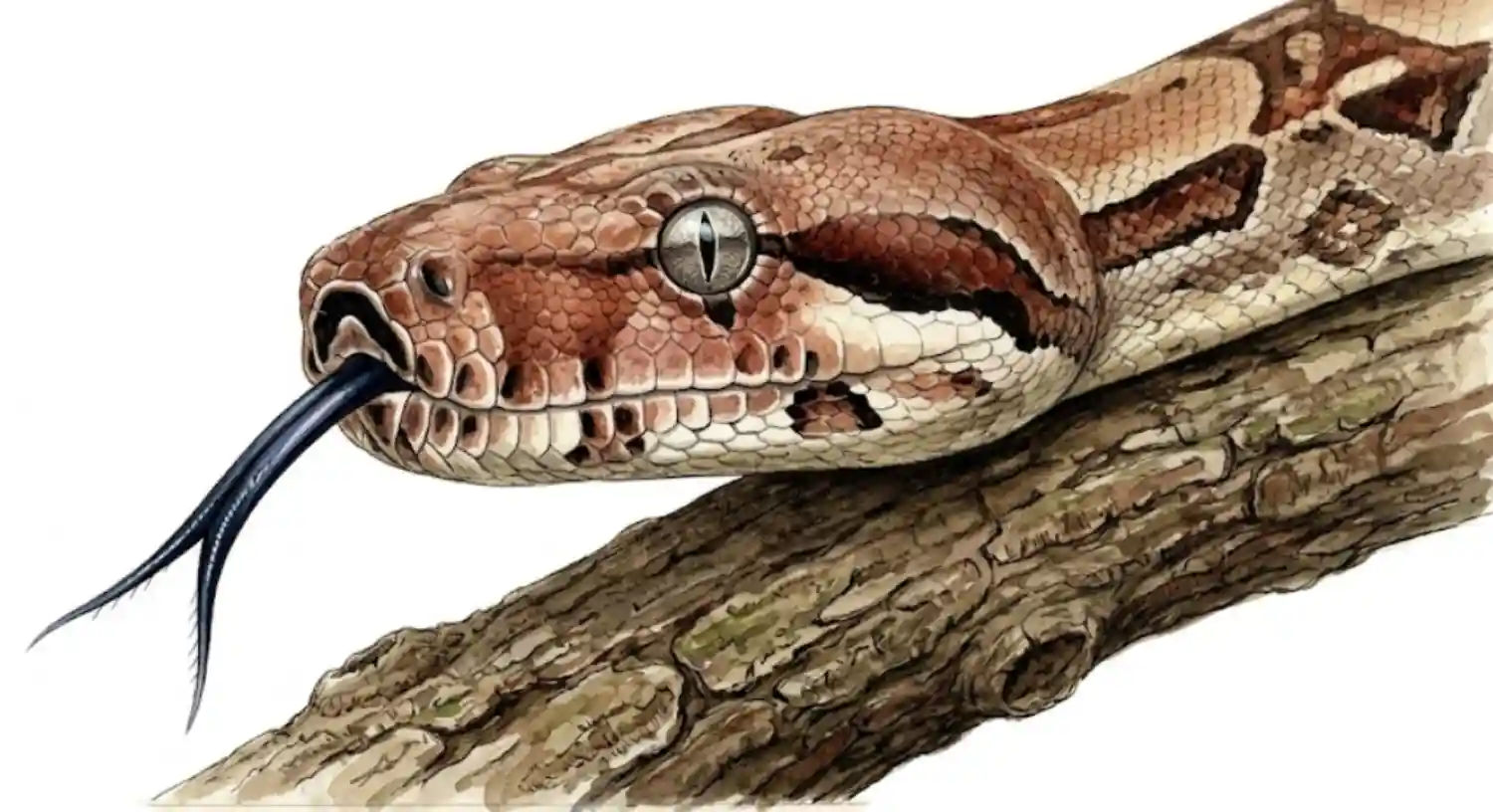
A predator that does not need to see
A boa constrictor can capture prey in complete darkness without relying on its eyes or making sounds to locate the target. It is guided by the heat of its victim’s body, an extraordinary biological ability that allows the snake to hunt when conventional vision is no longer useful.
For this reptile, night is not necessarily an obstacle. In Brazil’s tropical forests, where moonlight barely penetrates the canopy, the boa’s biology turns the metabolic heat of a bird or small mammal into a signal that can guide a precise attack.
This ability is more than an anatomical curiosity. It helps explain how a silent, nonvenomous snake occupies an important niche in the ecosystem. Its hunting strategy combines waiting, detection and constriction instead of relying on long pursuits.
The heat-sensing system gives the boa an advantage over warm-blooded animals in conditions where its own eyes would be of little use. Darkness removes much of the visual information available to other predators, but it does not eliminate the thermal signal produced by a warm body.
Labial pits that sense temperature
The ability is linked to sensory organs called labial pits. Unlike the loreal pits found in lanceheads and rattlesnakes, which are positioned between the eyes and the nostrils, the boa’s pits are located along the scales of the upper and lower lips.
Although their anatomical positions differ, both types of organs perform the same function: thermoreception. The small depressions in the boa’s skin are lined with extremely sensitive nerve endings capable of detecting temperature differences on the order of thousandths of a degree Celsius.
Science recognizes these structures as biological infrared cameras. They do not capture visible light in the way eyes do. Instead, they detect the thermal radiation emitted by warm bodies, convert that information into nerve signals and send it to the snake’s brain.
The boa’s labial pits therefore do not “see” light. They detect changes in temperature, allowing the brain to interpret those differences as a thermal image of the surroundings. This function becomes especially important when darkness makes a motionless animal difficult to distinguish visually.
In practical terms, the organs provide information about heat patterns in the environment. A bird or small mammal can become a distinct thermal source against the surrounding vegetation, giving the boa a target even when no clear visual image is available.
Thermal information alongside vision
When a boa receives the thermal radiation emitted by an animal, its brain processes the signal in a way that creates a representation of heat in the surrounding environment. Studies indicate that this thermal “vision” is overlaid with visual vision in the snake’s brain.
The result is a perception built from multiple layers of sensory information. The boa can use its eyes when light is available, but it can also rely on heat as a reference when its eyes cannot provide enough information to identify the target.
This ability explains why the snake can successfully strike even when its prey is motionless and the surroundings are completely dark. From the perspective of thermoreception, the warm-blooded animal remains a differentiated heat source within the vegetation.
The signal does not depend on the prey moving or making a sound. Its warm body already provides information that the nerve endings can detect. The boa can therefore remain silent and concealed until its thermal system indicates an opportunity to attack.
Triangulation guides the strike
One of the most remarkable aspects of this system is its ability to triangulate a heat source. Because the boa has pits on both sides of its head, it can determine the exact direction and distance of the heat source with precision.
This information from both sides of the head is crucial for locating prey in darkness. The snake does not need to illuminate its surroundings or begin a long chase. Its sensory organs help identify where the heat is coming from and guide the strike toward the right point.
In a dense, dark forest, this adaptation turns difficult conditions into an advantage. Moonlight barely reaches through the canopy, but the metabolic heat of a bird or small mammal remains available to the boa’s sensory system.
The attack can be fast and accurate, demonstrating energetic efficiency and ecological adaptation. The boa waits, hidden in the vegetation, until its thermal “camera” detects an opportunity. In this way, it avoids wasting energy on extended pursuits.
The ability to locate a target without relying on movement is particularly important for a predator that may remain still while waiting. A prey animal does not have to reveal itself through sound or visible motion. Its body heat alone can provide the information needed for the initial orientation.
Heat, constriction and ecological balance
Precise heat detection is only the first stage of the hunting strategy. Unlike snakes that depend on venom, the boa constrictor uses constriction to subdue its prey. The initial accuracy provided by the thermal system helps the attack reach its target.
Once the victim has been located, the snake applies pressure where it is needed to interrupt blood flow quickly. The method may appear slow, but it is extremely efficient and depends on the accuracy with which the attack begins.
For that reason, the labial pits are not merely a zoological curiosity. They are part of a set of adaptations that allows this nonvenomous predator to find food, act silently and exploit an environment in which its own eyes would have limited value.
Every detail of the boa’s anatomy, from the texture of its scales to the sensitivity of its labial pits, reveals the complexity of Brazilian wildlife. These organs show that animals can perceive aspects of the world that remain beyond the reach of human senses.
Protecting boa constrictors and the forests where they evolved over millions of years also means preserving remarkable biological mechanisms. While the snake moves silently and invisibly to us, its thermal system continues to support its role in the ecosystem.
The boa reminds us that every creature has its own way of “seeing” and interacting with the universe around it. In this case, the labial pits detect infrared radiation from warm bodies and turn temperature differences into information capable of guiding a strike, even in total darkness.
That hidden sensory world broadens the way we understand nature. The reality experienced by the boa is richer and more complex than what human vision alone can capture, and its heat-sensing system demonstrates how anatomy can shape an entire hunting strategy.
Reporting: Anne Silva / Amazonia Mag

Editor, English Edition — Amazonia Mag
Anne Silva is the editor of Amazonia Mag, the English-language edition of Revista Amazônia. She curates, translates and adapts the outlet's science and environment coverage for an international audience, reporting on Amazon wildlife, flora, rivers, climate and research. Every story she edits is grounded in peer-reviewed studies, official data and on-the-ground reporting from the Revista Amazônia newsroom in Belém, Pará, Brazil. More by Anne Silva →