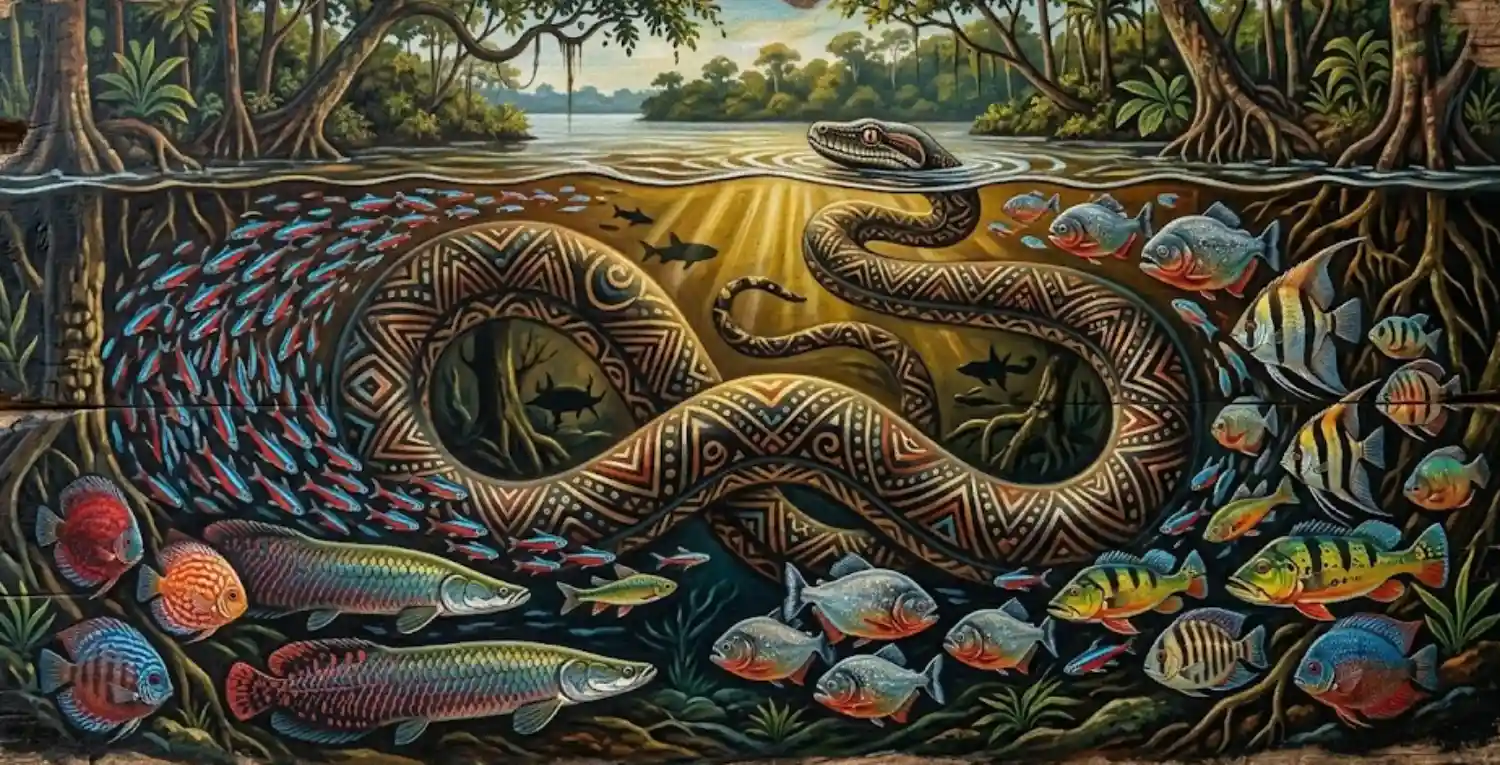
In the dark, acidic depths of the Rio Negro, where visibility is limited and life moves according to the rhythm of rising waters, there is a presence that cannot be reduced to a legendary creature. For the Dessana people, who have lived in this region for millennia, the Cobra Grande is the primordial force governing the balance of the entire aquatic ecosystem.
The serpent is not simply a myth or a physical animal of gigantic proportions. In Dessana cosmology, it organizes the relationship among people, fish, flooded forests and the waters that cross the rainforest. The Indigenous figure of the Rio Negro’s great snake also guides decisions about fishing and defines limits that must be respected if the cycle of life is to continue.
The Mother of Fish
According to tradition, the Cobra Grande is the Mother of Fish, responsible for bringing species into being and distributing them through igapós and igarapés. The image connects the serpent with reproduction, movement and aquatic abundance in a landscape where changing water levels continually transform feeding and shelter areas.
For a Dessana fisher, taking a fish from the river without proper spiritual permission, or catching more than basic needs require, is not merely a practical mistake. It is also an offense against the great protecting entity. Respect for the serpent establishes a rule of restraint and turns fishing into an activity that demands responsibility toward the river.
Recent estimates by biologists and anthropologists indicate that areas where belief in the serpent’s spiritual protection is strongest show fish-school preservation rates up to 40% higher than areas under intensive commercial fishing. This phenomenon has been described as evidence that Indigenous Amazonian serpent cosmology can operate as an environmental management system more efficient than many government protocols.
Spiritual refuges and reproduction
Reverence for the Cobra Grande creates what researchers call spiritual refuge zones. In these places, religious taboos prohibit fishing or severely limit the removal of animals. Although their foundation belongs to the Dessana spiritual world, their effects directly influence aquatic biodiversity.
In practice, these sites work as natural nurseries. Species can reproduce without human interference and then continuously replenish areas used by the wider community. Protection therefore depends not only on a written rule or outside enforcement, but also on a respectful relationship with the entity that tradition says distributes life through the waters.
The connection between the Cobra, Mother of Fish, and sustainability reveals striking technical sophistication. Indigenous rituals before fishing expeditions include songs and offerings intended to appease the serpent’s spirit. During these ceremonies, elders pass on knowledge about fish reproductive cycles and the importance of avoiding females carrying eggs.
Knowledge passed between generations
To an outside observer, the songs and offerings may appear to be religious practices alone. From the perspective of modern ecology, however, they are also part of a rigorous natural-resource management system. The teachings establish when to fish, how much to remove and which animals must remain in the river so populations can continue.
Traditional knowledge accumulated over generations allows the Dessana to identify subtle changes in water temperature and in bird behavior. These signs indicate the health of the river under the Cobra Grande’s protection. Daily observation of nature is therefore integrated with spirituality, without separating the territory’s ecological condition from its sacred meaning.
Academic science has moved increasingly closer to these forms of knowledge in an effort to refine conservation models. According to the researchers described in this discussion, listening to community experience can help explain processes that do not always appear immediately in formal management protocols. Among the Dessana, conservation is expressed through stories, rituals, restrictions and close observation of the environment.
The serpent as a sign of balance
Expeditions conducted by research institutes in the Amazon have documented that the presence of anacondas and other large snakes in river headwaters serves as a bioindicator of environmental health. Where the snake lives, the ecosystem is in balance. The Dessana understood this relationship long before the first laboratories were established in the forest.
For them, the serpent is the link connecting the underwater world to the terrestrial world. Its existence ensures that the water flowing through the veins of the Earth remains pure and abundant for all beings. This view does not treat the river as an isolated resource, but as a living body in which fish, forests, birds, people and currents depend on one another.
Many researchers now argue that Amazon conservation must recognize these entities as intangible heritage for biological protection. Protecting the Cobra Grande myth also means protecting the habitat where it resides and every form of life that depends on that habitat. Dialogue between scientific authority and ancestral wisdom is no longer merely an option, but an urgent necessity in times of climate change.
The chemical mystery of the Rio Negro
The Rio Negro is the largest left-bank tributary of the Amazon River and the largest blackwater river in the world. Its dark color comes from the decomposition of organic matter in the rainforest and the presence of humic acids, a unique chemical characteristic of this river system.
That chemistry selects highly specialized fish species, many of which are found only in this basin. For this reason, the Dessana’s protective role has an importance that extends beyond their territory and reaches global biodiversity.
The Rio Negro remains one of the planet’s most important natural laboratories, while the Dessana people continue as its most faithful guardians. With every new discovery about the blackwater currents and the sediments that nourish the forest, science encounters the shadow of the mythical serpent once again.
The Cobra Grande is a reminder that progress must not mean erasing the stories that kept the forest standing for millennia. The serpent that sees and protects everything continues to glide silently beneath canoes, ensuring that the cycle of life does not break in the face of human greed.
Amazon conservation depends directly on the ability to see the river not only as a water resource, but as a living and sacred body demanding respect and reverence in every drop flowing toward the ocean. In Dessana cosmology, that understanding takes the form of a primordial serpent protecting the waters and all their inhabitants.
Reporting: Anne Silva / Amazonia Mag

Editor, English Edition — Amazonia Mag
Anne Silva is the editor of Amazonia Mag, the English-language edition of Revista Amazônia. She curates, translates and adapts the outlet's science and environment coverage for an international audience, reporting on Amazon wildlife, flora, rivers, climate and research. Every story she edits is grounded in peer-reviewed studies, official data and on-the-ground reporting from the Revista Amazônia newsroom in Belém, Pará, Brazil. More by Anne Silva →