
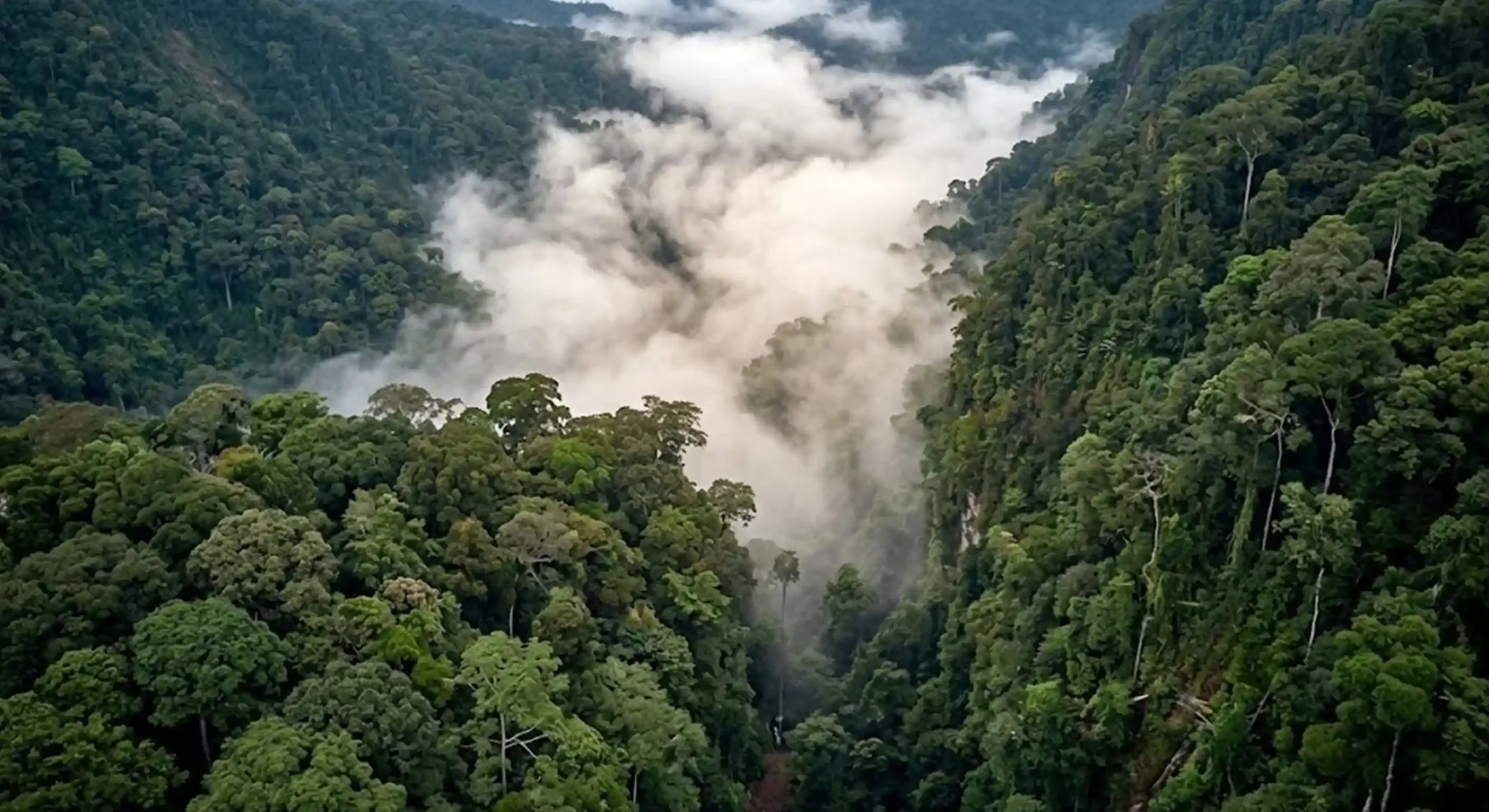
A single large tree in the Amazon rainforest, with a canopy 66 feet (20 meters) across, can pump more than 1,000 liters, or about 264 gallons, of water into the atmosphere in just 24 hours. This process is known as evapotranspiration, and its scale becomes extraordinary when the entire basin is considered.
Together, the forest releases about 20 billion metric tons of water vapor into the air every day. To put that amount into perspective, the Amazon River, the planet’s largest river by water volume, sends 17 billion metric tons of water into the Atlantic Ocean each day.
The comparison reveals the size of a phenomenon that remains invisible from the ground. A river of vapor flows above our heads with a greater volume than the world’s largest river, helping shape the climate across much of South America.
The biological pump behind the moisture
These immense bodies of moisture-laden air are known as Amazon flying rivers. They act as a vital artery for South America’s climate balance because they transport water as vapor toward regions thousands of miles away from the rainforest.
The journey begins over the Atlantic Ocean. Tropical heat evaporates seawater, and the trade winds push that moisture inland across the continent. The humid air moves over South America until it reaches the Amazon forest.
Once above the forest, the air receives a massive reinforcement of water vapor produced by the transpiration of billions of trees. Vegetation draws water from the soil and returns it to the atmosphere, recharging the air before it continues moving across the continent.
The result is a form of continuous recycling. The rainforest is not merely a passageway for ocean moisture. It renews that moisture and keeps the atmosphere saturated, ready to irrigate areas located thousands of miles away.
This process is connected to the theory of the biotic pump. The theory explains that native forests create areas of low atmospheric pressure that draw moist ocean air into the interior of a continent. Without the forest, the wind would change direction and moisture would be prevented from entering Brazilian territory.
In this view, trees are not simply water users. They are the drivers that help maintain the rainfall regime and support ecosystems far from the forest itself.
The Andes redirect the river in the sky
The destination of this atmospheric flow is shaped by a monumental physical barrier, the Andes Mountains. Their rocky walls rise as high as 6,000 meters, or about 19,685 feet, an elevation the moisture cannot overcome in its normal path.
When the vapor reaches the Andes, it is diverted laterally toward the south. This movement turns the volume of the Amazon flying rivers into a natural sprinkler for Brazil’s Center-West, Southeast and South, as well as neighboring countries.
The connection between the rainforest and those regions may seem distant, but it is part of the same atmospheric system. Moisture added above the Amazon eventually participates in rainfall that supports rivers, reservoirs, crops, cities and ecosystems located thousands of miles from the forest basin.
Without this mechanism, regions that are now agricultural powerhouses and densely populated urban centers could develop semi-arid climate characteristics, given their latitude. The warning shows that the Amazon is not an isolated landscape feature. It is a central component of the rainfall system that keeps broad areas of the continent productive and habitable.
The forest also helps create rainfall
Science has advanced in measuring this phenomenon in order to understand the fragility of the complex system. Studies indicate that the rainforest supplies not only water, but also condensation nuclei, tiny organic particles released by plants that allow raindrops to form.
That detail reveals a highly refined form of biological engineering. The forest contributes both the moisture in the air and the conditions needed for that moisture to become rain, linking the structure of forest cover directly to rainfall dynamics.
Any change to the vegetation can affect the speed and density of this transport. When a forested area is removed, the soil immediately loses its ability to pump moisture, breaking the hydrological cycle that depended on the vegetation.
The image of flying rivers helps show why deforestation should not be understood only as a local loss of trees. Reducing forest cover interferes with an atmospheric circulation that connects the Amazon with agricultural, industrial and urban regions across the continent.
Deforestation and the risk to the Southeast
The cause-and-effect relationship between deforestation and rainfall in Brazil is already beginning to be felt in hydroelectric reservoirs and farm productivity. According to data from Brazil’s National Institute for Space Research, INPE, each percentage point of deforestation reduces the efficiency of the so-called Amazon biotic pump.
If the forest reaches a tipping point, estimated at between 20% and 25% total degradation, the rainfall regime could undergo an irreversible change. Rainy seasons would become much shorter and dry seasons more severe, putting the energy and food security of the entire continent at risk.
The consequences would not stop at a cleared patch of land. They would affect the mechanism that supplies ecosystems far from the Amazon, including areas whose reservoirs, farms and cities depend on the continued movement of atmospheric moisture.
The theory of the biotic pump adds another dimension to this risk. If the native forest creates low-pressure zones that pull humid ocean air inland, removing the forest also weakens the force that brings moisture into Brazilian territory.
In that sense, the Amazon’s rainfall function is both local and continental. The forest pumps water into the air, helps organize its movement, and supports the rainfall regime that reaches distant parts of South America.
Protecting water that flows through the sky
Keeping the forest standing is therefore a strategy for national security and economic prosperity. Restoring degraded areas and protecting primary forests help ensure that the vapor flow continues feeding the watersheds that sustain urban and rural life.
Preserving the Amazon goes far beyond protecting its wildlife and plant life. The rainforest is the master mechanism that keeps Brazil hydrated and viable, while also contributing to the climate balance that reaches neighboring countries.
The future of water does not depend only on channels running across the ground. It also depends on the integrity of the forest cover that keeps rivers flowing through the sky, in an atmospheric network linking individual trees to rainfall in distant regions.
The connection between the forest and the water reaching cities, hydroelectric plants and agricultural areas makes a collective responsibility visible. Protecting the balance of the flying rivers means protecting the system that allows moisture to move, condense and sustain life across the continent.
Every large tree is part of that wider circulation. Its evapotranspiration contributes to an atmospheric flow that is larger than the Amazon River’s daily discharge into the Atlantic, while the forest as a whole helps keep the continent’s water cycle operating.
Reporting: Anne Silva / Amazonia Mag

Editor, English Edition — Amazonia Mag
Anne Silva is the editor of Amazonia Mag, the English-language edition of Revista Amazônia. She curates, translates and adapts the outlet's science and environment coverage for an international audience, reporting on Amazon wildlife, flora, rivers, climate and research. Every story she edits is grounded in peer-reviewed studies, official data and on-the-ground reporting from the Revista Amazônia newsroom in Belém, Pará, Brazil. More by Anne Silva →