
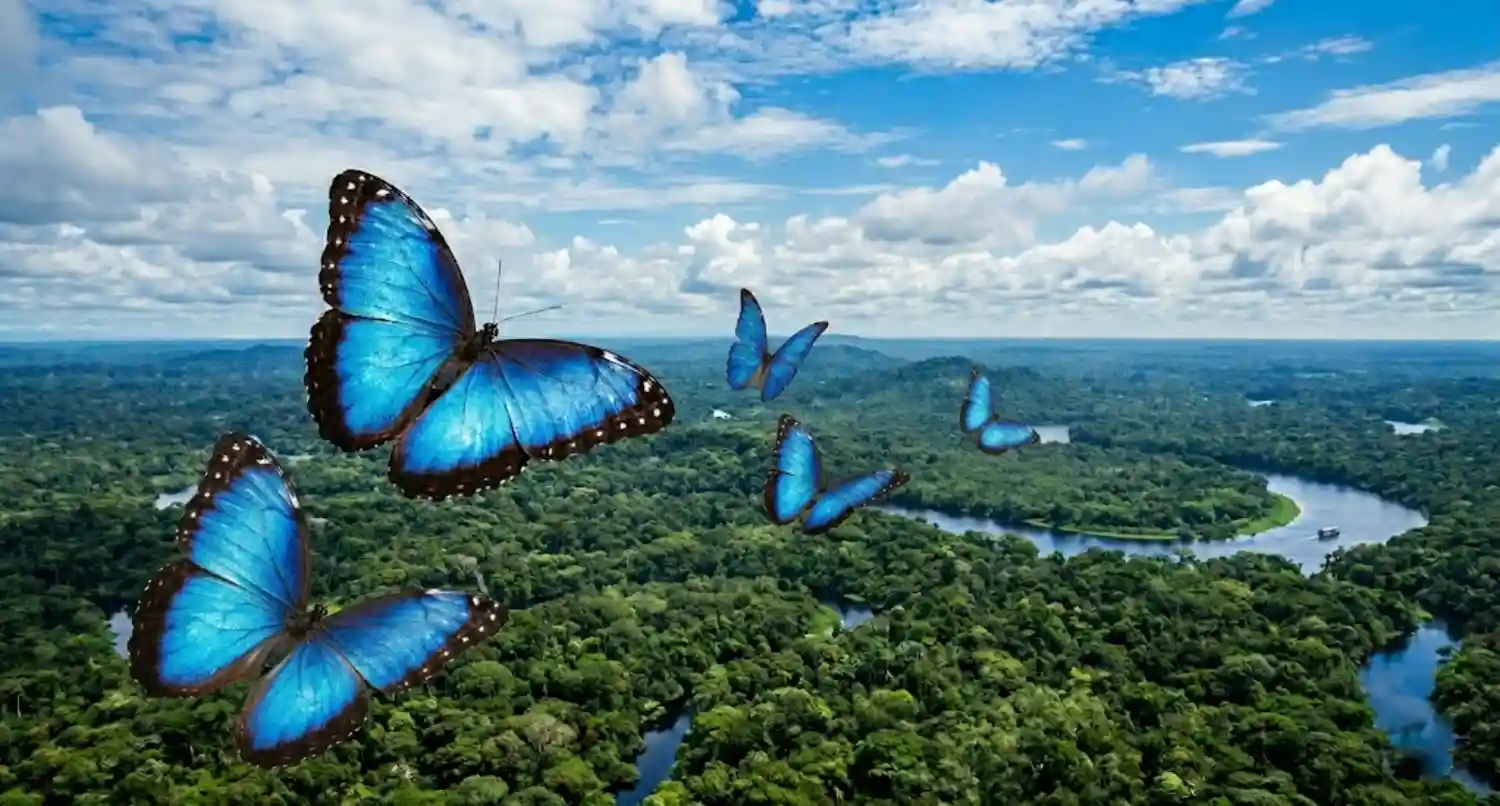
The radiant blue of the Amazon’s blue Morpho butterflies does not come from a conventional dye. It is a physical phenomenon that challenges traditional pigmentation and can reflect up to 80% of incident light, with a precision that chemical paints cannot achieve.
Many colors visible in nature result from the absorption of light by pigments. The brilliant color of these canopy-dwelling butterflies is purely structural instead. If one of their wings were ground up, the resulting powder would not be blue. It would be an opaque brown.
The difference lies in how the wing interacts with light. Rather than being absorbed as it would be by a pigment, light is manipulated by a complex biological architecture arranged on a scale smaller than the wavelength of visible light.
Blue made by architecture
Inside the dense vegetation of the Amazon, that architecture turns the insect into a living beacon. The color is not a blue substance spread across the scales. It is the result of a microscopic construction that selects some light waves while canceling others.
The nanoscale structures resemble tiny Christmas trees made of chitin. They are arranged in overlapping layers across the wing scales, creating a surface that can control the path of light when sunlight strikes the butterfly.
At that point, a phenomenon called constructive interference occurs. Waves corresponding to the blue portion of the spectrum are reflected in sync, while other colors cancel one another out. The result is an intense blue that changes with the observer’s position and with the movement of the wing.
That is why the blue Morpho cannot be understood simply as an insect covered in natural paint. Its color depends on the geometry of the surface. The arrangement of the chitin layers determines which part of the incoming light returns to the eyes of an observer.
The effect also explains why the wings can appear different as the butterfly moves through the forest. A shift in angle changes how the layered structures send light outward. The same surface can therefore produce a sudden flash, a fading signal or a blue reflection that seems to vanish.
A flash against predators
For the Amazon blue Morpho, this feature is not merely decorative. It is also a vital survival tool in an environment where sunlight enters the forest in broken patches between canopy, branches and shadow.
When the butterfly beats its wings in flight, it creates an intermittent flash. The effect can disorient birds and lizards, causing a predator to lose track of where the insect’s body actually is among the changing bursts of light and the darkness of the forest.
The optical mechanism goes beyond simple camouflage by distraction. Iridescence makes the blue signal appear and disappear according to the viewing angle. A butterfly can attract attention from one direction and become far less visible from another.
That shifting signal is part of a physical game of appearing and hiding. The predator sees flashes rather than a stable outline, which makes it harder to maintain a precise reference to the insect’s position while it moves through the vegetation.
The same property also supports communication within the species. Males can be seen by females from long distances as they hover over rivers or clearings, without remaining permanently visible to predators watching from different angles.
Reproduction can therefore take place while individual safety is preserved by a natural optical illusion. The wing does not simply display a fixed color. It produces a changing visual message shaped by movement, sunlight and the position of whoever is looking.
Wings built for Amazon rain
The iridescent wing also acts as a thermal regulator and as a highly efficient water-repellent surface. In a biome marked by high humidity and torrential rain, keeping the wings dry can be a matter of life and death.
The nanoscale architecture prevents water droplets from accumulating. Instead, the droplets roll off the surface and carry dust particles away with them, reducing the material that could interfere with the wing’s interaction with light.
This self-cleaning action helps keep the reflection efficient. As a result, visual communication among members of the species can continue even after a severe tropical storm, when moisture and dust could otherwise cover the wings.
The same structure that produces the blue therefore has several functions. It controls reflection, contributes to moisture management and keeps the surface ready for the visual flash to work inside the Amazon forest.
The effect is not based on a chemical coating that would simply wash away. It comes from the physical arrangement of the scales and their layers. The wing’s architecture remains central to both its appearance and its performance.
Nature as a materials laboratory
Materials scientists and optical engineers around the world study the Amazon blue Morpho to reproduce its properties in advanced human technologies. Biomimicry, the field that seeks solutions in nature, has found an important model in the structure of these insects’ scales.
Knowledge of the scales is already inspiring electronic device displays that use less energy. It is also guiding the creation of fabrics that do not fade, because their color does not depend on chemical dyes that are sensitive to ultraviolet rays.
The ability to manipulate light at the nanoscale also inspires highly sensitive gas sensors. It supports the development of new kinds of environmentally friendly paints that eliminate the need for heavy metals in their industrial composition.
The natural design of the wings has applications beyond blue color. Its light-filtering structure inspires banknotes that are difficult to counterfeit and cosmetics that do not harm the skin with chemical substances.
According to materials scientists and optical engineers who study these properties, the Morpho shows how a biological solution can combine beauty, light control, moisture resistance and technological potential. In the Amazon, what appears to be simple beauty is actually one of the most sophisticated forms of applied physics found anywhere on Earth.
Within the Amazon ecosystem, the presence of these butterflies points to a sophisticated environmental balance. Sunlight entering through the canopy becomes the energy for a complex biological signaling system, in which iridescence helps connect visual communication with reproduction.
Understanding the butterfly’s nanoscale structure reinforces the need to protect biodiversity. Every species living in the Amazon Basin may hold solutions to complex problems in physics and chemistry, refined by evolution over millions of years.
Protecting the blue Morpho’s habitat means protecting more than an icon of tropical beauty. It also means preserving a living library of materials engineering that could help shape the future of sustainable technology and global energy efficiency.
The preservation of the Amazon is, in this sense, the safeguarding of a high-technology natural laboratory. Its patents belong to wildlife itself, and its answers may be hidden in surfaces, scales and wings beating silently nearby.
Looking closely at nature reveals that solutions to major human challenges may already be moving through the forest. In the blue Morpho, those solutions appear as blue flashes, layers of chitin and an optical illusion that turns flight into a survival strategy.
Reporting: Anne Silva / Amazonia Mag

Editor, English Edition — Amazonia Mag
Anne Silva is the editor of Amazonia Mag, the English-language edition of Revista Amazônia. She curates, translates and adapts the outlet's science and environment coverage for an international audience, reporting on Amazon wildlife, flora, rivers, climate and research. Every story she edits is grounded in peer-reviewed studies, official data and on-the-ground reporting from the Revista Amazônia newsroom in Belém, Pará, Brazil. More by Anne Silva →