
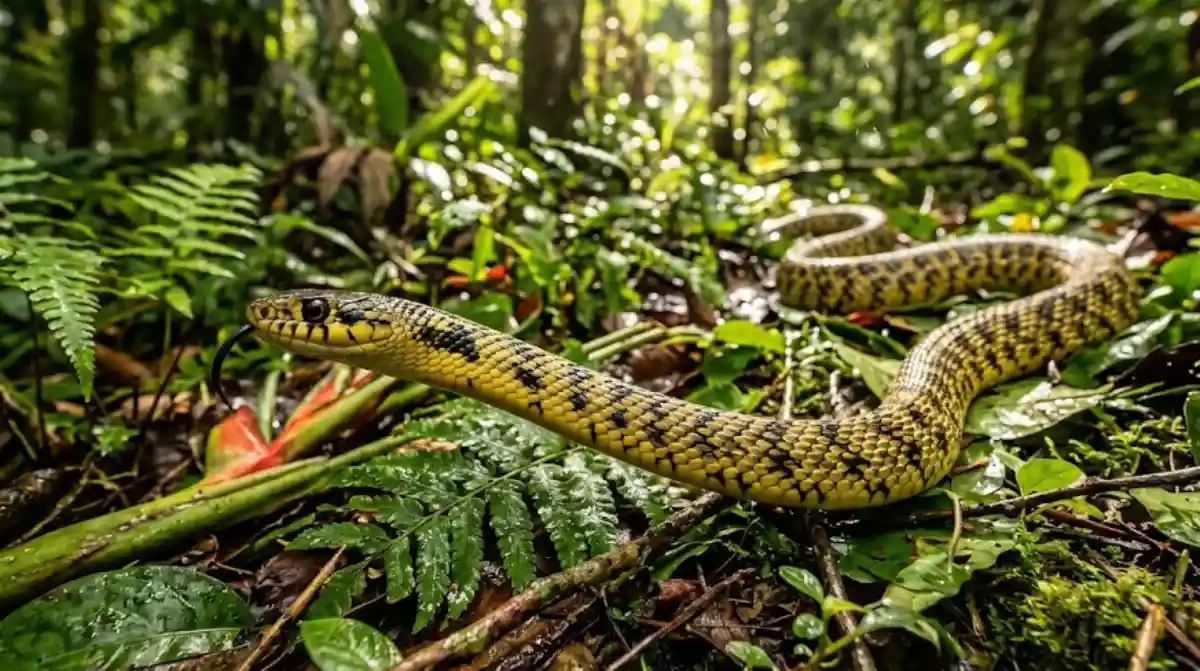
A snake that seems to run across the leaf litter
The caninana, Spilotes pullatus, can reach surprising speeds. It moves with such fluidity that it seems to float over the forest leaf litter, surpassing the movement speed of most nonvenomous snakes in the Americas.
Popular imagery often presents snakes as slow, stealthy animals that wait motionless for prey. The caninana overturns that expectation. It is an active hunter with a highly specialized muscular structure that allows it to move powerfully both on the ground and through the tree canopy.
Its body is adapted to an environment packed with obstacles. Among exposed roots, fallen branches and trunks, the snake turns every uneven surface into part of its route, showing a motor versatility that few reptiles can reproduce with the same mastery in the dense Amazon biome.
The biological design behind its extreme speed
To understand how the caninana became a Brazilian benchmark for agility, it is necessary to look at its unique morphology. Unlike heavier, more robust snakes such as boas, it has a long, slender body.
It can reach three meters, or nearly 9.8 feet, but its weight is distributed in a way that favors propulsion. According to established herpetological studies, its epaxial musculature is extremely well developed and generates superior lateral traction.
This structure allows the snake to use any small irregularity in the ground as leverage. A dry branch, an exposed root or a stone can serve as a foothold from which it projects its body forward in milliseconds.
Speed is not only an escape tool. It is central to the species’ survival strategy, because in a competitive environment such as the Amazon, moving quickly can mean securing a meal before another predator intervenes.
Rather than relying on a stationary strike, the caninana is known to “run” after its targets. Its varied diet includes small mammals, birds and even other snakes, showing that its speed is matched by broad hunting opportunities.
That speed is accompanied by sharp vision and a highly refined sensory system for detecting vibrations in the ground. Together, these traits allow the snake to respond quickly to prey movements and changes in its surroundings.
The defensive display behind the myths
The caninana’s reputation for being “fierce” is one of the subjects most often discussed by local residents and wildlife enthusiasts. When it feels threatened, it adopts an imposing defensive posture: it inflates its neck and vibrates its tail against dry leaves.
The resulting sound is often mistaken for the rattle of a rattlesnake. This behavior is a classic example of mimicry and defensive display, an intimidating performance designed to drive away potential threats without forcing the animal into a physical confrontation.
The caninana has no venom glands. Instead, evolution equipped it with this threatening performance, allowing it to appear more dangerous and gain time when faced with a possible aggressor.
It is also important to dispel the idea that the caninana chases people out of needless aggression. In most encounters, the snake disappears into the vegetation within a fraction of a second, using its characteristic speed to avoid contact.
What is sometimes interpreted as an attack may simply be the animal’s desperate attempt to find a fast escape route. Respecting its space is essential for peaceful coexistence, and understanding that it helps control rodent populations can change public perceptions of the species.
A specialist on the ground and in the canopy
Although it is often seen on the ground, the caninana is an exceptional climber. Its ventral scales have a slight keel that helps it grip vertical trunks, allowing it to climb tall trees with the same ease with which it moves across the earth.
This semi-arboreal ability expands its range of movement and protects it from larger terrestrial predators. In the canopy, the snake can become almost invisible among shadows and shafts of light passing through the leaves.
Its black-and-yellow color pattern works as highly effective disruptive camouflage. The contrasting colors break up the outline of its body, an important advantage as it moves among branches and foliage.
Its climbing agility also reveals a fascinating aspect of its motor intelligence. When moving from one branch to another, the caninana can keep more than half of its body suspended in the air without falling, using the strength of its rear third to anchor itself.
This dynamic balance is essential when it captures bird nests, one of its preferred food sources during the birds’ breeding season. Watching a caninana in motion is like witnessing biomechanics in its purest and most adapted form.
Why the caninana matters to the rainforest
The presence of a caninana in an area is an excellent indicator of ecological balance. As a top predator in its niche, it regulates the abundance of several species and prevents certain populations from becoming pests.
In transition zones between forest and rural areas, it provides an invaluable environmental service by controlling rat populations. These rodents can transmit diseases to people and destroy crops, which makes the snake a natural guardian of rural and forest environments.
Conserving the caninana is closely connected to protecting the biological corridors that allow it to move and reproduce. Habitat fragmentation and unfounded fear, however, lead to the unnecessary deaths of many individuals.
Environmental education projects in Amazonian communities have worked to show that the caninana does not pose a real danger when left alone. Valuing wildlife in all its forms, including animals that may initially cause fear, strengthens the biodiversity network that supports the planet.
Protecting this snake also means preserving the evolutionary history of one of the continent’s most fascinating reptiles. As biodiversity loss becomes an increasing concern, charismatic and visually striking species such as the caninana can help draw attention to the protection of tropical forests.
Brazilian science continues to document new behaviors in this species, revealing that much remains to be learned about the way these animals interact with the Amazon’s complex ecosystem. Support for extractive reserves and national parks helps ensure that the “fastest snake in Brazil” can continue to play its vital role.
Whenever a caninana crosses a trail, it reminds us that the forest is alive, vibrant and filled with defense and survival mechanisms refined over millions of years. Knowledge is a powerful tool against prejudice, transforming fear into admiration for one of the most dynamic creatures in these lands.
The beauty of the Amazon lies not only in monumental trees or colossal rivers. It also lives in the silent agility moving across the forest floor, in the caninana’s golden sheen and in its cinematic movements.
By protecting its habitat, we protect the stage where life unfolds with a speed and precision that human engineering would struggle to match. The caninana shows that every link in biodiversity is essential to ecosystem health and to the food security of communities living in harmony with nature.
Reporting: Anne Silva / Amazonia Mag

Editor, English Edition — Amazonia Mag
Anne Silva is the editor of Amazonia Mag, the English-language edition of Revista Amazônia. She curates, translates and adapts the outlet's science and environment coverage for an international audience, reporting on Amazon wildlife, flora, rivers, climate and research. Every story she edits is grounded in peer-reviewed studies, official data and on-the-ground reporting from the Revista Amazônia newsroom in Belém, Pará, Brazil. More by Anne Silva →