
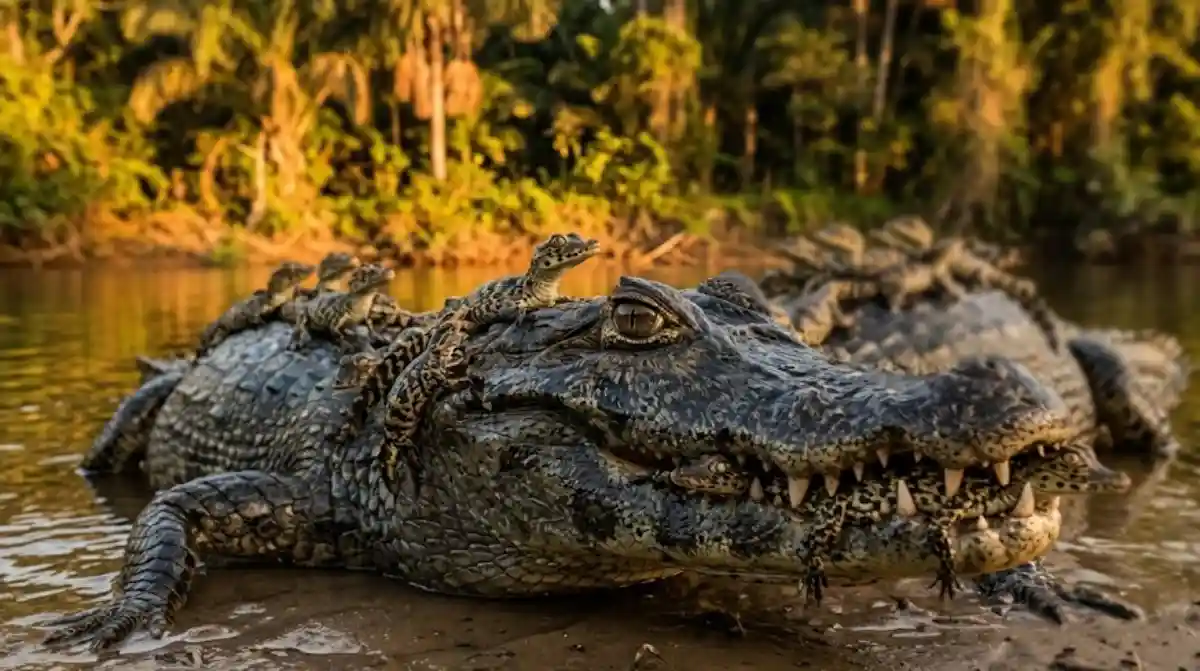
A protective mother in Amazonian waters
The black caiman, Melanosuchus niger, displays one of the most complex and delicate forms of parental behavior in the reptile kingdom. Its jaws deliver overwhelming bite pressure, yet the animal can use them to carry newly hatched young with the softness of a silk touch to the safety of the water.
Many people believe that reptiles abandon their nests to their fate. The largest predator in South America’s freshwater systems challenges that stereotype by devoting months to constant surveillance and protection of its offspring.
This protective behavior is vital to the species’ survival. It helps the young get through their most vulnerable period, when they face predators such as birds of prey and carnivorous fish.
Calls that signal the moment of hatching
The bond between mother and young begins before birth through a fascinating and verifiable form of communication: pre-hatching vocalizations. Still inside eggs buried in an organic-matter nest, black caiman hatchlings produce high-pitched sounds that resemble tiny whimpers.
According to established biological studies, these calls signal to the female that hatching time has arrived. After hearing them, the mother uses her sturdy legs to carefully dig into the nest, removing the layer of decomposing vegetation that served as a thermal incubator while the embryos developed.
This sound-based communication system is essential for synchronizing the brood’s birth. Without the mother’s intervention, many hatchlings could remain trapped beneath the weight of the nest material or become easy targets as soon as they pushed their heads outside.
The female’s immediate response to the young’s calls demonstrates a deep sensory and hormonal connection, characteristic of animals that invest energy in preserving the next generation. It is a moment of high tension in the wild, when the protective instinct overrides the aggressive nature of a powerful predator.
Carrying hatchlings between powerful jaws
Once the hatchlings leave their shells, the species’ most emblematic parental-care scene begins: mouth transport. The female opens her enormous mouth and allows the young, which measure just over 8 inches, or slightly more than 20 centimeters, to enter voluntarily or be gently settled between her teeth.
With slow, precise movements, she carries them to a nursery, generally an area of shallow water rich in floating vegetation. There, the newborns have better chances of hiding and finding food while remaining close to maternal protection.
The mechanical precision required for this act is remarkable. The black caiman has highly sensitive pressure sensors around its teeth and on its lips, known as integumentary sensory organs. These sensors let the mother detect exactly how much force she is applying.
That control prevents the young from suffering physical harm during the journey. The behavior offers a lesson in how brute strength can be perfectly regulated to serve life and the continuation of a lineage in Amazonian rivers.
Nurseries, territory and early learning
Care does not end when the brood reaches the water. Female black caimans establish nurseries, defined areas where they remain close to their young for several months and sometimes for more than a year.
During that period, any animal approaching the brood may face the fury of a mother that can exceed 16 feet in length, or more than 5 meters. This level of territorial protection is among the longest-lasting observed in modern crocodilians.
The guarded area creates an exclusion zone that benefits not only the caimans, but also helps maintain the trophic structure of that particular region of floodplain forest or igapó. Inside the nurseries, the young learn to hunt insects and small crustaceans under the matriarch’s watchful eye.
Researchers observe that the mother responds immediately to the slightest danger signal from a hatchling. She may burst explosively from the water to drive away the threat, creating a moving barrier between the young and whatever has approached them.
This constant vigilance drastically reduces infant mortality. In other, less attentive reptile species, mortality can reach extremely high levels during the first weeks of life.
The calls also have a social purpose. Through specific vocalizations, the young keep the group together and tell the mother their exact location among dense vegetation.
This continuing sound dialogue between parents and offspring is one of the most efficient adaptations for survival in an environment where visibility is often limited by turbid water and plants. The sounds are not merely cries for help, but tools that hold the family group together.
A key species for Amazonian wetlands
Beyond being a devoted parent, the black caiman is considered a keystone species for the health of Amazonian ecosystems. Through its movements and diet, it helps recycle nutrients and maintain the balance of fish populations.
Its feces enrich the water with minerals essential to phytoplankton, which forms the base of the aquatic food chain. The animal’s influence therefore extends far beyond the immediate protection of its young.
Conserving the species, once threatened by predatory hunting because of the value of its hide, is one of the major victories of Brazilian environmental management in recent decades. Today, sustainable-management projects in the Amazon, such as those carried out in the Mamirauá Sustainable Development Reserve, demonstrate that it is possible to live alongside these giants.
Recognizing the black caiman as biological and cultural heritage allows local communities to act as guardians of these animals. Understanding its parental care also humanizes the animal in the public imagination, turning the monster of the waters into an example of resilience and family devotion.
That change in perception strengthens environmental conservation efforts. The black caiman is not only a formidable predator, but also a living expression of the complex relationships that support life in Amazonian waters.
The species’ survival, along with its unique parental behavior, depends directly on the integrity of Amazonian wetlands. Changes in rainfall patterns and the clearing of gallery forests can affect nest temperature and the availability of safe places for nurseries.
Maintaining connectivity between rivers and flooded forests helps ensure that future generations of caimans continue to call beneath the protection of their parents. Continued study of these social interactions opens new windows onto the evolution of animal behavior.
Each new discovery about how these giants care for their young reinforces the idea that the Amazon still holds secrets that challenge our understanding of the natural world. The black caiman is a symbol of the biological complexity flourishing in the heart of Brazil, and it demands lasting respect and protection.
The image of a mother caiman carrying her young is a powerful metaphor for Amazon conservation: immense strength used to protect what is most fragile and promising. By protecting the habitat of these remarkable reptiles, people help keep the cycle of life turning with the same precision and care that this species has demonstrated for millions of years.
Reporting: Anne Silva / Amazonia Mag

Editor, English Edition — Amazonia Mag
Anne Silva is the editor of Amazonia Mag, the English-language edition of Revista Amazônia. She curates, translates and adapts the outlet's science and environment coverage for an international audience, reporting on Amazon wildlife, flora, rivers, climate and research. Every story she edits is grounded in peer-reviewed studies, official data and on-the-ground reporting from the Revista Amazônia newsroom in Belém, Pará, Brazil. More by Anne Silva →