
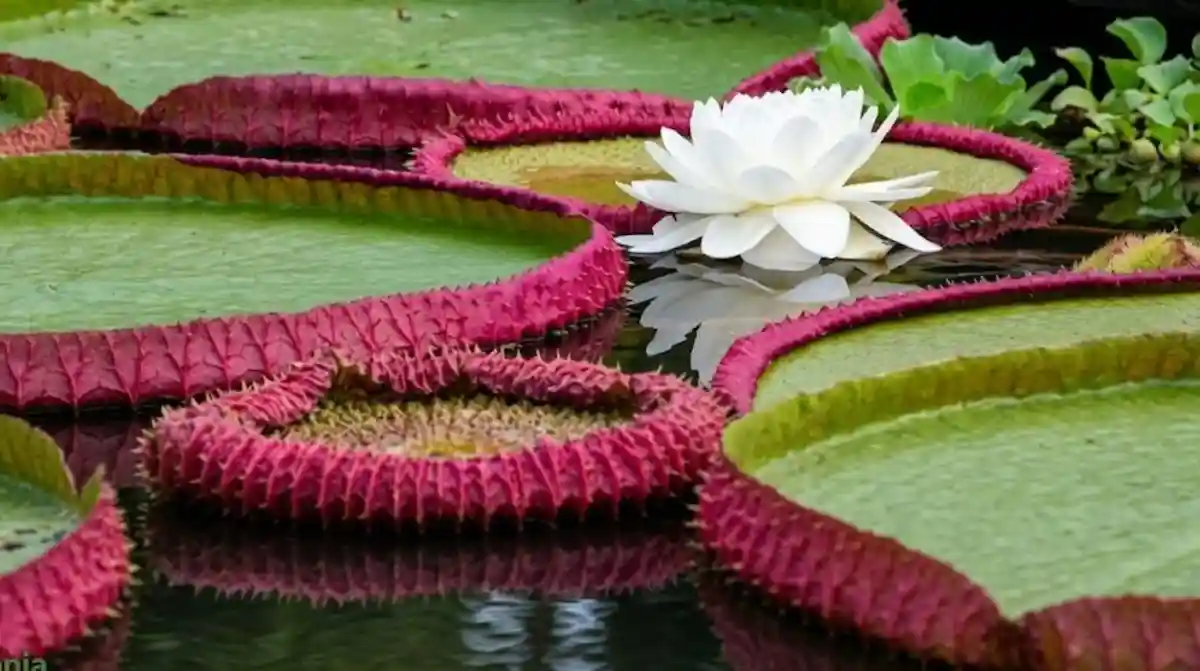
The Amazon water lily (Victoria amazonica) stages one of the rainforest’s most dramatic biological events. Its flower can raise its temperature by up to 18°F (10°C) above the outside environment, becoming a beacon of warmth and scent in the middle of the Amazonian night.
This phenomenon is known as thermogenesis. It is not merely a curious detail of flowering, but a strategy that combines chemical energy, heat and fragrance to attract pollinators, especially beetles in the genus Cyclocephala.
By burning stored starch at an accelerated rate, the plant produces heat and releases an intense perfume reminiscent of sweet fruit. The warm scent guides the beetles toward the center of the flower, where they find shelter and food in the darkness surrounding the lakes.
A flower that becomes a nighttime shelter
Unlike many flowers that simply offer nectar, the Amazon water lily acts as an active host. When a beetle enters, drawn by the heat and aroma, it finds a protected and warmed environment inside the flower.
The arrangement also includes a temporary confinement. At dawn, the flower begins to close, keeping the insect apparently trapped within its interior for approximately 24 hours.
This confinement does not harm the beetle. Instead, the insect spends the day feeding on nutrient-rich sterile tissues supplied by the plant, while its body becomes covered with grains of pollen.
The flower therefore does more than receive a visitor. It creates the conditions needed for pollen to be collected and carried away later, combining warmth, food, shelter and a timed closing movement in one reproductive strategy.
Color tells the beetle where to go next
According to records from the Instituto de Pesquisas da Amazônia, INPA, the flower opens again on the following night. At that point, it changes from its original white color to shades of pink or purple.
This color change is a crucial visual signal. It shows that the flower has already been pollinated and tells the beetle to leave that older floral shelter and look for a newer white flower.
When the insect emerges, it carries the pollen collected during the day. Its next visit can transfer that pollen to another flower, promoting cross-pollination and the genetic diversity of the species.
The sequence resembles a precise choreography of survival. The plant provides a reward and temporary protection, while the beetle becomes the carrier of the Amazon water lily’s reproductive material.
The science behind plant heat
The ability to generate heat is rare in the plant kingdom. Although heat production is usually associated with homeothermic animals, the Amazon water lily has a highly specialized metabolism that allows its flower to warm during flowering.
The mitochondria in its cells operate at a very high rate during this period. Energy stored as starch is rapidly processed, with part of that energy released as heat inside the flower.
The heat also helps volatilize aromatic compounds. As a result, the flower’s perfume can travel farther through the dense moisture of the rainforest, reaching beetles that might otherwise overlook the plant in the darkness of the lakes.
Research indicates that the warmed environment also increases the beetles’ metabolic activity. This prepares them for flight on the following night, when they leave the flower after its color has changed.
The result is a fascinating mutualistic relationship. The plant receives the service of pollen transport, while the beetle gains a warm space, protection from nighttime predators and a highly caloric diet.
An icon of resilience and regional culture
The Amazon water lily is much more than an impressive botanical structure. Its leaves can reach 6.6 feet, or two meters, in diameter, making the plant a symbol of the adaptive intelligence of Brazil’s ecosystems.
In popular culture, oral traditions among Amazonian communities describe its origin through the legend of a young woman who tried to touch the moon’s reflection on the water and was transformed into the star of the waters.
The connection between the mystical and the biological reinforces the plant’s place in the collective imagination. It also highlights its role in regional identity and in the conservation of the environments where its reproductive cycle takes place.
Protecting várzea lakes and igapó forests is essential if this cycle is to continue. Water pollution and deforestation along the shores directly affect populations of the pollinating beetles.
Conscious ecotourism initiatives and environmental education projects have focused on the Amazon water lily as a flagship species. Through it, they help explain how small interactions, such as the heat of a flower and the flight of a beetle, are fundamental to life in the planet’s largest river basin.
Natural engineering for the future
Studying thermogenesis in the Amazon water lily opens a way to understand how plants respond to extreme temperature variations. This field is increasingly relevant in an era of climate change.
The efficiency with which the plant converts chemical energy into heat is a source of interest for biologists and biomimetic engineers. Its behavior shows how metabolism, signaling and reproduction can be integrated into a single living strategy.
The leaves reveal another form of natural engineering. Radial and transverse veins provide exceptional buoyancy, while raised edges keep water from entering and small channels allow rain to drain away.
A network of air chambers supports the robust structure. When weight is distributed evenly, the leaf can support the weight of a small child, offering one of nature’s clearest demonstrations of structural design through lightness, strength and function in one aquatic organism.
Looking at an Amazon water lily on a lake means seeing more than a beautiful plant floating on the surface. It means seeing a sophisticated biological machine that breathes, warms itself and interacts proactively with the surrounding world.
Protecting the species ensures that the nighttime pollination spectacle can continue. It also keeps alive the combination of magic and science that defines the Amazon and gives meaning to one of its most recognizable plants.
The lesson of the Amazon water lily concerns the importance of creating welcoming environments where life can flourish. Just as the plant warms its flower to receive its pollinator, conservation efforts must be strengthened so Brazil’s biodiversity can continue to surprise us with ingenious solutions and unequaled beauty.
The balance of the rainforest rests on these small but immense daily miracles, including a flower that warms itself at night and a beetle that emerges covered in pollen to begin the next cycle.
Reporting: Anne Silva / Amazonia Mag

Editor, English Edition — Amazonia Mag
Anne Silva is the editor of Amazonia Mag, the English-language edition of Revista Amazônia. She curates, translates and adapts the outlet's science and environment coverage for an international audience, reporting on Amazon wildlife, flora, rivers, climate and research. Every story she edits is grounded in peer-reviewed studies, official data and on-the-ground reporting from the Revista Amazônia newsroom in Belém, Pará, Brazil. More by Anne Silva →