
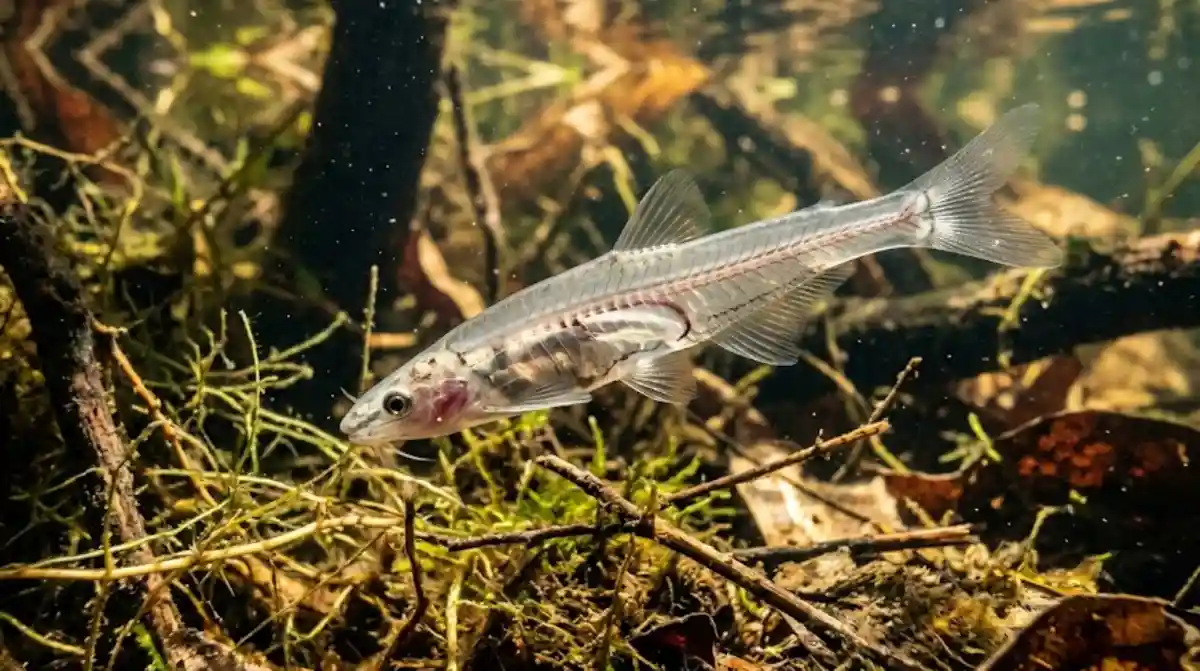
The Amazon is home to a fish with one of the most powerful ammonia sensors in the underwater world. The candiru, Vandellia cirrhosa, can detect microscopic traces of urea amid the flow of major rivers such as the Solimões and Madeira. Often reduced to a horror legend, it is actually one of the most sophisticated examples of biological specialization in Amazonian wildlife.
Popular belief portrays the fish as an unstoppable invader of human body openings. Science offers a different picture: a blood-feeding fish with remarkable precision, shaped by evolution to interact with large fish in the Amazon Basin. Its body, senses and feeding behavior reflect the demands of one of the most competitive environments on Earth.
A transparent body built for concealment
Unlike the images commonly used in popular accounts, the candiru is an almost ethereal animal. Its body is long, thin and nearly translucent, an evolutionary adaptation that allows it to approach prey without being detected. In waters where being seen can mean being eaten, transparency is a practical survival strategy.
The candiru belongs to the family Trichomycteridae and is a small siluriform, the same broad order that includes catfish. It has no visible scales, a feature that reduces drag and helps it move through strong currents. The same smooth body also makes it easier to slide into the gill openings of its hosts.
When researchers observe a candiru in the laboratory, its circulatory system is the feature that stands out most through its clear skin. The movement of blood inside the body creates a striking contrast beneath the transparent surface. This unusual appearance challenges the vision of larger predators and contributes to the fish’s ability to remain unnoticed.
That natural camouflage allows the candiru to thrive in several habitats. It can live near the sandy bottoms of rivers as well as along densely vegetated igapó margins. In each setting, its body shape and visual discretion help it survive among predators, currents and potential hosts.
How the fish finds prey, and why the myth survives
One of the major debates in modern ichthyology concerns the exact method the candiru uses to locate prey. For decades, people firmly believed that the fish was attracted to human urine because of its nitrogenous compounds. Recent studies conducted by Brazilian and international biologists, however, indicate that vision and mechanoreception are far more important than isolated chemical smell.
Mechanoreception is the ability to sense vibrations and movement in water. The candiru monitors the water expelled from the gills of large fish and identifies the moment when a host is vulnerable. Its behavior is associated with these water flows, not with a deliberate search for human beings.
Attacks on people are extremely rare and, in the overwhelming majority of cases, represent a biological wrong turn. The fish seeks the currents leaving a fish’s gills so it can feed on blood. Confusion with other water flows is what produces the documented incidents.
The candiru also cannot survive for very long inside the human body. For the fish, a human body is a biological dead end because it lacks the oxygen-rich, nutrient-rich environment provided by the gills of a large fish. This limitation helps separate the animal’s biology from the more frightening versions of its legend.
A quiet participant in river balance
Within the Amazon’s vast food web, no creature exists without a systemic role. The candiru acts as a natural regulator of populations of large catfish and other scaleless fish. By feeding on small amounts of blood, it rarely kills its host.
Its role is therefore closer to that of an aquatic mosquito than to that of a lethal predator. This interaction helps maintain the vigor of larger species, removes weakened individuals or encourages fish schools to keep moving. That movement prevents an overload of nutrients in particular parts of the riverbed.
The presence of candirus is also an indicator of environmental health. These fish are sensitive to major changes in water chemistry, so their abundance reflects a balanced environment with a plentiful supply of hosts. Their presence links river quality with the relationships among parasites, fish and seasonal water cycles.
During expeditions by the National Institute of Amazonian Research, known as INPA, monitoring several candiru species helps scientists understand how flood and low-water cycles influence the movement of parasites and hosts. According to INPA researchers, these observations provide valuable information about the resilience of the river basin in the face of global climate change.
One name for a diverse group of fish
It is also a mistake to treat candiru as if it were a single species. The name covers several genera with different habits. While Vandellia is the famous blood-feeding form, other types consume dead tissue or even the scales of other fish.
This diversification shows that the niches of cleaner and parasite were explored in multiple ways during Amazonian evolution. Some candirus developed opercular odontoids, small spines along the sides of the head that work as anchoring hooks. They allow the fish to hold firmly even in strong currents.
This taxonomic variety is represented in natural history museums and research centers such as the Museu Paraense Emílio Goeldi. Their biological collections preserve specimens ranging from a few millimeters, less than a quarter inch, to several centimeters, roughly an inch or more.
Recognizing that candiru belongs to a diverse family helps dismantle the image of a monster and restores the fish to its proper place as a wonder of Neotropical biodiversity. Each subspecies carries a distinctive adaptation to its microhabitat, whether in the Rio Negro Basin or the muddy waters of the Solimões.
Living with the fish and learning from local knowledge
Amazonian river communities have lived alongside candiru for thousands of years. Their relationship combines respect with caution, an experience often overlooked by people who encounter the fish only through sensational stories. Far from the panic shown in sensational television documentaries, caboclo communities and Indigenous peoples know the times and places when the fish is most active.
Wearing suitable clothing when entering the river and choosing areas with greater water circulation are ancestral practices that support peaceful coexistence. Local knowledge teaches that a river is not simply a place of danger. It is an environment with rules that must be understood.
According to the oral tradition of several communities in the Lower Amazon, the candiru is seen as a watchful spirit of the waters. Modern science, in turn, confirms its importance through biomonitoring studies. The meeting of local knowledge and academic rigor is what makes the study of Brazilian wildlife so rich and necessary for future generations.
The candiru is a survivor and a master of adaptation. Its small size conceals a remarkable complexity that invites people to look beyond appearances and prejudice. Nature does not operate according to human concepts of good and evil, but according to efficiency and interconnection.
Protecting rivers for candiru means protecting the habitat of thousands of other species and ensuring that the cycle of life continues with the same precision that allows this small fish to find its destination in the deep waters of the planet’s largest river system. Amazon conservation depends on understanding every one of its parts, from its largest trees to its smallest fish.
Exploring the world of candiru opens a path toward a broader understanding of biodiversity. Its myths can give way to curiosity, and fear can give way to a deeper appreciation of the life moving through every drop of Amazonian water.
Reporting: Anne Silva / Amazonia Mag

Editor, English Edition — Amazonia Mag
Anne Silva is the editor of Amazonia Mag, the English-language edition of Revista Amazônia. She curates, translates and adapts the outlet's science and environment coverage for an international audience, reporting on Amazon wildlife, flora, rivers, climate and research. Every story she edits is grounded in peer-reviewed studies, official data and on-the-ground reporting from the Revista Amazônia newsroom in Belém, Pará, Brazil. More by Anne Silva →