
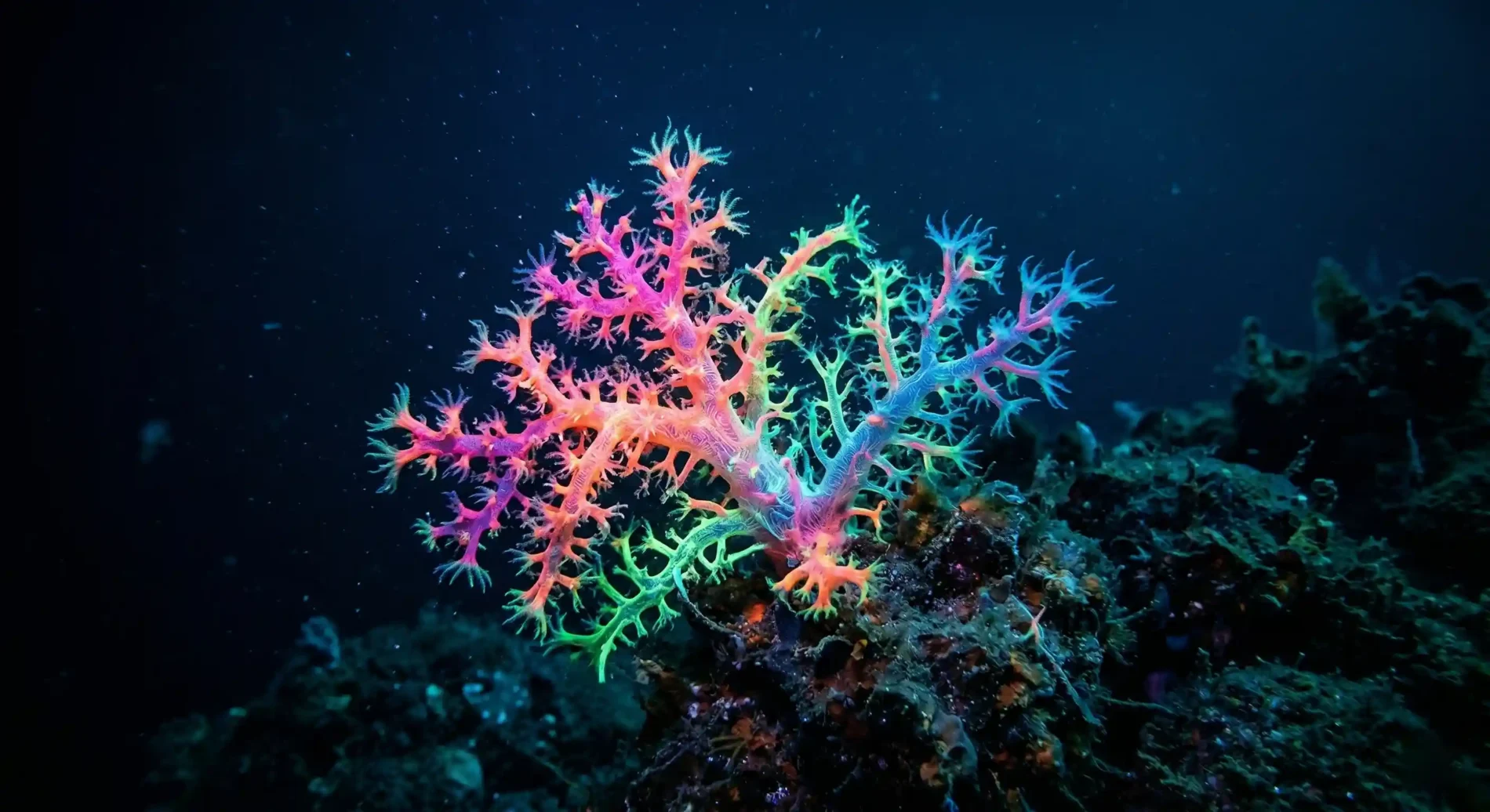
Brazil has a second Amazon, and it lies underwater. The country calls it the Blue Amazon, a term created to describe the immense marine zone under Brazilian jurisdiction, an ocean territory that extends far beyond the visible coastline and that almost no one outside Brazil has heard of. It is not a metaphor for the river or its delta: it is a legally defined stretch of the South Atlantic that the Brazilian state administers, monitors and, increasingly, studies. Scientists linked to institutions such as the University of Sao Paulo and the Brazilian Navy now confirm that this blue territory concentrates, in specific regions, a density of life forms per square metre that exceeds the records obtained in the tropical rainforest.
The conclusion does not rest on a single expedition. It draws on data accumulated by underwater sensors and by deep monitoring campaigns, which together describe a genetic repository without precedent in the Southern Hemisphere. The finding reframes an old assumption: that Brazil’s biological wealth is essentially a green story told above the waterline.
Scale explains part of the surprise. Brazil holds an Exclusive Economic Zone of 4.5 million square kilometres, an area almost equivalent to the land extent of the Amazon rainforest, yet its marine biomes remain barely explored. In other words, the country manages two territories of continental proportions and understands only one of them well. The Interministerial Commission for Sea Resources, known by the acronym SECIRM, coordinates the federal programmes devoted to that oceanic strip.
The secret beneath the South Atlantic
Geological and biological mapping shows that Brazilian waters host seamounts covered by coral gardens that do not depend on sunlight to survive. That is a decisive difference from the classic tropical reef, which needs shallow, transparent water to exist at all. Down there, life organises itself far from the surface and still thrives.
These structures behave like oases in the middle of the open ocean. Entire communities of crustaceans, molluscs and fish assemble around them, and a large share of those animals has never been formally catalogued by science. In practice, every research campaign that descends to those submerged peaks comes back with biological material nobody had described before.
The pace of discovery is striking. Specialists at the Oceanographic Institute report that new living beings are being identified in these areas at a rate of two species per week. Applied to any land biome, a figure like that would be treated as a permanent scientific event. In the Brazilian sea, it unfolds with very little public visibility.
Why the ocean can outperform the rainforest
Unlike the terrestrial environment, where thermal variability limits certain adaptations, the deep marine environment allowed the evolution of unique biological strategies. Relative temperature stability, extreme pressure and the absence of light pushed organisms toward chemical and metabolic solutions with no equivalent at the surface.
That detail turns the Brazilian ocean into the country’s largest biotechnology laboratory. Researchers point to the potential of these organisms for developing drugs against cancer and new classes of antibiotics, precisely at a moment when bacterial resistance is pressing health systems worldwide. Every species lost before it is described is also a molecule lost before it is tested.
The isolation of the seamounts explains much of that wealth. Separated from one another by thousands of metres of open water, they work as natural laboratories of evolution, which is why the Brazilian sea shows an endemism rate, meaning organisms found nowhere else, of close to 60% at certain points. Losing one of those mountains does not mean losing a fraction of a set: it means losing the entire set.
How that heritage should be explored already has international reference frameworks. The UNESCO report on the Ocean Decade lays out the sustainability protocols that guide research and the use of marine resources, and it serves as a benchmark for countries currently mapping their own exclusive economic zones.
A race against time for protection
To keep this heritage from being destroyed by seabed mining or predatory fishing, Brazil needs to accelerate the creation of Marine Conservation Units. At present, less than 5% of the Brazilian ocean area sits under full protection, an alarming proportion given the richness that territory sustains.
The Ministry of the Environment is discussing the implementation of pelagic sanctuaries, protected areas in open water designed to safeguard the migration routes of the large cetaceans and sharks that cross Brazilian waters. These are animals that ignore administrative borders, so protecting them requires instruments different from the ones applied along the coastal strip.
Science as a tool of national sovereignty
Mastering knowledge about the Blue Amazon is, above all, a question of national security and economic sovereignty. Investing in research vessels and deep diving technology allows Brazil to set the rules of sustainable exploitation in international forums instead of accepting rules written elsewhere. A country that does not know its own territory always negotiates from a weaker position.
There is a climate dimension as well. High impact reports indicate that preserving these marine ecosystems is vital for global carbon sequestration, and that on this front the ocean can slow warming more efficiently than many land areas. The journal Nature has already published detailed studies on the role of the ocean in regulating the climate.
One obstacle remains, and it is cultural. Protecting the Brazilian ocean depends on a shift in mentality in a country that historically turned its back on the sea and treated it mainly as a leisure backdrop. The sea is not only a physical frontier: it is the invisible lung that sustains life on the continent. Brazil’s future is blue, and it breathes beneath the waves.
Reporting: Anne Silva / Amazonia Mag. Source: revistaamazonia.com.br

Editor, English Edition — Amazonia Mag
Anne Silva is the editor of Amazonia Mag, the English-language edition of Revista Amazônia. She curates, translates and adapts the outlet's science and environment coverage for an international audience, reporting on Amazon wildlife, flora, rivers, climate and research. Every story she edits is grounded in peer-reviewed studies, official data and on-the-ground reporting from the Revista Amazônia newsroom in Belém, Pará, Brazil. More by Anne Silva →