
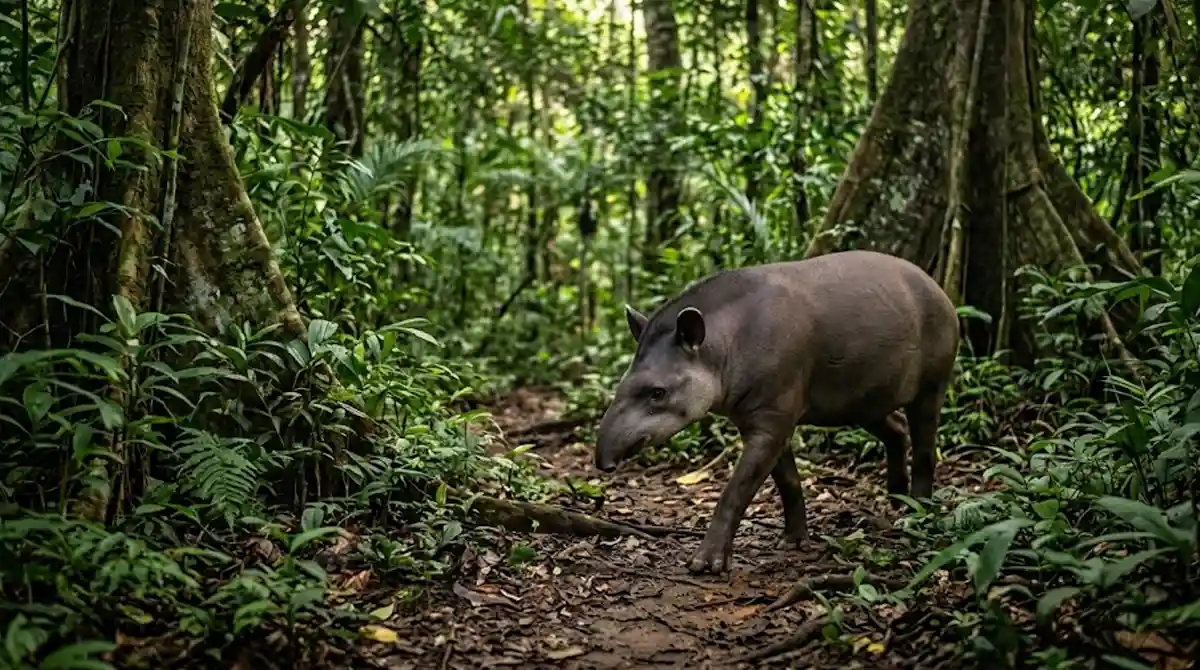
In a single day of walking through dense forest, one animal can carry and release more than ten thousand seeds inside its digestive tract. The record holder is not a migrating bird or a quick rodent. It is the largest herbivorous mammal in South America, the lowland tapir, known in Brazil as anta and catalogued by science as Tapirus terrestris. Its slow, almost silent walk hides one of the most decisive ecological functions in the tropical forest: planting, without ever intending to, the giant trees that hold up the entire architecture of the biome.
The architect that works while it walks
For a long time the tapir was treated as just another forest resident, a large and shy creature that showed up in travellers’ notes and in the stories told by forest peoples. That reading changed once researchers began measuring what happens after the animal feeds. The tapir is not a passive tenant of the ecosystem. It is the fundamental architect of its structure. Without this animal, several species of large trees, the ones that matter most for carbon capture, would simply stop reproducing at the pace needed to keep the biome in balance.
The mechanism is as simple as it is effective. The tapir eats fruits from palms and from fruiting trees, processes the seeds without damaging them, and deposits them hours or days later at a completely different point in the forest, wrapped in a natural load of fertiliser. Every dropping works as a portable nursery, a small deposit of genetic material ready to germinate in a spot the animal chose without knowing it, guided only by hunger and by the geography of its own territory.
Big seeds no other animal can swallow
What makes the tapir unique inside the Amazon network of seed dispersers is the combination of sheer body size with a generalist diet. Unlike birds or smaller monkeys, the tapir manages to swallow large diameter seeds that no other animal in the forest is able to process. That anatomical detail carries enormous consequences. It turns the tapir into the guardian of the hardwoods and of the trees that form the highest canopy of the Amazon, precisely the species that store the most carbon and that take centuries to reach their final height.
The service becomes even more valuable in wounded ground. When a tapir moves through areas hit by degradation or by fire, it carries with it the genetic material of the primary forest and speeds up natural regeneration in a way that human intervention rarely manages to replicate with the same efficiency. No replanting crew spreads seeds with that precision, or with that accumulated knowledge of the terrain. The animal does for free, and every single day, what restoration projects achieve only after years of planning and budget.
Satellite collars and the map of a walker
Modern science has rediscovered Tapirus terrestris from a new angle. Brazilian and international researchers now use satellite monitoring collars to understand how these animals cover kilometre after kilometre between different vegetation types. What showed up on the maps was not random wandering but a pattern of strategic movement. The tapir works as a biological bridge, connecting forest fragments that would otherwise sit isolated from one another. Each route logged by the sensors is also the record of a genetic exchange that keeps plant populations alive across roads, pastures and fire scars.
A living fossil that also swims
The tapir is considered a living fossil, having changed very little in evolutionary terms over the last million years. That means today’s rainforest still shares its ground with a biological design tested across entire geological eras. Its extremely thick skin acts as natural armour against thorns and predators in closed vegetation. On top of that, tapirs are excellent swimmers and use rivers and lakes not only to cool down, but as escape routes from threats and as aquatic dispersal corridors for seeds, widening even further the reach of their involuntary sowing.
Slow breeding against fast pressure
Despite its vital importance for the ecosystem, Amazon wildlife faces growing challenges that threaten the survival of these invisible engineers. Habitat fragmentation driven by the expansion of infrastructure and by deforestation shrinks the safe territory available to the species. Added to that is the tapir’s slow reproductive cycle, with pregnancies lasting around thirteen months and producing a single calf, which makes population recovery a hard task in the face of external pressures that advance far faster than the animal’s biology can answer.
Protecting the tapir means protecting carbon
The preservation of the species is intrinsically tied to keeping the planet’s carbon stocks in place, since forests without tapirs become less diverse and less resilient to climate change. Recognising that ecological role has been driving new conservation models built around wildlife. Community monitoring initiatives and ecological corridors are being designed using the tapir’s territory as the unit of measurement, a scale that forces planners to think in whole landscapes rather than in isolated plots.
Protecting the tapir means, in practice, protecting the entire web of interdependence that sustains the largest tropical forest on the planet. Keeping these animals walking freely is exactly the same effort required to guarantee that the next generations inherit a functional and vibrant ecosystem. The survival of the forest does not depend only on what we plant with our hands, but on what we allow nature itself to cultivate through its oldest inhabitants.
Reporting: Anne Silva / Amazonia Mag. Source: Revista Amazônia, revistaamazonia.com.br.

Editor, English Edition — Amazonia Mag
Anne Silva is the editor of Amazonia Mag, the English-language edition of Revista Amazônia. She curates, translates and adapts the outlet's science and environment coverage for an international audience, reporting on Amazon wildlife, flora, rivers, climate and research. Every story she edits is grounded in peer-reviewed studies, official data and on-the-ground reporting from the Revista Amazônia newsroom in Belém, Pará, Brazil. More by Anne Silva →