
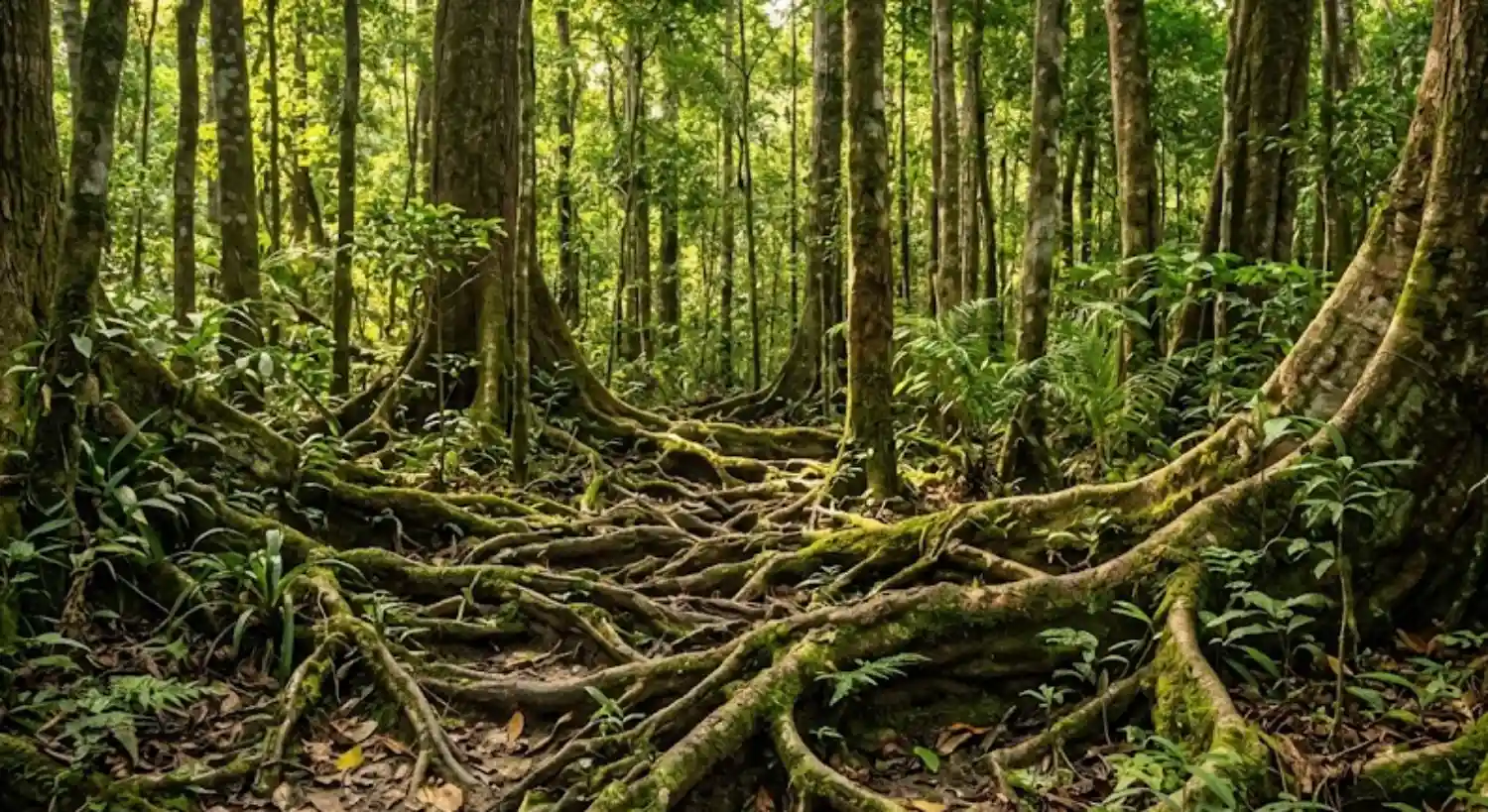
Beneath every hectare of Amazon rainforest sits a reservoir that no satellite photographs clearly. The soil of the world’s largest tropical forest holds more carbon than all the trunks, branches and leaves standing above it. That buried volume, assembled over thousands of years, works as a silent brake on global warming, and it depends entirely on the canopy staying in place.
Climate debate tends to focus on visible biomass, on the giant trees that show up in aerial photographs. Yet the physics of the biome points elsewhere: a large share of the carbon dioxide pulled out of the atmosphere ends up immobilised underground, bound to minerals, roots and microscopic organisms. When the forest goes, that hidden bank goes with it.
The reservoir nobody sees
Across much of the basin, the organic matter held in Amazon soil exceeds the carbon stored in the vegetation above ground. It is a slow construction. Every fallen leaf, every dead root and every drop of rain carrying dissolved organic compounds downward adds particles to a chemical archive that can be thousands of years old.
The archive stays stable as long as ground temperature remains low and moisture constant. Closed canopies block direct sunlight and keep the soil cool, slowing the microorganisms that break organic matter apart. Remove that permanent shade and the same material now locking carbon away begins handing it back to the air.
Roots as an injection system
The root systems of Amazon trees push tens of metres down in search of water and nutrients. Besides anchoring tonnes of timber, they act as a pump that drives carbon deeper. Close to half the carbon held by a plant sits in that underground structure, beyond the reach of fire and of most surface disturbance.
As fine roots die and regrow, they leave residues in deep layers where decomposition crawls. That slow pace is decisive: the further down carbon travels, the longer it stays sealed off from the atmosphere. A mature forest repeats the cycle continuously, at no cost to society.
Leaf litter, the entry point
The forest floor takes in dry leaves, broken branches and fallen fruit every day. That layer, known as leaf litter, is where carbon enters the soil. Fungi, bacteria and insects process the material under high humidity, turning plant tissue into organic compounds that join the earth in the form of nutrients.
Some of that carbon returns quickly to the atmosphere through microbial respiration. Another share travels the opposite way, dissolved by rainfall and carried down into mineral layers. That descent is the decisive step, the one that converts short lived plant debris into long term reserves.
Clays that trap ancient carbon
Deep down, dissolved organic matter binds to particles of clay and sand. The physical and chemical bond shields carbon from microbial attack and explains why material recovered from deep layers can be more than a thousand years old. Soil stops being mere support for roots and starts behaving like a mineral vault.
The stability of that vault is thermal. Sharp swings in ground temperature speed up biological activity and release gases that had been held in place. Canopy protection, then, is not a scenic detail of the landscape: it is the condition that keeps the reservoir shut.
Mycorrhizae, the living web underground
Amazon roots live in partnership with a microscopic mesh of fungi known as mycorrhizae. The fungi receive liquid carbon produced in the leaves and hand back phosphorus and nitrogen extracted from minerals. That subterranean network is a massive storage compartment in its own right, because fungal biomass immobilises the element in the coolest layers of the ground.
Moisture keeps the reservoir closed
None of this works without water. Forest leaves transpire millions of litres of vapour a day, a process that consumes solar energy and cools the surface. The vapour builds clouds, secures local rainfall and prevents natural fires. Constant humidity also ensures that dead wood decays without burning, keeping carbon inside the closed cycle of the biome.
What happens when the forest falls
Felling a tree cuts the capture service instantly. The plant stops photosynthesising and stops injecting carbon into its root system. Soil that was shaded is suddenly exposed to direct radiation: temperature climbs, moisture evaporates and microorganisms accelerate the breakdown of organic matter accumulated over centuries.
When fire is used to clear the ground, the thermal shock reaches the surface layer and wipes out the biological agents behind soil fertility. Combustion snaps cellulose molecules and releases into the atmosphere, within hours, reserves assembled across generations. The land is left compromised for decades to come.
Warming in two stages
The climate effect of deforestation is double. The first stage is direct emission: old carbon, stored in trunks and soil, returns to the air through burning or decay. The second stage stretches over years, because the degraded area loses its ability to absorb future emissions. Together they double the real weight of every hectare lost.
Soil holds up the rivers too
Soil rich in organic matter behaves like a geological sponge, soaking up heavy rain and releasing it gradually into watercourses. Cleared land compacts, loses that infiltration capacity and generates surface erosion. Keeping carbon underground means, in practice, sustaining the water supply of human communities and aquatic wildlife alike.
Regrowth rebuilds the underground store
The Amazon ecosystem retains a strong capacity to heal. When a cleared area is shielded from new fires, seeds already present in the soil germinate quickly and pioneer species form green cover within a few years. That secondary forest works as a suction pump for carbon dioxide.
Regenerating areas capture carbon at rates above those of untouched primary forest, because rapid growth demands high volumes of energy and atmospheric gas. As the canopy closes, shade returns, ground temperature falls and the underground reservoir starts rebuilding itself.
Measuring the invisible
Producing that inventory requires technology and fieldwork in combination. Laser equipped satellites scan the three dimensional structure of the vegetation and estimate biomass density without touching a leaf. On the ground, researchers measure trunk diameters and extract deep soil samples to quantify the buried stock. Merging both sets of data allows scientists to project scenarios and measure real recovery in degraded areas.
The value of leaving carbon underground
Underground storage anchors the economic value of an intact biome. Payment for environmental services turns conservation into a financial asset and supports extractive communities and Indigenous peoples who depend on standing forest. Countries and companies channel resources to guarantee that carbon stays where it is, avoiding the double release.
The thermal regulation delivered by the forest also benefits agriculture in other regions of Brazil, since continuous evapotranspiration moderates temperatures and sustains rainfall patterns. Understanding Amazon soil as an active reservoir, rather than a simple substrate, changes the scale of the problem: protecting what lies beneath the roots is as urgent as protecting what can be seen from the air.
Reporting: Anne Silva / Amazonia Mag. Source: Revista Amazônia (revistaamazonia.com.br).

Editor, English Edition — Amazonia Mag
Anne Silva is the editor of Amazonia Mag, the English-language edition of Revista Amazônia. She curates, translates and adapts the outlet's science and environment coverage for an international audience, reporting on Amazon wildlife, flora, rivers, climate and research. Every story she edits is grounded in peer-reviewed studies, official data and on-the-ground reporting from the Revista Amazônia newsroom in Belém, Pará, Brazil. More by Anne Silva →