
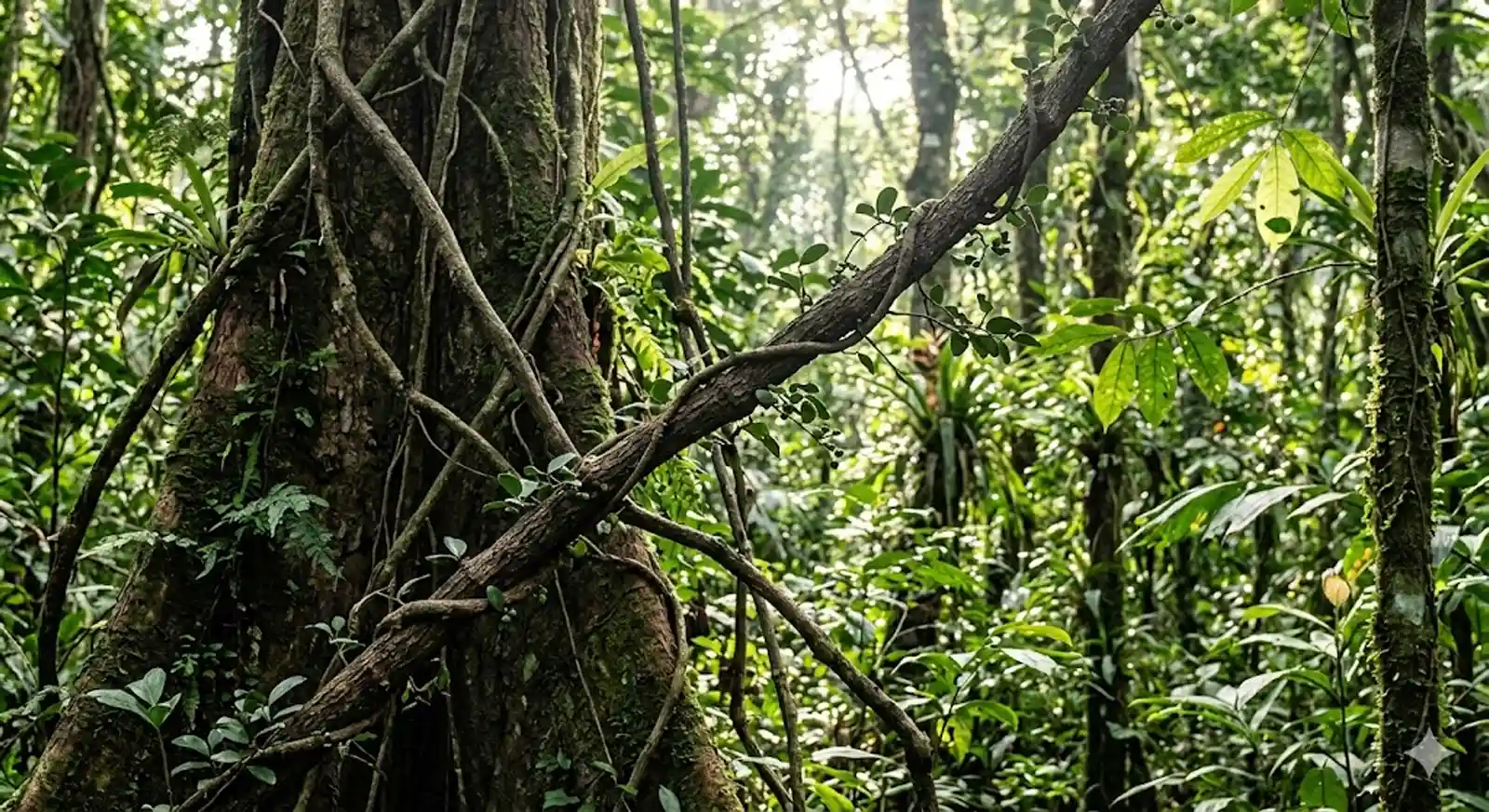
A single drop of that dark, viscous substance is enough to fully paralyse the skeletal muscles of a large animal within minutes, without ever stopping its heartbeat. The property sounds impossible, and yet it was observed, refined and mastered over thousands of years by Indigenous peoples of the Amazon, among them the Ticuna and the Yanomami, long before any laboratory in the northern hemisphere could name the molecules involved. What was known for centuries only as a fearsome hunting poison is today one of the most critical components in high complexity operating rooms across the planet. Curare, drawn from woody vines that climb through the shade of the forest understorey, stopped being an exotic curiosity and became a quiet fixture of contemporary medicine, allowing invasive procedures to be performed with a safety margin that earlier generations of surgeons could not imagine.
The chemical secret hidden in the genus Strychnos
The origin of this pharmacological phenomenon lies in several plant species, and the genus Strychnos is the leading character across the vast stage of Amazonian flora. The extraction of curare works as a practical lesson in applied chemistry. Indigenous preparers scrape the bark of specific vines and boil the material in water for hours, until it thickens into a dense, sticky syrup. That paste concentrates powerful alkaloids, and among them tubocurarine is the most famous and the most studied by science. One detail still impresses researchers: traditional knowledge established, with no microscopes and no reagents, that the poison is lethal only when it enters the bloodstream directly, while it remains harmless if swallowed. That precise distinction is what allowed hunted meat to be eaten safely, and it reveals an extremely fine reading of how a substance and a body interact.
A silent revolution inside operating theatres
The journey from the tropical forest to European and North American hospitals began to take shape in the 19th century, but it was during the 1930s and 1940s that medicine managed to isolate and standardise the active principle for clinical use. Before muscle relaxants derived from curare arrived, surgeons faced a dangerous dilemma. To obtain the muscular relaxation needed to open a patient’s abdomen or operate on the chest, they had to administer nearly lethal doses of general anaesthetics such as ether or chloroform. The distance between surgical stillness and irreversible harm was narrow, and every long operation became a gamble against the anaesthetic itself. With the introduction of d-tubocurarine the whole scene changed: doctors could keep patients under far lighter and safer planes of anaesthesia, while the muscles stayed perfectly still under the scalpel.
Neuromuscular blockade and biological precision
The way curare acts is a masterpiece of natural engineering. The substance blocks nicotinic receptors at the neuromuscular junction, the exact point where a nerve speaks to the fibre it is supposed to contract. In plain terms, it prevents the signal sent by the brain from reaching the muscle: it behaves like a key that slides into the lock but never turns, and by occupying the space it shuts out the real key, acetylcholine. The result is a controlled, reversible and surgically useful paralysis. That discovery did not only save millions of lives on the operating table. It also opened the door to the study of neurotransmission, supported progress in the treatment of conditions such as myasthenia gravis, and encouraged the development of new substances for controlling chronic muscle spasms.
Biodiversity as a laboratory of innovation
Today the pharmaceutical industry works mostly with synthetic derivatives inspired by the molecular structure found in the Amazonian vine, yet the debt modern science owes to Brazilian biodiversity is immeasurable. The surgical use of curare is the clearest proof that a standing forest is not merely an environmental heritage worth protecting for aesthetic or moral reasons. It is a living biotechnology laboratory that still holds answers to diseases we currently classify as incurable. Every hectare kept intact keeps that flow of discoveries open, and every hectare lost closes it before anyone has had the chance to read what was written there. Preserving these ecosystems is what guarantees that the conversation between the ancestral knowledge of forest peoples and the most advanced technologies of the future is never cut short.
The bridge between ancestral knowledge and the future
Exploring the potential of Amazonian plants demands deep respect for the original holders of that knowledge. Every Strychnos vine growing in the dim light of the understorey carries a chemical complexity that took Western science ages to understand, and that Indigenous practice was already handling with remarkable functional precision. When we look at contemporary medical innovation, it is impossible to ignore that the success of an emergency intubation or of a complex heart transplant has its roots planted in the humid, rich soil of the largest tropical forest in the world. The Amazon keeps whispering its cures to whoever has the patience to observe and the wisdom to protect.
Preservation as a pillar of public health
Valuing the genetic heritage of the Amazon is a matter of sovereignty and of global public health at the same time. As new research advances, it becomes clear that curare was only the tip of the iceberg. Other species of climbing plants and shrubs are being studied for the development of new painkillers and neuroprotective compounds, in a catalogue that keeps growing. Keeping the forest preserved is therefore a direct investment in human longevity and in our capacity to overcome the medical challenges of the coming century with the generosity of nature as an ally.
There is also an uncomfortable asymmetry worth naming. The knowledge that made this leap possible was produced, tested and transmitted by hunters and preparers in the forest, while the benefits circulate mainly through hospitals and industries thousands of kilometres away. Recognising that the comfort and safety of modern anaesthesia were born from the wisdom of an Indigenous hunter is an invitation to rethink our relationship with the environment and with the peoples who defend it. This is not a historical footnote, it is a practical warning: the next molecule capable of transforming surgery may be growing right now on a vine that science has not yet bothered to name.
Reporting: Anne Silva / Amazonia Mag. Source: Revista Amazônia (revistaamazonia.com.br).

Editor, English Edition — Amazonia Mag
Anne Silva is the editor of Amazonia Mag, the English-language edition of Revista Amazônia. She curates, translates and adapts the outlet's science and environment coverage for an international audience, reporting on Amazon wildlife, flora, rivers, climate and research. Every story she edits is grounded in peer-reviewed studies, official data and on-the-ground reporting from the Revista Amazônia newsroom in Belém, Pará, Brazil. More by Anne Silva →