
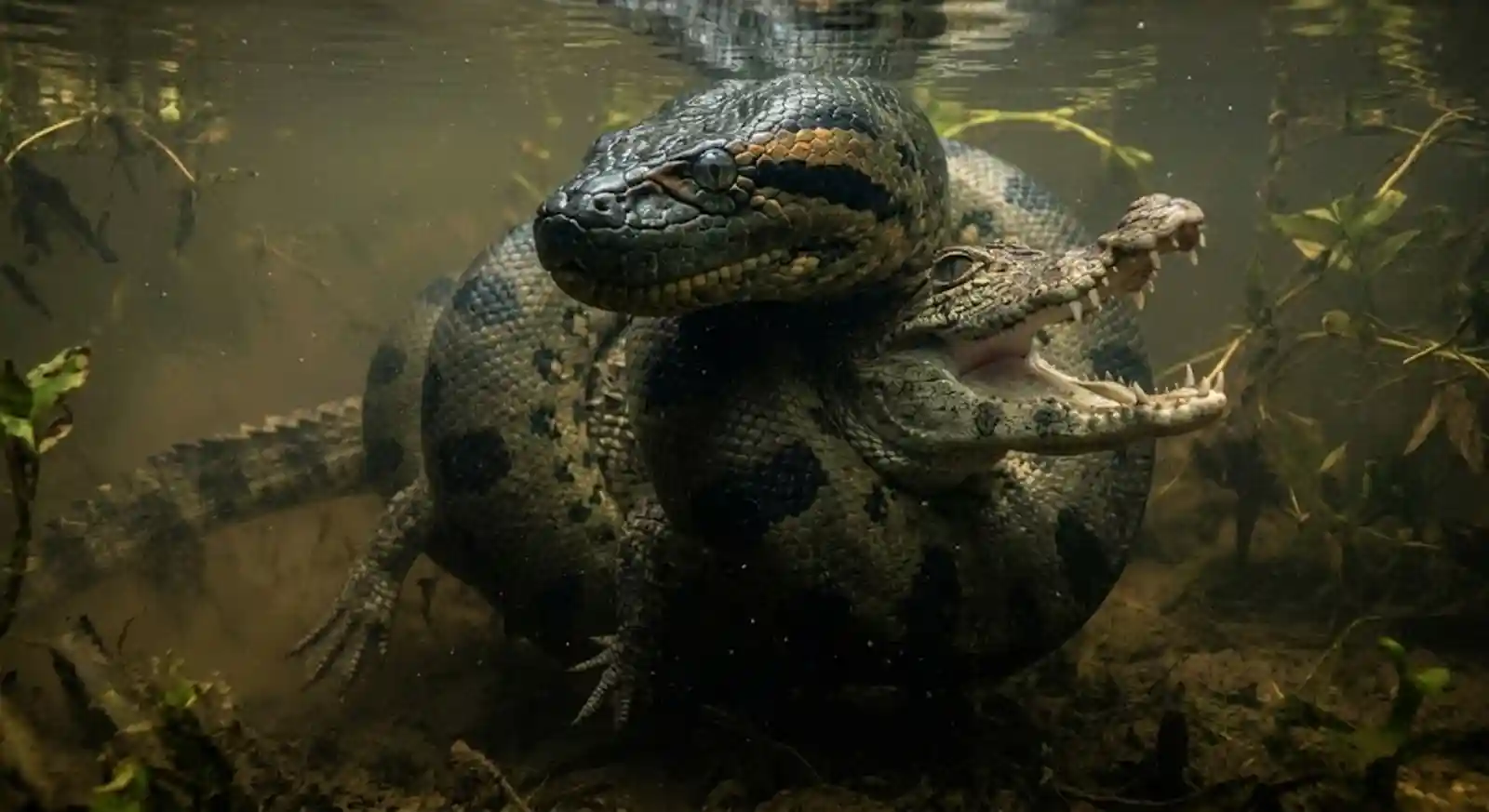
The force required to stop the blood flow of a prehistoric reptile is comparable to the weight of a bus pressing on a person’s chest. Researchers recently documented that an adult green anaconda can exert pressure of up to 90 pounds per square inch during constriction.
That scientific finding changes the common view of these snakes and elevates them to the status of biomechanical engineers of the Amazonian floodplains. Contrary to what was once believed, their main goal is not to break bones.
The primary objective is to cause an immediate circulatory shutdown in the prey, ensuring that the confrontation ends before the predator suffers serious injuries. In dark, crowded waterways, this strategy allows the snake to control a dangerous animal while keeping the struggle as brief as possible.
An ambush hidden in the water
New images captured in the basins of the Negro and Solimões rivers show the exact moment when an anaconda uses its natural camouflage to approach spectacled caimans and adult capybaras. Such visual records are rare because these events usually happen in dense vegetation or beneath the water’s surface.
Those settings make observation difficult. Thick plants conceal the snake, while suspended sediment and limited light reduce visibility for both animals and anyone trying to document the encounter.
The photographs also detail the use of heat-sensing receptors located in the snake’s labial scales. These structures act like biological heat radars, allowing the anaconda to detect the precise position of a prey animal’s neck and chest.
That ability remains useful in total darkness or muddy water. By locating the areas that must be controlled, the snake can begin its attack with greater precision instead of relying only on sight.
An anaconda hunting a caiman is one of the most complex spectacles in Brazilian nature. The predator blends into the surroundings, approaches within striking range and then combines surprise, speed and muscular power in a single sequence.
Speed followed by constriction
When the attack begins, the strike reaches approximately five meters per second, or about 16.4 feet per second. In an aquatic environment, that movement is too fast for the caiman to react effectively.
Once the snake’s serrated, inward-pointing teeth anchor in the opponent’s skin, the anaconda begins to coil around it. With every breath the prey exhales, the snake tightens its muscular loops a little more.
The pressure prevents the lungs from expanding again and also interferes with circulation. It is a quiet and efficient process that helps explain why the green anaconda is regarded as an apex predator of the Amazon.
Constriction is not limited to one point of the body. The coils adjust as the prey moves, maintaining contact and limiting its ability to escape into deeper water or reach an opening between the vegetation.
According to researchers, the key result is the interruption of blood flow rather than the crushing of bones. That distinction offers a clearer picture of how the snake handles large prey while reducing the time it remains exposed to injury.
A jaw built for oversized meals
The size of the prey recorded during the new expeditions impressed even experienced biologists. Researchers documented anacondas measuring about six meters long, or nearly 19.7 feet, swallowing caimans that reached almost two-thirds of their own length.
This physical feat is possible because the anaconda’s jaw has extremely elastic ligaments. Unlike the human jaw, the two sides of the lower jaw can move independently, allowing the snake to work its way over the prey.
Each side advances separately and helps pull the animal into the esophagus. The snake does not need to swallow the entire body in one motion. Instead, its jaws appear to walk along the prey, drawing it inward a little at a time.
Elastic skin adds another essential adaptation. Together, the flexible ligaments and the stretching skin allow the snake to ingest animals much wider than its own head, an evolutionary mechanism suited to life in environments where large meals can be available.
Swallowing an adult prey animal can take hours and requires an immense expenditure of energy. Even so, such a meal can provide enough sustenance for months without the need for another hunt.
Why an apex predator matters
The importance of this behavior extends beyond biological curiosity and reaches the basic balance of the ecosystem. As an apex predator, the anaconda regulates populations of caimans and large rodents.
By helping prevent overpopulation, it can limit damage to riverbanks and protect the supply of fish available to riverside communities. Its role is part of a larger ecological network in which changes in one population affect the conditions around it.
The presence of large anacondas in a stretch of forest is an indicator of environmental health. It suggests that the food chain below the snake remains preserved and functional.
Protecting marshes and gallery forests is essential if these giants are to continue performing their ecological role. Field studies indicate that conserving these wetlands is the greatest current challenge for maintaining biodiversity.
Protecting the waters of the ambush
Deforestation and river siltation reduce the places where the snake can hide and ambush prey. As those areas disappear, anacondas are forced to move into locations where conflict with humans becomes more frequent.
Understanding the animal’s biology can help society move from irrational fear toward respect and admiration. Far from being monsters, these snakes are silent guardians of the water and essential components of Amazonian ecosystems.
Each time an anaconda dives after a successful hunt, it carries the result of thousands of years of evolution in a challenging environment. Its strength is not an isolated trait, but the combined effect of camouflage, heat sensors, speed, constriction and a jaw adapted to large meals.
Watching wildlife in its purest form is a reminder that the forest has its own rules of survival. The Amazon still holds mysteries that only the silence of its waters can reveal, and preserving that setting means allowing the cycle of life to continue.
The future of this ecosystem depends on the ability of people to live alongside what is wild and essential in Brazilian nature. Large anacondas do more than survive in this landscape. Their presence also shows that the condition of a river can be reflected in the predators at the top of its food web.
Reporting: Anne Silva / Amazonia Mag

Editor, English Edition — Amazonia Mag
Anne Silva is the editor of Amazonia Mag, the English-language edition of Revista Amazônia. She curates, translates and adapts the outlet's science and environment coverage for an international audience, reporting on Amazon wildlife, flora, rivers, climate and research. Every story she edits is grounded in peer-reviewed studies, official data and on-the-ground reporting from the Revista Amazônia newsroom in Belém, Pará, Brazil. More by Anne Silva →