
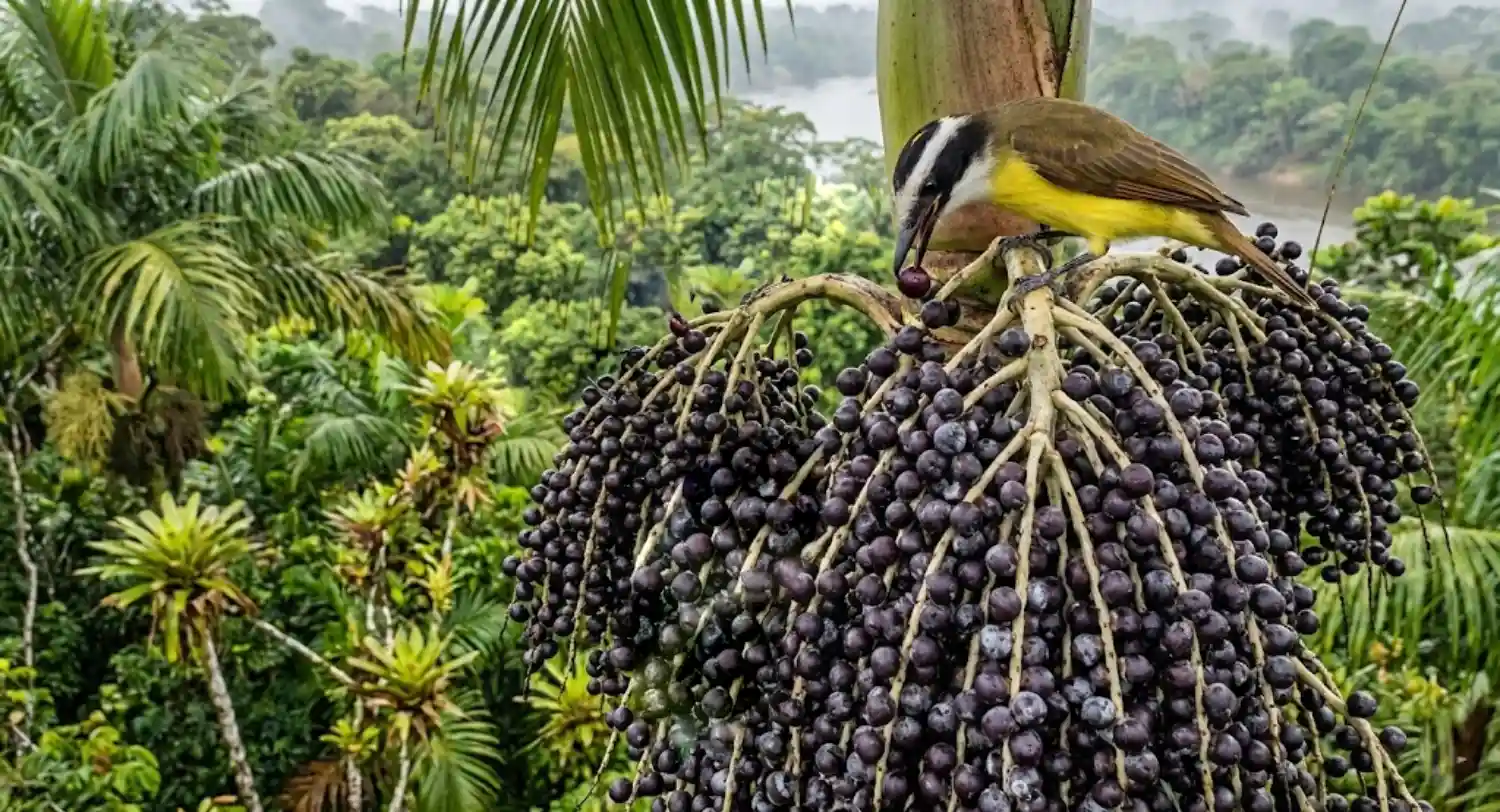
A single mature acai palm, standing in the flooded lowlands of Para, in northern Brazil, is far more than a food crop. The acai palm is the tall, slender tree that produces the small purple berry now sold worldwide in bowls and smoothies, and in its home forest it behaves like a busy vertical city: one plant feeds and shelters at least 47 different species of birds and bats. That figure, revealed by field research in the Amazon, turns the most famous palm in Brazil into a pillar of local biodiversity, a complex hideout and a natural supermarket open twenty four hours a day.
Far from being only an agricultural commodity, the acai palm (Euterpe oleracea) builds a natural architecture that seems designed for life. Its dense bunches, loaded with small dark fruit, and its broad, arching leaves offer an ideal hiding place from predators and the right spot for many birds to nest. For bats, the structure of the palm works both as a safe daytime roost and as an inexhaustible source of energy during their night flights.
Seen up close, the palm behaves like a building with several inhabited floors. High above, the arching crown filters sunlight and wind. A little lower, among the fruit bunches, there is a protected space where ripening berries set the calendar of animal visits. At the base, the trunk and the fallen leaf litter complete the structure. Each layer answers a different need, which is why a single plant can support animals with completely opposite habits and schedules.
A symphony of feathers and night flights
The relationship between the palm and the fauna around it is a textbook case of coevolution and mutualism, and it goes well beyond feeding. Birds such as the great kiskadee, the tanager known in Brazil as sanhaco and the forest thrush do not merely eat the fruit. They also use fibres and leaves to build their nests among the bunches, protecting their chicks at the safe height of the crown. In return, those birds act as seed dispersers, carrying the potential for new palms far away from the mother plant.
When the sun goes down, the palm does not rest. Bats then play a decisive ecological role that is often underestimated by anyone who sees acai only as a business. Fruit eating species of the genus Artibeus are essential pollinators and dispersers. They feed on the nectar of the palm flowers and, above all, on its fruit, carrying seeds for kilometres in the middle of the night and securing both genetic variability and the expansion of the forest. Without those winged allies, the natural regeneration of acai groves would be seriously compromised.
A balance threatened by monoculture
This biodiverse refuge, however, faces a growing challenge as production intensifies. Acai became a global craze, boosting the economy of Para, but it also drove the conversion of species rich floodplain areas into dense palm monocultures. When management ignores the complexity of the forest and focuses only on the productivity of a single species, stripping out other native trees, the fauna of the acai grove pays the bill directly.
Monoculture simplifies the environment. Birds that depend on a varied diet, or on different kinds of foliage to nest, simply disappear. Pollinating insects, which are crucial for acai production itself, lose their alternative sources of nectar and shelter. Pollination drops and, ironically, so does long term productivity. The associated biodiversity that once guaranteed the resilience of the ecosystem is replaced by a homogeneous, vulnerable landscape.
The invisible insect banquet
While birds and bats dominate the upper floors, the base of the palm and the decomposing fruit bunches form a micro world crowded with life. More than 100 insect species, among them beetles, ants and wasps, depend on the palm to feed and reproduce. That discreet swarm builds the food base for larger animals and helps keep the soil of the varzea healthy, the floodplain that the river fills and drains following the rhythm of the tides.
Sustainable management: the answer is the standing forest
The good news is that sustainable management of the acai palm offers a workable and positive path. Research shows that keeping a managed grove inside the native forest, preserving trees of other species and respecting the natural spacing between palms, does not only protect biodiversity. It also improves the quality and the quantity of the fruit that is harvested. It is practical proof that economy and ecology can walk together in the Amazon rather than cancel each other out.
Those practices ensure that the palm remains a vital habitat for the 47 species of birds and bats, along with countless insects and small mammals. By valuing the standing forest and its complexity, producers in Para are not simply selling a superfood. They are protecting an entire ecosystem that sustains winged life and, in the process, the viability of their own future harvest. The real value of acai lies in its ability to feed people while keeping the symphony of the forest alive.
For the consumer ordering an acai bowl thousands of kilometres away, that invisible chain almost never appears on the label. Yet every bunch harvested inside a diverse grove carries the story of a nest tucked among the leaves, of a bat flying at night with seeds in its mouth and of dozens of insects working at the foot of the palm. Protecting that network is not a romantic gesture: it is the condition for the fruit to keep existing at all.
The lesson travelling out of the Para floodplains is therefore quite simple, even if it is hard to put into practice. A palm left standing inside a living forest is worth more, both ecologically and commercially, than a palm isolated in a cleared field. Every decision taken on the ground, about which trees to cut and which to keep, decides whether those 47 species stay or vanish. The acai palm shows, in a single trunk, that conservation and harvest can share the same address.
Reporting: Anne Silva / Amazonia Mag. Source: original reporting by Revista Amazônia and field research in the Brazilian Amazon.

Editor, English Edition — Amazonia Mag
Anne Silva is the editor of Amazonia Mag, the English-language edition of Revista Amazônia. She curates, translates and adapts the outlet's science and environment coverage for an international audience, reporting on Amazon wildlife, flora, rivers, climate and research. Every story she edits is grounded in peer-reviewed studies, official data and on-the-ground reporting from the Revista Amazônia newsroom in Belém, Pará, Brazil. More by Anne Silva →