
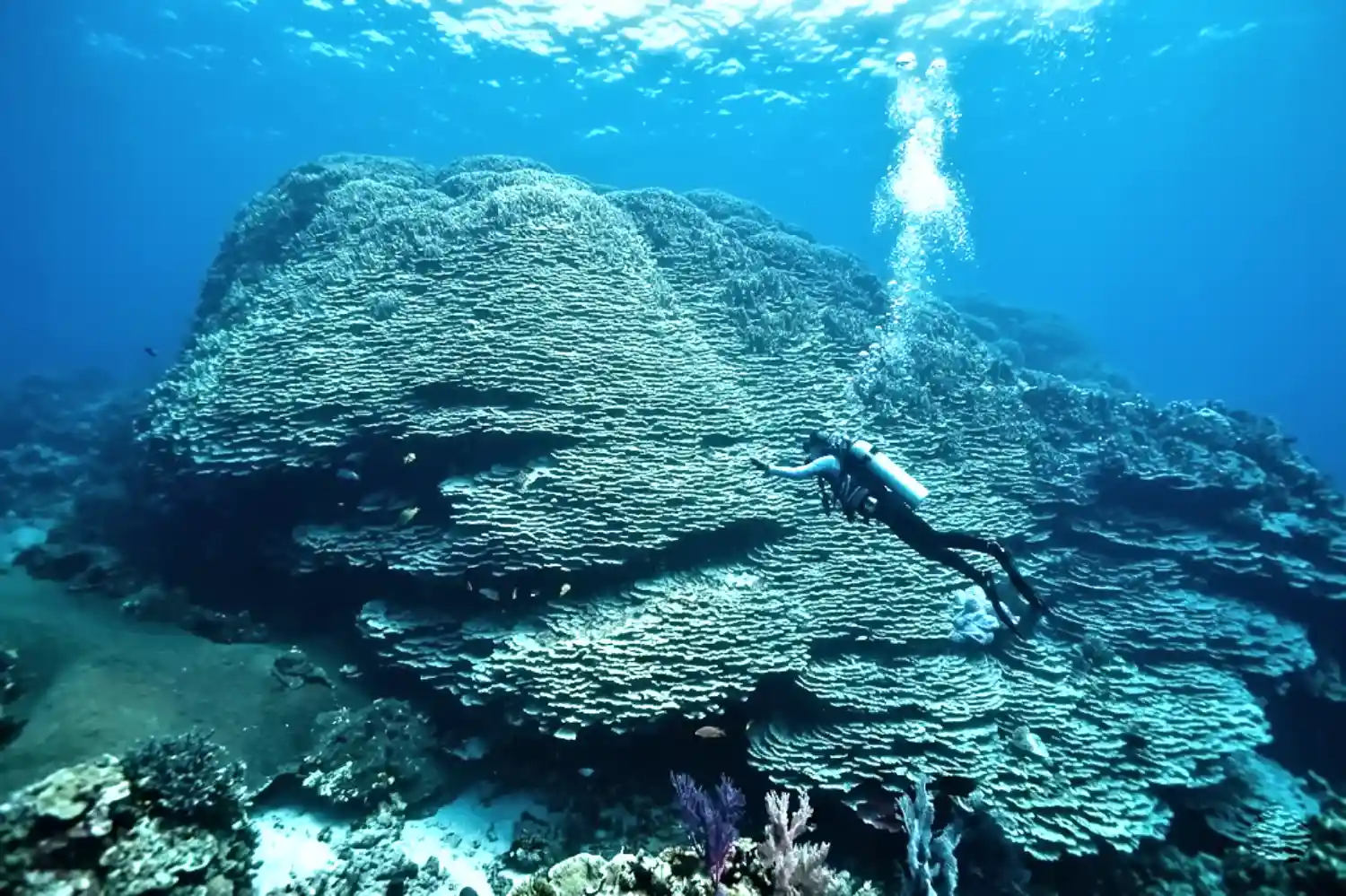
2,075 years of uninterrupted life beneath the waves of the western Pacific. That is the minimum estimated age of the coral colony recently mapped by the United States National Oceanic and Atmospheric Administration, NOAA. The organism belongs to the species Porites rus and covers a colossal 1,347 square meters, an extent that surpasses, in both size and longevity, almost every modern biological record for invertebrate animals known to science.
Found in the Maug Islands, in the Mariana archipelago, the marine giant resembles a submerged cathedral. It stretches 31 meters across at the top and reaches 62 meters at its base. The scale forces a change of perspective: this is not a cluster of neighbouring corals, but one single colonial organism that has been growing, polyp by polyp, for roughly twenty centuries.
The biology of longevity in the Mariana Islands
Unlike trees or other corals that display easily readable growth rings, Porites rus requires rigorous mathematical work to be dated. Researchers rely on the constant growth rate of the species, a value already verified in the field, and apply it to the measured dimensions in order to rebuild the timeline of the organism.
Because the colony expands by only 1 centimeter per year, the arithmetic leads to a striking conclusion. This coral began its development around the year 25 BC. It has therefore outlived the fall of empires, industrial revolutions and every transformation humans have imposed on the planet since then, without ever leaving the same patch of seafloor.
“The scale was so vast that dive safety restrictions ruled out a simple manual measurement,” says Thomas Oliver, chief scientist at NOAA. The team had to turn to advanced photogrammetry to process the real dimensions, stitching thousands of images into a three dimensional model able to reproduce every ridge and every hollow of the colony.
A natural laboratory of acidic water
The location of the supercoral defies the gloomiest forecasts about climate change and global warming. The organism lives inside a submerged volcanic caldera, a naturally hostile setting where the chemistry of the water departs sharply from what is considered normal for a tropical reef.
Underwater carbon dioxide vents bubble constantly through the area. The phenomenon creates zones of extreme ocean acidity and simulates, in real time, what scientists expect the oceans of the future to look like as pollution keeps building up.
What surprises researchers is that the giant coral shrugs off the chemical hostility unfolding only a few meters away. It thrives where other organisms would succumb to bleaching, acting as a bulwark of genetic resilience in a scenario that ought to be lethal.
The largest marine animal ever recorded
Although the public tends to associate the word animal with creatures that move, corals are colonial invertebrate animals. This particular colony is 3.4 times larger than the previous record, set in 2020, which makes it the largest marine animal ever recorded by science.
The sturdiness of Porites rus allows it to build complex three dimensional structures. Those formations shelter hundreds of other species and create a self sustaining ecosystem in miniature, with fish, invertebrates and algae that depend on the crevices of the colony to feed and reproduce.
Studies published in scientific journals reinforce the idea that massive colonies enjoy greater thermal stability. That factor helps explain why this individual survived multiple El Niño events and successive marine heatwaves that devastated reefs elsewhere on the planet.
Science hunts for the secret of longevity
Research institutions and international centers monitor these hope spots in the ocean. The central goal is to find out whether such resistance can be replicated in reef restoration projects, currently one of the most urgent bets in marine conservation.
The genome of these millennial corals may hold the key to the survival of reefs worldwide. The ability to keep growing under reduced pH points to an unprecedented evolutionary adaptation, something classical biology still cannot fully explain.
The measurement itself also illustrates how much ocean science has changed. A colony of this size would once have demanded weeks of manual survey work with tape measures and slates, and even then the numbers would have carried wide margins of error. Photogrammetry compresses that effort into a handful of dives and delivers a digital replica that can be revisited, remeasured and compared years later, turning a single expedition into a permanent baseline for anyone studying the site.
Unlike the declining reefs of the Caribbean or the Great Barrier Reef, the Maug giant continues its slow and steady expansion. In practice, it ignores the biodiversity crisis hitting other latitudes, a crisis that has already reduced far younger formations to rubble.
Conservation, bioeconomy and global impact
The finding strengthens the case for full protection of the Mariana Trench Marine National Monument. Protected areas ensure that the gene flow of these superorganisms remains intact and available for the future.
Scientists argue that corals like this one work as biological libraries. They store information about ocean chemistry across two millennia and serve as eyewitnesses to the history of the Earth, a living archive that no laboratory could ever rebuild from scratch.
Continuous monitoring now uses artificial intelligence to predict new growth areas. Preserving this particular site has become an absolute priority for the ecological security of the Pacific.
A future written in calcium carbonate
The survival of this organism proves that nature holds defense mechanisms not yet fully understood by classical biology. Science needs to hurry in order to decode them before new threats emerge.
The Maug coral is not only a monument to the past: it is also a guide for the future of marine conservation. It represents the victory of life over chemical and thermal adversity, and it stands as living proof that resilience is the greatest strength of the ocean. Neither time nor acidity has been able to stop this submerged colossus.
Reporting: Anne Silva / Amazonia Mag. Source: NOAA, the United States National Oceanic and Atmospheric Administration, and Revista Amazônia.

Editor, English Edition — Amazonia Mag
Anne Silva is the editor of Amazonia Mag, the English-language edition of Revista Amazônia. She curates, translates and adapts the outlet's science and environment coverage for an international audience, reporting on Amazon wildlife, flora, rivers, climate and research. Every story she edits is grounded in peer-reviewed studies, official data and on-the-ground reporting from the Revista Amazônia newsroom in Belém, Pará, Brazil. More by Anne Silva →