
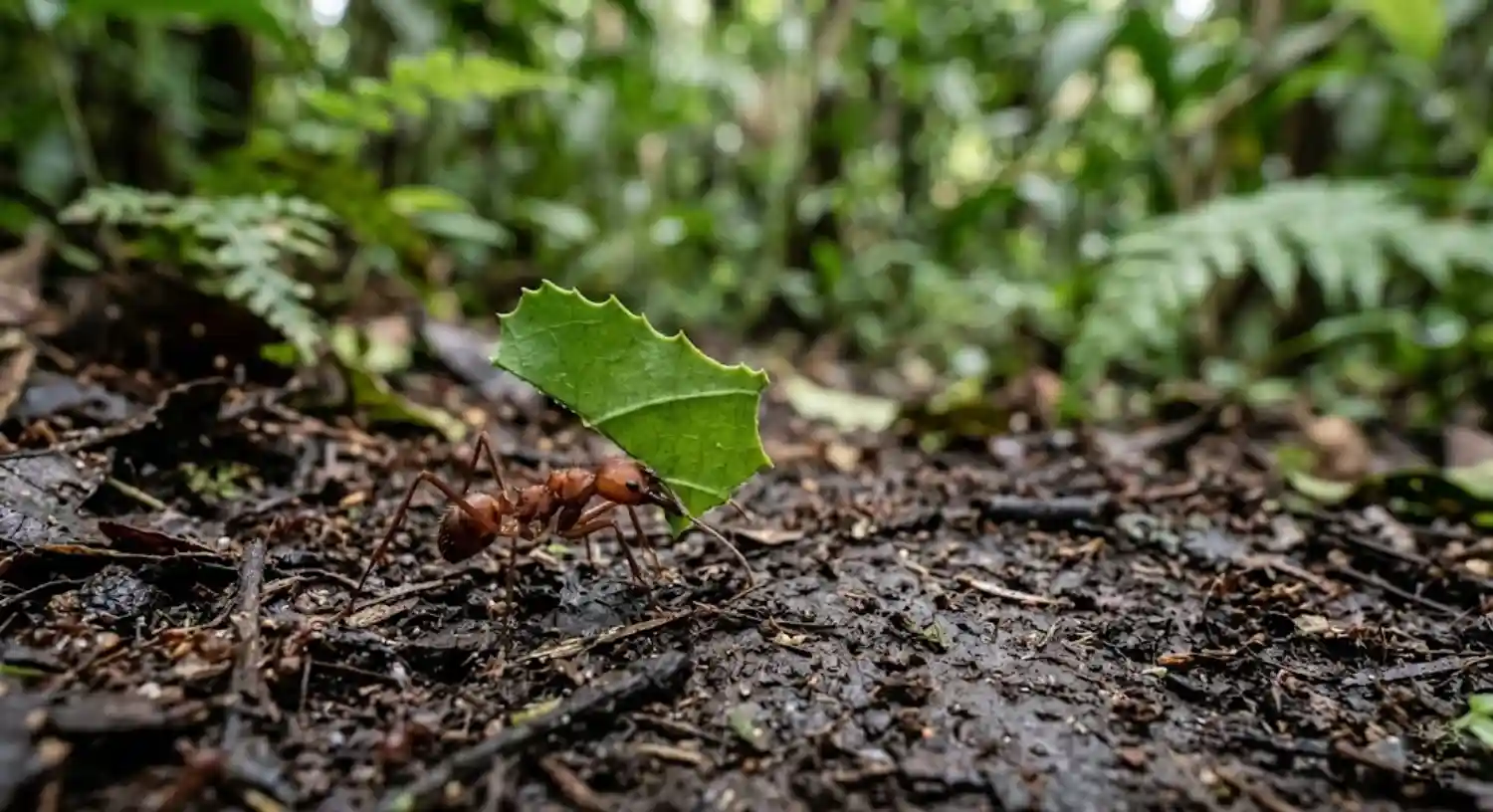
The leafcutter ant does not eat the leaves it trims so carefully in the canopy and in the understorey of the tropical forest. Contrary to popular belief, this industrious species, Atta colombica, uses plant biomass not as direct food but as a growing medium for its real and only meal: a specific fungus that science recognises as indispensable to the survival of the colony. That surprising biological fact reveals one of the most complex and most ancient mutualisms on the planet, a partnership in which ant and fungus became so evolutionarily dependent on each other that neither of them can thrive without the presence of the other.
The symbiotic fungus of the genus Leucoagaricus is grown in special chambers inside the nest, away from the light and under controlled conditions of temperature and humidity. Once the leaf fragments have been carried underground, other castes of ants take over the processing of the material: they chew the leaves into a moist paste that is mixed with their own faeces and with digestive enzymes. That compost is then laid down in the growing chambers, where it serves as the base for the spreading mycelium. The fungus, in turn, breaks down cellulose and other complex plant compounds that the ants cannot digest, and it produces nutrient rich structures that feed the entire colony.
The oldest agriculture on the planet
Leafcutter ants therefore work as genuine farmers, and they do so inside a highly specialised system that predates human agriculture by millions of years. The efficiency of that arrangement rests on strict quality control: the workers constantly monitor the health of the fungus garden. Studies indicate that when a given plant species contains substances that are toxic to the symbiont, the ants quickly detect the negative reaction and immediately stop harvesting that particular vegetation, which shows a remarkable capacity for learning and for collective response.
Such a sophisticated interaction demands a complex social organisation, and the colony operates as a superorganism. Inside the nest, the caste system is strictly defined by the size and by the function of each ant. Nothing is left to chance: every group of workers occupies a precise position in a production line that begins in the crown of a tree and ends in a lightless underground chamber.
A superorganism with defined trades
The gardeners, the smallest ants in the colony, tend the fungus with great delicacy, cleaning it and removing parasites or contaminants with their tiny mandibles. They also shred the plant material brought in by the cutters even further, preparing it for incorporation into the garden. Without that constant and specialised care, the fungus cultivated by the leafcutter ants would quickly be overrun by competing fungal species and by opportunistic bacteria.
Medium sized workers handle the cutting and the transport of the leaves, a task that demands strength and coordination. They form long foraging trails that often stretch for dozens of metres from the main entrance of the nest, and they carry fragments that can weigh several times their own body weight. Coordination and communication between these ants are essential to the efficiency of the harvest: they follow pheromone trails that guide their nestmates to the most suitable sources of vegetation.
To defend that complex food production system against predators and invaders, the colony relies on the soldier caste, the largest and most aggressive ants of the nest. Equipped with powerful mandibles and with robust head musculature, they patrol the foraging trails and the nest entrances, ready to confront any threat, from spiders and other insects to small vertebrates. That highly specialised division of labour secures the integrity and the continuity of the farming process, which is fundamental to the stability of the superorganism.
A fungus that can no longer live alone
Science recognises that the relationship between the leafcutter ant and the Leucoagaricus fungus is so intimate that the symbiont has lost the ability to produce sexual spores and now depends exclusively on the ants for its propagation. When a new queen leaves to found another nest, she carries a small portion of the fungal mycelium in her mouth cavity, which guarantees that the emerging colony will have the fungus garden it needs in order to survive. That process of vertical transfer keeps the ancient partnership going in every new generation of leafcutter ants.
The detail matters: the fungus stopped being an autonomous organism and became a crop, dependent on the workforce that sows it, cleans it and protects it. The ant, for its part, lost the ability to feed on anything else. Two very different lineages ended up bound to a single fate, and the boundary between the farmer and the harvest became almost impossible to draw.
Soil engineering in the rainforest
The ecological impact of that agricultural practice is significant for tropical ecosystems. By harvesting large quantities of vegetation, leafcutter ants act as major herbivores and influence the structure and the composition of plant communities. In addition, the deposition of organic matter and of nutrients inside the nests, together with the excavation of tunnels and chambers, contributes to the aeration and to the fertilisation of the soil, drives nutrient cycling and benefits the growth of other plants.
The activity of these ants therefore reaches far beyond the cultivation of the fungus. Studies indicate that the excavation of their extensive nests, which can cover dozens of square metres, improves the aeration and the drainage of the soil. The transport and the deposition of decomposing plant material in the deep chambers of the nest enrich the ground with nutrients and fertilise it in a natural way. The action of that superorganism is, in that sense, a key factor in the dynamics and in the health of the Amazon rainforest.
Seen from above, a foraging trail looks like a thin green river moving across the leaf litter. Seen from below, it is the supply line of a farm that never closes, one that has been refined by natural selection for far longer than any human field has existed. The scale is modest and the machinery is microscopic, yet the logic is unmistakably agricultural: plant a crop, feed it, weed it, defend it and pass the seed on to the next generation.
Understanding the complexity of the interaction between leafcutter ants and their exclusive fungus offers a glimpse of how sophisticated the evolutionary solutions that shape tropical biodiversity can be. The study of that consolidated mutualistic relationship reinforces the importance of preserving every component of an ecosystem, because even the smallest and apparently simplest interactions can play fundamental roles in maintaining the balance and the resilience of the forest. Cooperation and interdependence prove to be survival strategies as powerful as competition.
This extraordinary partnership invites reflection on the intricate web of life, where the survival of a superorganism ultimately depends on the careful cultivation and on the vigilant protection of a microscopic companion.
Reporting: Anne Silva / Amazonia Mag. Source: Revista Amazônia.

Editor, English Edition — Amazonia Mag
Anne Silva is the editor of Amazonia Mag, the English-language edition of Revista Amazônia. She curates, translates and adapts the outlet's science and environment coverage for an international audience, reporting on Amazon wildlife, flora, rivers, climate and research. Every story she edits is grounded in peer-reviewed studies, official data and on-the-ground reporting from the Revista Amazônia newsroom in Belém, Pará, Brazil. More by Anne Silva →