
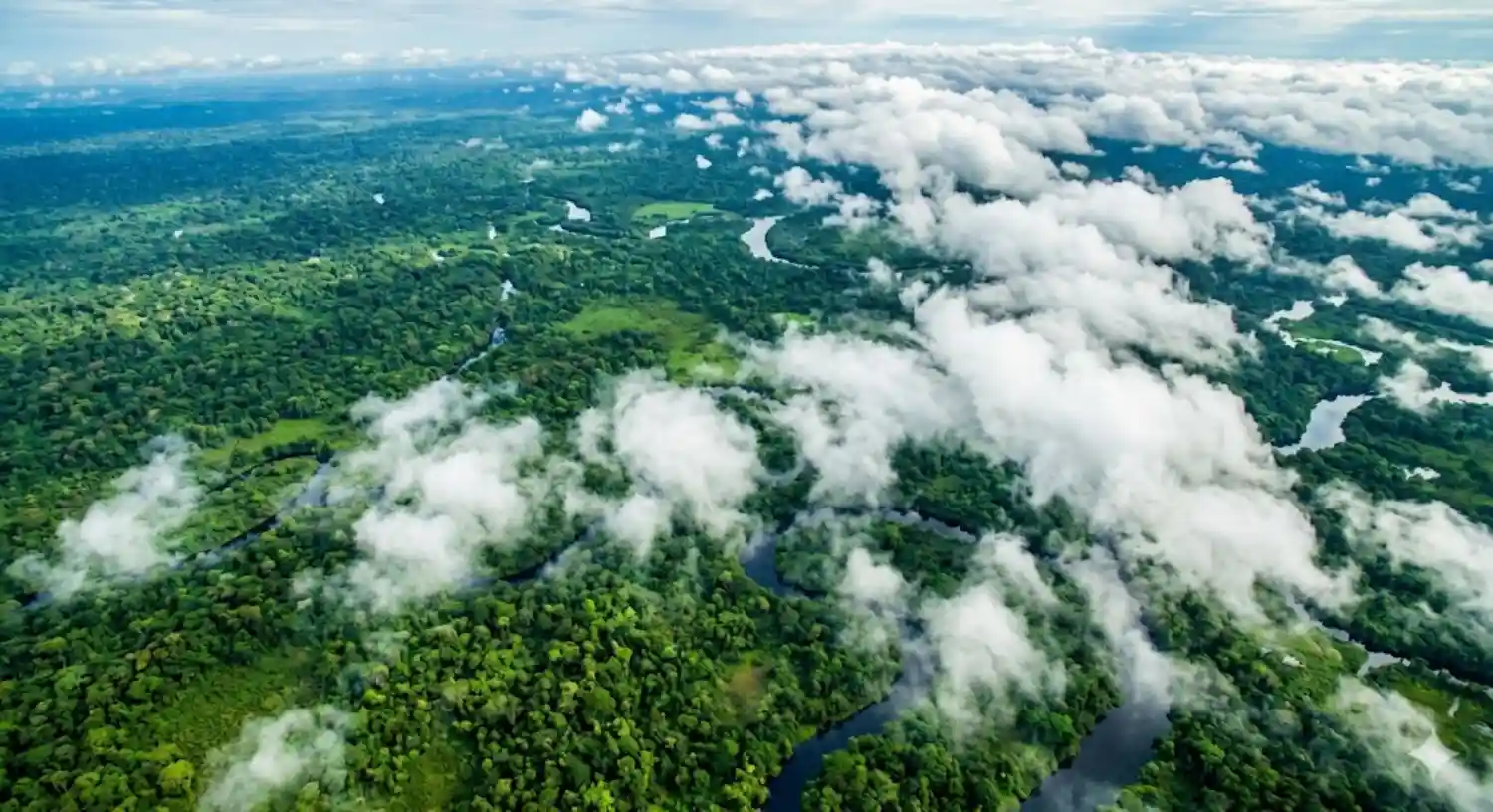
The Amazon rainforest is more than a storehouse of biodiversity. It is also the engine of one of the planet’s largest water-transport systems, powered by billions of trees whose deep roots draw water from the soil and send it into the atmosphere through a continuous biological process that cannot be seen with the naked eye.
Studies indicate that a single large tree, with a canopy 20 meters in diameter, or about 66 feet, can pump more than 1,000 liters of water into the air each day, or about 264 gallons, in the form of vapor. Multiplied across the hundreds of billions of trees that make up the biome, this immense volume of moisture forms what science recognizes as Amazon flying rivers, currents of humid air whose volume exceeds the combined flow of all the rivers on Earth.
A living pump above the forest
The biotic pumping mechanism begins when solar energy reaches the rainforest canopy. As the leaves warm, plant transpiration is stimulated, allowing water taken up by the roots to return to the environment as vapor.
Water vapor is lighter than dry air, so it rises. As it moves upward, it creates a zone of low atmospheric pressure over the forest. This low-pressure area draws moist air loaded with evaporation from the Atlantic Ocean toward the interior of the continent.
A constant movement of moisture is therefore established, first from the ocean to the forest and then from the forest to the atmosphere. According to the studies cited in the scientific explanation of the phenomenon, this cycle of forest transpiration and rainfall is essential to maintaining the Amazon itself and irrigating the entire ecosystem.
Without this plant-powered pumping, the region could become a desert. The idea shows that the forest is not a passive landscape responding only to climate. It is a biological structure that helps create the atmospheric conditions required for its own persistence.
Moisture redirected by the Andes
After rising into the atmosphere, the water vapor forms dense clouds. These masses of moist air, however, do not necessarily produce rain immediately. The trade winds push them westward, carrying them deeper into the continent.
The flow eventually meets the imposing natural barrier of the Andes. Because the flying rivers cannot cross the mountain range, they are diverted southward and southeastward. In this way, moisture produced or renewed by the rainforest reaches areas hundreds or thousands of miles from the trees that helped send it into the air.
This phenomenon is crucial to the climate of South America. These currents of humid air are largely responsible for bringing the rainfall that supports farming and water supplies in Brazil’s Center-West, Southeast and South regions, as well as in parts of Paraguay, Argentina and Uruguay.
The water and food security of these densely populated areas depends directly on this Amazonian flow. The relationship between the rainforest and the regions that receive its rainfall is not a distant environmental connection. It reaches agriculture, water availability, energy production and the daily life of cities.
Forest particles that help make rain
The forest therefore acts as a biotic pump. The biotic pump theory, proposed by Russian scientists, suggests that dense natural forests such as the Amazon are major drivers of atmospheric circulation on continental scales.
Intense tree transpiration creates areas of low atmospheric pressure that attract moist ocean air inland. According to the theory, this mechanism helps ensure regular rainfall over the forest and neighboring regions, while emphasizing the vital importance of maintaining vegetation cover for climate stability.
The Amazonian pump releases more than moisture. It also produces biogenic particles, including pollen, fungal spores and volatile organic compounds. These particles serve as condensation nuclei around which raindrops can form.
Without these nuclei, water vapor would not condense efficiently enough to form clouds and precipitation. The health of the forest, including its physical integrity and biodiversity, is therefore inseparable from the efficiency of the water cycle.
Removing native vegetation weakens the force of this pump. When transpiration declines, the amount of water transported toward other regions also decreases, weakening the system that links the ocean, the rainforest, the atmosphere and the lands to the south.
The rainforest as water infrastructure
Understanding this phenomenon has changed the way science and society view the Amazon. The rainforest is no longer seen only as a vast green area that should be protected for ethical reasons or because of its biodiversity. It is also recognized as a vital part of South America’s water and economic infrastructure.
A standing forest is a guarantee of rainfall for agribusiness, hydroelectric power generation and urban water supplies thousands of miles away. The connection between a tree in the rainforest and a faucet in a city is direct and scientifically proven.
Protecting the Amazon means protecting the rainfall regime that sustains the continent. Maintaining this water system is a powerful example of how biological processes on a large scale shape the physical environment and establish conditions that support life and production.
The Amazon rainforest does not merely respond to climate. It creates climate as well. Recognizing and valuing this ecological function is essential for strategic sustainable-development planning in Brazil, because the future of farming and the well-being of the Brazilian population are closely tied to the Amazon’s ability to keep pumping its invisible rivers into the atmosphere.
From this perspective, the region’s greatest wealth is not only what can be extracted from the soil. It is also what the trees release into the sky every day, in a silent movement that connects the forest with rainfall, rivers, crops, dams and cities.
When clouds gather overhead, they can be understood as more than a promise of rain. They are also the vital breath of a forest that, even from far away, helps keep much of the continent alive.
Reporting: Anne Silva / Amazonia Mag

Editor, English Edition — Amazonia Mag
Anne Silva is the editor of Amazonia Mag, the English-language edition of Revista Amazônia. She curates, translates and adapts the outlet's science and environment coverage for an international audience, reporting on Amazon wildlife, flora, rivers, climate and research. Every story she edits is grounded in peer-reviewed studies, official data and on-the-ground reporting from the Revista Amazônia newsroom in Belém, Pará, Brazil. More by Anne Silva →