
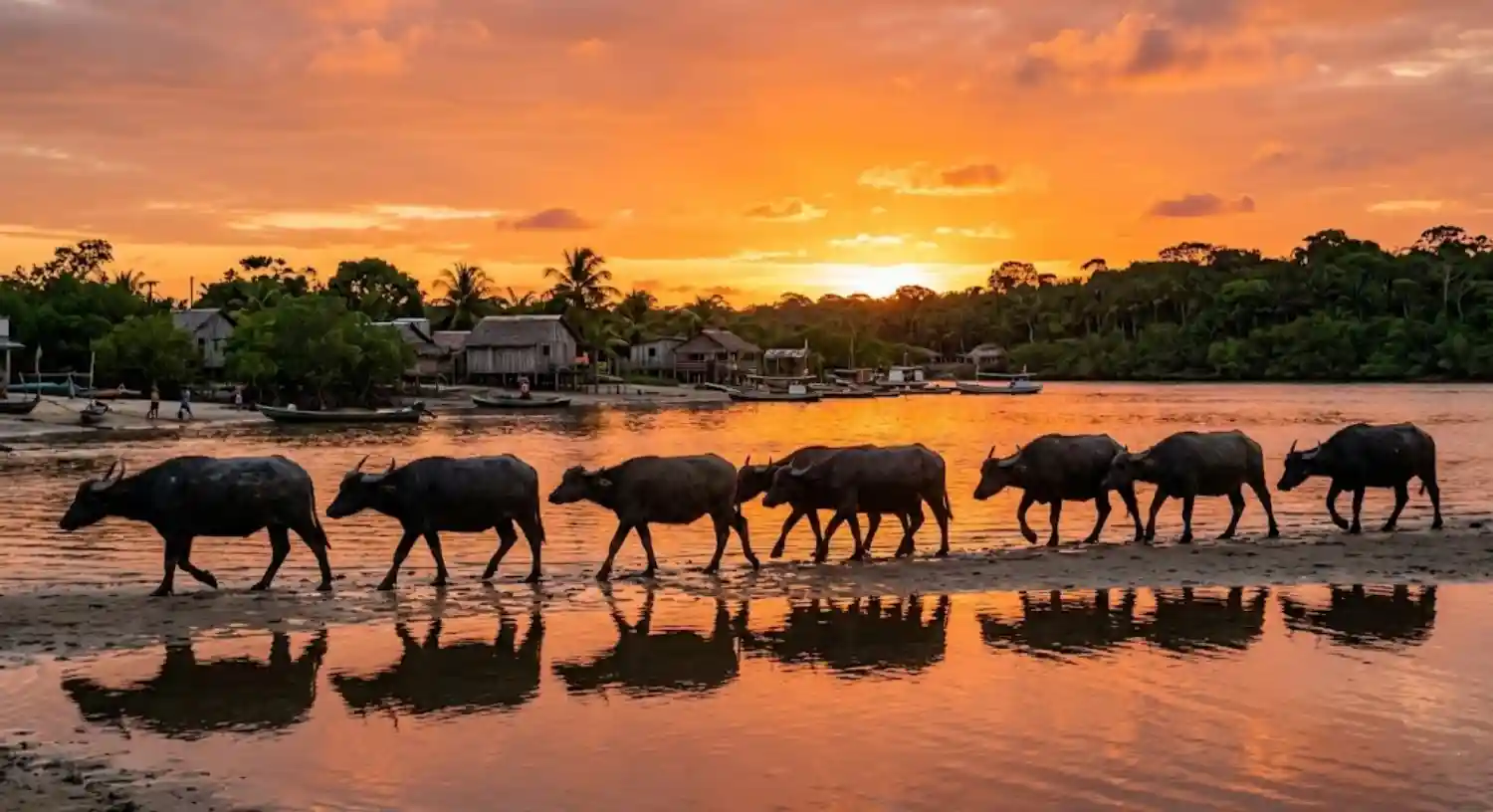
Imagine an island so vast that its surface area exceeds that of entire countries, including Switzerland or Belgium, set at the mouth of the planet’s most voluminous river, the Amazon. Now picture taxis, police patrols and even freight transport being handled, in many cases, by half-ton water buffaloes that calmly walk through city streets.
This is not a scene from magical realism. It is part of everyday life in the Marajó Archipelago, in the Brazilian state of Pará. Marajó is the world’s largest fluvio-marine archipelago, a place where the tides of the Atlantic Ocean meet the force of the Amazon’s freshwater, creating ecosystems and landscapes found nowhere else on Earth.
The clearest symbol of that uniqueness is the water buffalo, Bubalus bubalis. The animal is tied to transportation, food, tourism and local identity, making it one of the defining images of Marajó.
Water buffaloes as part of city life
The story of how the buffaloes arrived is surrounded by local legends. The best-known account says that a ship traveling from Asia to French Guiana sank in the 19th century. The surviving buffaloes supposedly swam to the island, where they found an ideal habitat in its broad flooded fields.
According to local tradition, that journey explains the beginning of a population that adapted remarkably well to Marajó’s landscape. Whatever their exact origin, the result is unmistakable. Estimates put the island’s buffalo population at more than 600,000 head, a number greater than Marajó’s human population.
In major towns such as Soure and Salvaterra, visitors can encounter the animals along the waterfront, on beaches and even in front of city hall. They are not confined to farms or distant rural areas. Buffaloes move through the same spaces as residents and have become part of the visual identity of the towns.
They also serve practical purposes. In Soure, the buffalo-mounted police are an attraction in their own right, showing how docile and intelligent these animals can be while moving through difficult terrain where horses and vehicles would have trouble.
The animals’ presence reflects an unusual form of cultural and economic adaptation. A buffalo can carry people, help move loads and cross flooded ground, while also representing the island in tourism images seen far beyond Marajó.
Riding buffaloes and tasting Marajó
For visitors wondering what to do on Marajó Island, riding a buffalo is one of the signature experiences. The pace is slow and contemplative, allowing travelers to explore farms and flooded fields while the animal displays its strength in places where other forms of transport would struggle.
The relationship between people and buffaloes goes well beyond transportation and tourism. It is also central to Marajoara cuisine, where buffalo meat and milk have become defining ingredients in dishes and traditional products.
Filé Marajoara is a famous preparation made with a cut of sun-dried buffalo meat topped with melted buffalo cheese. It combines meat that is lighter and more delicate than many people might expect with the creamy texture of a local dairy product.
Authentic Queijo do Marajó, made by hand with buffalo milk, is a protected and valued specialty. Its production reaches back to old traditions and gives the cheese a mild flavor and unmistakable texture.
Tasting these foods is an essential part of a trip through the island. The buffalo therefore connects several parts of Marajó at once: the roads and streets, the flooded countryside, the farms, the restaurants and the cultural image presented to visitors.
Flooded fields and wildlife shaped by water
Marajó’s geography can be divided into two major ecosystems. The eastern portion, facing the Atlantic, is characterized by broad plains and flooded fields known as the Marajó fields.
During the rainy season, known as the Amazonian winter, these fields become submerged. In summer, they dry out partially and attract an impressive variety of migratory birds, including scarlet ibises, herons and spoonbills.
The western portion of the island is dominated by dense forest and the rivers that form the estuary. This contrast creates a mosaic of wildlife and ecotourism opportunities, from boat trips through igapó forests to forest trails and wildlife watching.
Monkeys, sloths and caimans can be seen in their natural habitat. Together, the two sides of Marajó show how a single island can contain open plains that disappear under water and forests crossed by rivers.
Beaches between the Amazon and the Atlantic
The beaches of Marajó are another irreplaceable attraction. They are not ordinary beaches because both the Amazon River and the Atlantic Ocean influence their water, shoreline and daily appearance.
At low tide, the Amazon’s force pushes back the saltwater, turning the beaches into stretches of freshwater. The waves are gentle and the sand is extremely fine and dark. At high tide, saltwater moves inland and the water becomes brackish.
Pesqueiro Beach, in Soure, is a perfect example of this process. Freshwater dominates for much of the year, while the beach extends for miles beside dunes and native vegetation.
Joanes Beach, in Salvaterra, offers a similar setting. Historical ruins from the Jesuit period add a mysterious element to the landscape, where water, sand and vegetation are constantly defined by the tides.
Swimming in these beaches, with the Amazon’s warm water and the Atlantic’s seemingly endless horizon, is a unique and relaxing experience. The meeting of river and ocean is not an abstract geographical detail. It is something visitors can feel in the water and see in the changing character of the shore.
Pottery preserving an ancient memory
Marajó’s richness is also reflected in its ancestral culture. Marajoara pottery is considered one of the most elaborate pre-Columbian artistic expressions in Brazil and the Americas.
It was produced by peoples who lived on the island between 400 and 1350 CE. The pieces are known for complex geometric patterns, raised designs and painting techniques that portray daily life, mythology and the rituals of those ancient populations.
Famous objects include funerary urns and ceramic loincloths. Their details demonstrate a surprising level of technical and artistic sophistication for the period, while also presenting symbols linked to Amazonian wildlife and mythology.
Local artisans in Soure continue this tradition today. They reproduce ancient techniques and styles, offer replicas to visitors and help keep alive a cultural heritage that has become one of the region’s main foundations for cultural tourism and is protected as intangible heritage.
The Marajó Museum, in Cachoeira do Arari, is an important place to explore this history. Its original pieces reveal the island’s past and help visitors understand a culture that took shape long before European arrival.
Marajó is therefore much more than an ordinary tourist destination. It is a place where natural forces meet human adaptation, ancestral memory and the slow, steady movement of great buffaloes. According to local tradition and the cultural history preserved by museums and communities, each landscape tells part of the relationship between people, animals and water.
Looking toward the broad horizon of Marajó’s beaches, where the Amazon and the Atlantic meet, it is possible to imagine a different pace of time, one set by tides and by the measured steps of buffaloes. Preserving the island’s flooded fields, forests, beaches, wildlife and pottery means protecting a singular heritage, where everyday reality can still appear magical.
Reporting: Anne Silva / Amazonia Mag

Editor, English Edition — Amazonia Mag
Anne Silva is the editor of Amazonia Mag, the English-language edition of Revista Amazônia. She curates, translates and adapts the outlet's science and environment coverage for an international audience, reporting on Amazon wildlife, flora, rivers, climate and research. Every story she edits is grounded in peer-reviewed studies, official data and on-the-ground reporting from the Revista Amazônia newsroom in Belém, Pará, Brazil. More by Anne Silva →