
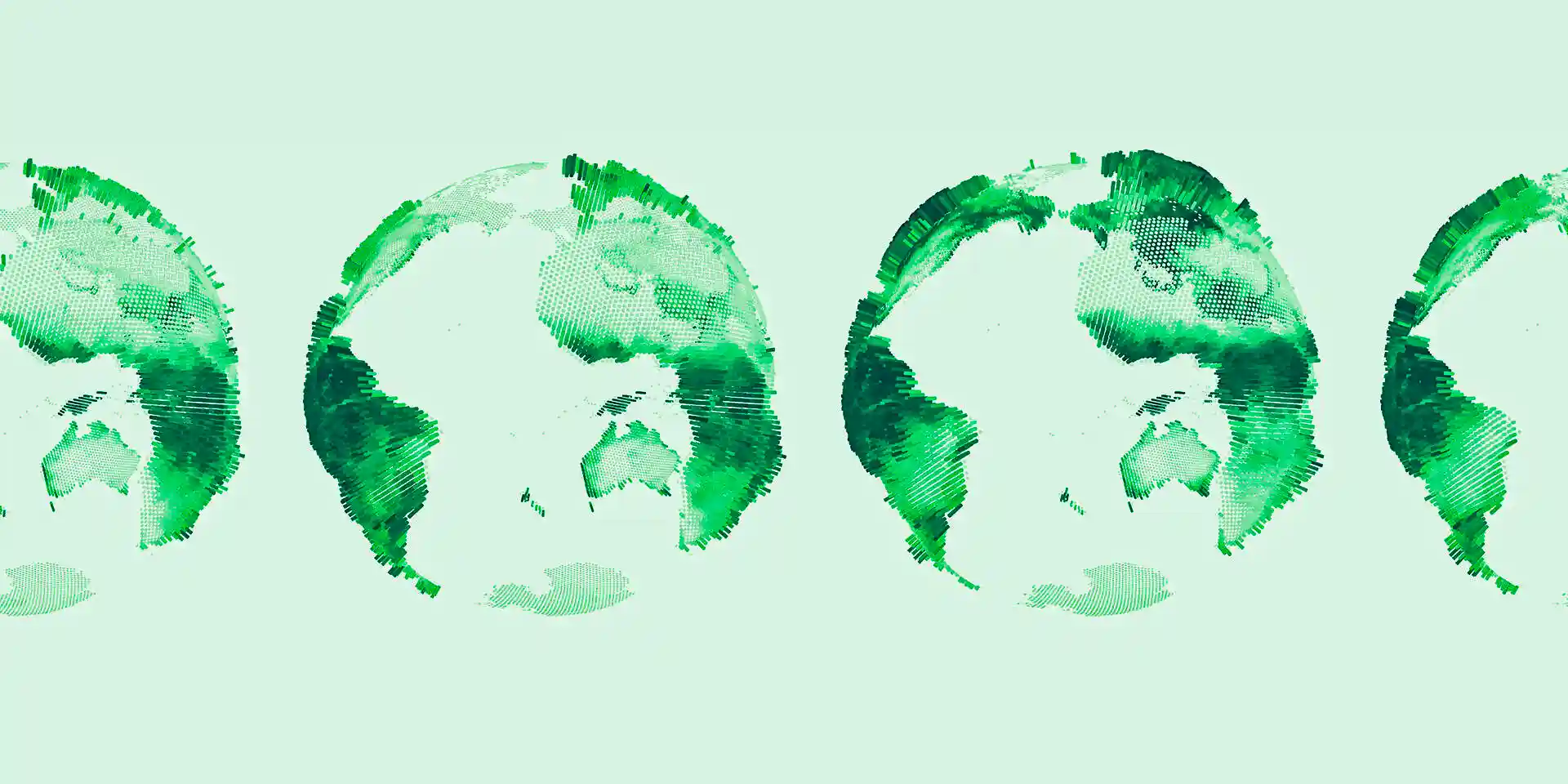
Every year, the vegetation of the Earth breathes in a rhythm that can be seen from space. Forests in the Northern Hemisphere leaf out while those in the south fade, and months later the movement reverses. Scientists call this planetary pulse the “green wave.” It shapes the life cycles of organisms, biogeochemical cycles and climate feedbacks. Until now, however, there was no intuitive metric to track its dynamics.
A team of scientists led by the German Centre for Integrative Biodiversity Research (iDiv), the Helmholtz Centre for Environmental Research (UFZ) and Leipzig University has now proposed one. And with it, the researchers found something they were not expecting: the green wave is on the move, and it is heading in a clear direction, toward the northeast.
A globe, some weights and a bucket of still water
The core idea behind the method is surprisingly simple. The researchers developed a new way to monitor the degree of greenness on Earth, a fundamental indicator of the health and activity of vegetation, by calculating its center of mass.
Lead author Prof. Miguel Mahecha, a researcher at Leipzig University, at the Helmholtz Centre for Environmental Research (UFZ) and a member of iDiv, explains it with a household image.
“Imagine holding a perfectly round globe in your hands and attaching small weights to it, each one representing the green leaves at every point on the surface of the Earth,” he says. “If you then carefully place this globe in calm water, the center of mass will always point downward.”
That imaginary point, the center of mass of all the vegetation on the planet, is what the team learned to calculate and follow through time. Its path is called the green wave centroid trajectory, and it behaves like a needle that registers the condition and activity of global plant cover.
Between Iceland and Liberia
Using satellite observations and model data, the researchers tracked how this “green center” shifts over time. In sync with the seasons, green vegetation moves like a wave from north to south and back again every year.
By tracking the center of that wave, its direction and its speed, the team discovered that it swings between two extremes. It reaches its northernmost position in mid-July, in the North Atlantic, near Iceland. Its southernmost position falls in March, off the coast of Liberia.
The study, published in the Proceedings of the National Academy of Sciences (PNAS), sheds new light on global-scale greening and its acceleration, a lesser-known aspect of global climate change that refers to the overall increase in vegetation density around the world.
A drift nobody predicted
Analyzing changes in the green wave across several decades, the researchers detected a consistent northward shift in every season of the year. Then came the surprise: contrary to their expectations, they did not observe a southward shift during the Southern Hemisphere summer.
“This was a big surprise for us,” Mahecha says. “Longer growing seasons and milder winters in the Northern Hemisphere, which allow vegetation to stay a little greener for longer, may be driving the overall shift toward increased vegetation on Earth throughout the year. However, this is a hypothesis we need to explore further.”
Beyond the northward movement, the team also identified a sharp eastward shift. According to the researchers, that pattern is probably linked to areas of intense green activity in eastern regions such as India, China and Russia.
The pace of the change is not uniform across the calendar either. The fastest shifts occur during Southern Hemisphere summers. In the tropics, by contrast, the intensity of the green color of vegetation varies very little: evergreen rainforests stay green almost constantly, all year round.
Human fingerprints on photosynthesis
Just as with climate change and biodiversity change, global-scale greening is driven mainly by human activities. Two mechanisms work at the same time.
The first is chemical. Rising atmospheric CO2 acts as a fertilizer, intensifying photosynthesis. The second is thermal. Higher temperatures lengthen growing seasons in many regions, handing plants more active days each year.
Phenology, the study of recurring seasonal patterns in the development of plant organs, is crucial for monitoring the impacts of climate change on ecosystems. The new method leans on that tradition and lifts it to a planetary scale.
Miles per decade, not abstract indices
The practical value of the proposal lies in its unit of measurement. The centroid trajectory expresses planetary change caused by land use and by climate change in miles (kilometers) across decades. It is no longer a matter of abstract indices, but of distance traveled.
To build it, the team used the Normalized Difference Vegetation Index (kNDVI) derived from data from the Moderate Resolution Imaging Spectroradiometer (MODIS), along with the GIMMS LAI4g leaf area index series covering 1982 to 2020. From those inputs the researchers computed a three-dimensional trajectory of the centroid of green surfaces in a Cartesian coordinate system, which is then projected onto the surface of the Earth.
They even coined new terms for the key moments of that annual circuit, by analogy with solstices and equinoxes: the viridistices mark the extreme positions of the green center, and the equiviridis mark the crossings between hemispheres. A circular representation of the annual viridistice and equiviridis illustrates a clear seasonal asymmetry.
A tool for a planet reorganizing itself
Monitoring seasonal greening on Earth and precisely measuring the speed and direction of that change connects multiple facets of global transformation, including climate-biosphere interactions, land use change, fire dynamics, droughts and animal migration.
The approach therefore offers a foundation for monitoring the dynamics of the biosphere and its interaction with Earth system dynamics and human activity. In other words, a powerful tool for understanding how the living surface of our planet is reorganizing itself in a warming world.
The green wave is still there, rising and falling each year the way it always has. It simply no longer returns to exactly the same place.
Sources: iDiv, Helmholtz Centre for Environmental Research (UFZ), Leipzig University and PNAS.
Reporting: Anne Silva / Amazonia Mag
This article is the English edition of reporting originally published by Revista Amazônia. Images: Revista Amazônia archive.

Editor · Amazonia Mag
Anne Silva is the editor of Amazonia Mag, the English-language edition of Revista Amazônia. She curates, translates and adapts the outlet's science and environment coverage for an international audience, reporting on Amazon wildlife, flora, rivers, climate and research. Every story she edits is grounded in peer-reviewed studies, official data and on-the-ground reporting from the Revista Amazônia newsroom in Belém, Pará, Brazil. More by Anne Silva →