
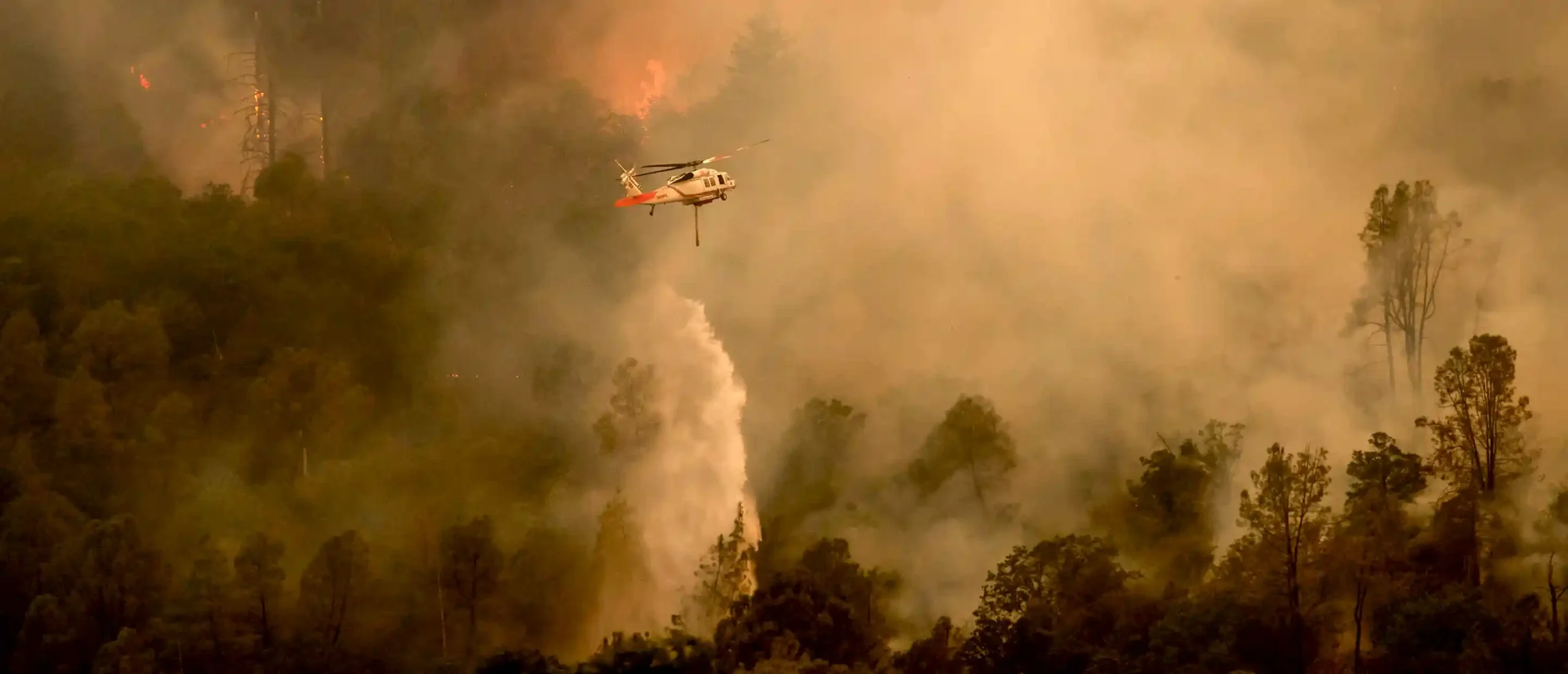
The worst fire days on Earth are no longer arriving one country at a time. New research shows that the hot, dry and often windy conditions that turn a spark into a megafire are increasingly striking many regions of the world on the very same day, and that overlap is quietly dismantling one of the few defenses humanity has: the ability to lend firefighters, aircraft and equipment across borders.
Scientists at UC Merced and the University of East Anglia found that this synchronized extreme fire weather has increased considerably worldwide since 1979, spreading across whole regions rather than flaring in isolated spots. The findings were published in the journal Science Advances.
When these widespread high-risk days occur, the researchers report, there is also more fire activity and worse air quality across multiple regions at once, not merely in the place where the flames are burning.
In many areas, the number of high-risk days occurring simultaneously has more than doubled. Extreme weather raises the danger by making vegetation more susceptible to ignition and by helping flames spread once they take hold.
“This ultimately makes wildfires harder to fight at the moments when they pose the greatest threat,” said Matthew Jones of the Tyndall Centre for Climate Change Research at UEA. “Addressing these challenges requires coordinated international efforts, including the implementation of early warning systems, improved wildfire management strategies and clear communication between agencies.”
The team examined patterns and trends in synchronous fire weather both within regions and between them, and explored the links to climate variability and air quality. They observed a climatological increase in intraregional synchronous fire weather in boreal regions, as well as interregional synchrony between northern temperate and boreal regions. Significant increases occurred between 1979 and 2024, with a more than twofold rise seen in most regions.
More than half of the observed increase, the team estimates, is attributable to human-caused climate change. Natural modes of climate variability can amplify the effect sharply in specific places. Equatorial Asia, for example, experiences 43 additional days of intraregional synchronous fire weather during El Nino years.
Synchronous fire weather is also strongly correlated with regional concentrations of PM2.5 from fires across multiple parts of the world. In Europe, during the 25 percent of years with the highest number of fire weather days, population exposure to smoke pollution is nearly 200 percent higher than in other years.
Previous studies had mostly examined the simultaneous occurrence of fire-friendly weather in a handful of places, such as the western United States, Europe or Australia. This study is the first to measure and visualize the phenomenon globally, and to distinguish two distinct types: synchrony within a single region, where many locations in the same region face extreme fire weather on the same day, and synchrony between regions, where two or more regions face it on the same day.
“Currently, regions such as Europe and Southeast Asia, and fire-prone countries such as the United States, Canada and Australia, have established bilateral and multilateral firefighting cooperation systems, which have been effective in managing recent large wildfires,” said Cong Yin, a postdoctoral researcher at UC Merced and the Chinese Academy of Sciences. “However, when extreme fire-conducive weather occurs in many places at the same time, it increases the likelihood of widespread outbreaks and overwhelms firefighting capacity, because crews, aircraft and equipment cannot be easily shared when everyone needs help at once.”
“A key conclusion is that the growing overlap of fire risk seasons can shrink the window in which countries or regions can effectively support one another,” said Yin, who is affiliated with UC Merced’s Sierra Nevada Research Institute. “For example, the United States and South Africa record, on average, four consecutive days of extreme wildfire weather per year, increasing by 1.2 days per decade.”
The researchers identified hotspots where pressure on resource-sharing networks is set to grow fastest. In Portugal and Spain, the number of days with extreme fire-conducive weather on the same day has risen by more than 12 per year since 1979.
The stakes are not hypothetical. During Canada’s 2023 wildfire season, firefighters from South Africa and other countries around the world helped battle hundreds of devastating fires that destroyed homes and land. That kind of mutual aid depends on the lender’s own fire season being quiet.
North America, Europe, boreal Asia, the Middle East and South America show the highest levels of interregional overlap, facing extreme fire weather on the same day as at least one other region for more than 30 days a year on average. In low- to mid-latitude regions, including South America, Central and East Asia, Africa and the contiguous United States, the average annual number of such days between 2001 and 2024 was three to seven times higher than during the 1979 to 2000 period.
South America’s fire season, concentrated in Brazil, accounts for 72 percent of burned area between August and October, with September the peak month. Intensified drought periods extend the risk, as in the Cerrado from June to September and in the Amazon early in the year. Critical years such as 2024 registered record numbers of hotspots. The Amazon’s risk season has lengthened, with significant fires recorded as early as the first half of the year because of prolonged droughts, including those tied to the 2023 to 2024 El Nino. Fire seasons, the study notes, are becoming longer, more intense and increasingly overlapping across regions, driven by climate change.
The team, which also included researchers from the University of Washington and Boise State University, used global weather data to calculate daily Fire Weather Index values worldwide from 1979 to 2024, then identified when days of extreme fire risk occurred simultaneously across large regions or across multiple regions. They examined how human-caused climate change and natural climate patterns such as El Nino influenced those events, and compared the results with actual burned area and smoke pollution to assess real-world impacts.
Their intraregional metric is precise: a qualifying day is one in which the Fire Weather Index exceeds its historical 90th percentile across at least 30 percent of the burnable native vegetation within a given global fire region.
Projections for Europe point the same direction. Under CMIP6 multi-model simulations, more than 50 percent of Europe is expected to see at least a twofold increase in the probability of extreme fire events, accompanied by a minimum fire season extension of five days by the end of the century.
Societies can both adapt to and resist the rising fire risks that come with a warming climate, and regional policies certainly matter for preventing wildfires or reducing their severity. But Jones is blunt about the limits of local action.
“In the end, though, we will be fighting against the rising tide of fire risk as the world warms further,” he said. “Redoubling efforts to cut greenhouse gas emissions and limit warming to less than 3.6 degrees Fahrenheit (2 degrees Celsius) is the single most effective measure we can take to avoid the worst wildfire risks on a global scale.”
Jones added that the consequences reach far beyond the burn scar itself: “Wildfires can have extremely damaging impacts on society, the economy, human health and livelihoods, biodiversity and carbon storage. These impacts are generally amplified in the case of forest fires.”
The research was funded by the National Science Foundation, the US Department of the Interior’s Joint Fire Science Program and a public grant through the UK’s Natural Environment Research Council.
The authors argue that the findings provide a scientific basis for understanding simultaneous extreme fire weather and for preparing for an increasingly fire-prone future. Meeting that future, they write, demands coordinated international efforts: early warning systems, improved wildfire management strategies, and targeted interventions to reduce population exposure to wildfire smoke in vulnerable regions.
Reporting: Anne Silva / Amazonia Mag
This article is the English edition of reporting originally published by Revista Amazônia. Images: Revista Amazônia archive.

Editor · Amazonia Mag
Anne Silva is the editor of Amazonia Mag, the English-language edition of Revista Amazônia. She curates, translates and adapts the outlet's science and environment coverage for an international audience, reporting on Amazon wildlife, flora, rivers, climate and research. Every story she edits is grounded in peer-reviewed studies, official data and on-the-ground reporting from the Revista Amazônia newsroom in Belém, Pará, Brazil. More by Anne Silva →