
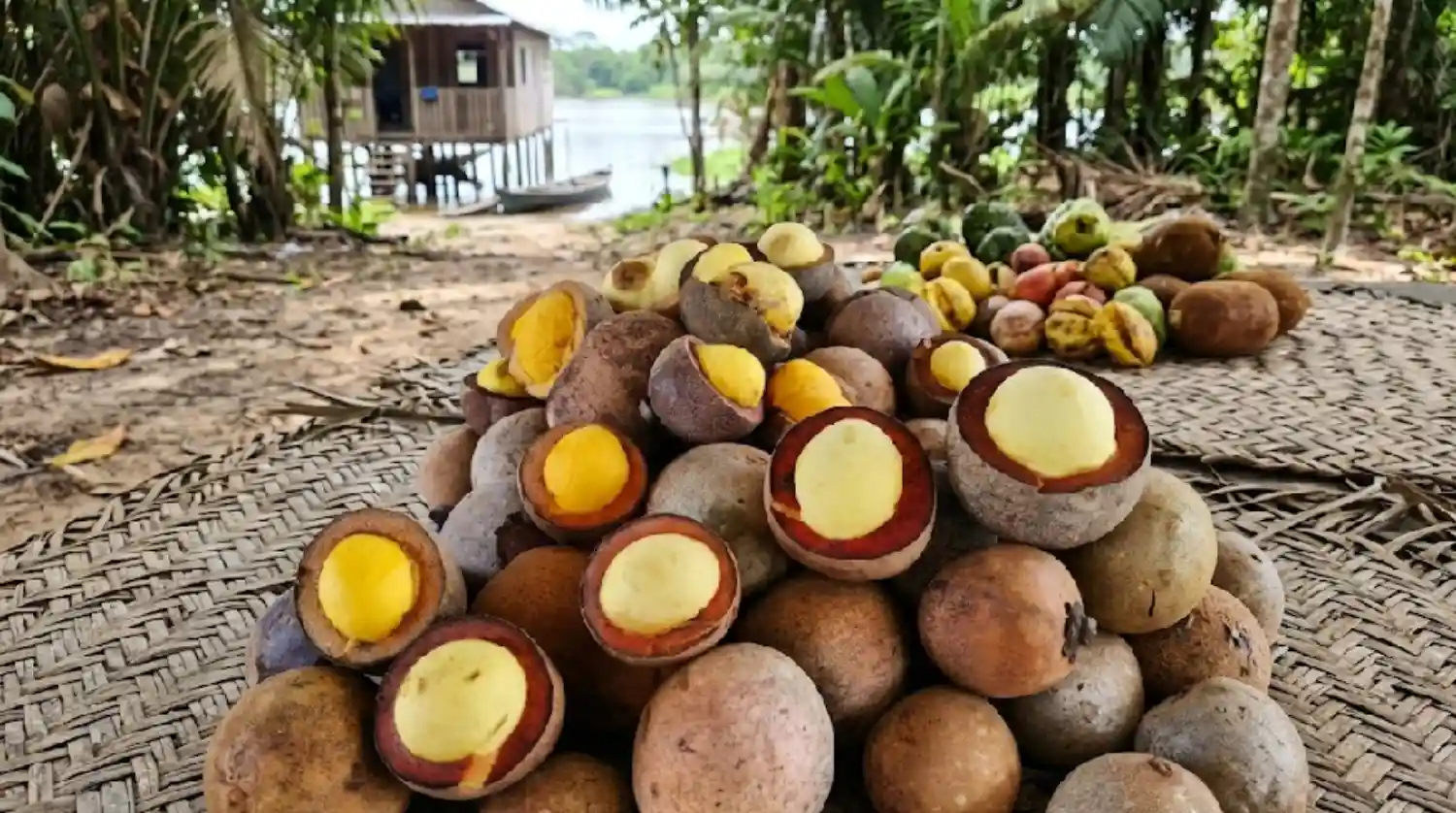
Deep in the Amazon rainforest grows a discreet giant. Piquia (Caryocar villosum) is a native Amazonian tree that can reach 50 metres in height and produces a large, thick skinned fruit whose yellow, oily pulp is boiled to release a golden edible oil. Far less famous abroad than açaí or the Brazil nut, piquia plays a decisive role in the food security and the economy of many riverside communities in the Brazilian Amazon, which use an ancestral technique to draw a valuable oil out of that pulp. The result is a rich, savoury product that works as a natural substitute for butter.
A technique handed down through generations
Extracting piquia oil is a living example of traditional knowledge passed on across generations. The process begins with gathering the ripe fruits that fall to the forest floor. Once the outer skin is removed, the pulp surrounding the seed is boiled in water for several hours. The heat breaks open the oil bearing cells, and the oil, being less dense than water, rises to the surface, where it is carefully skimmed off with spoons or shells. The method is simple and effective, and it requires neither presses nor chemical solvents, which is precisely what preserves the purity and the distinctive flavour of the finished product.
That detail matters more than it may seem. Because no industrial chemistry is involved, the oil keeps its sensory identity and its nutritional profile intact, and the work stays in the hands of people who know the forest. Every pot simmering on a riverbank is, in practice, a small production unit sustained by knowledge that is not taught in any school.
There is an environmental logic to the gesture as well. Since the raw material is the ripe fruit the tree itself drops, the harvest never requires felling or wounding the piquia. The giant remains standing, producing year after year, while the community collects what the forest floor offers. It is a long term relationship, very different from the kind of extraction that exhausts whatever it touches.
A nutritional profile that echoes olive oil
Nutritionally, piquia oil is a genuine jewel of the forest. Studies indicate that it is rich in unsaturated fatty acids, particularly oleic acid, the same beneficial fat found in olive oil and recognised by science for its positive effects on cardiovascular health. The oil also contains carotenoids, precursors of vitamin A that are essential to eye health and to the immune system, along with natural antioxidants that help protect the body’s cells against premature ageing.
Taken together, those components explain why the oil is so often compared to olive oil. For the families who produce and consume it, however, the comparison arrived very late. Long before any laboratory analysis existed, piquia oil was already an everyday source of good fats and energy on the table.
Far more than food
For riverside communities, piquia is not merely a source of food. It is a central element of their culture and their subsistence. The oil goes into a wide range of preparations, from rice and fish dishes to handmade soaps, and it is also used as a traditional remedy for a variety of ailments. Its importance reaches well beyond the physical properties of the product, standing for the deep connection between Amazonian populations and the biodiversity that surrounds them.
The leap into fine dining in Para
In recent years, piquia has been gaining ground in contemporary cuisine in Para, prized by renowned chefs in search of authentic and sustainable ingredients. The oil’s assertive flavour and creamy texture have inspired new creations, from savoury dishes to inventive desserts, delivering a sensory experience that carries the essence of the forest. That arrival on high end menus does more than diversify the region’s culinary offering: it also helps to give traditional knowledge the recognition it deserves and to strengthen the local economy.
The challenges of a supply chain still taking shape
Producing piquia oil faces clear obstacles, among them the need to guarantee that fruit gathering remains sustainable and the difficulty of reaching markets that genuinely value the quality and the origin of the product. Even so, the growing appetite for natural ingredients with traceable origins opens promising opportunities for riverside communities to keep benefiting from this forest wealth without compromising the preservation of the species or of the ecosystem it inhabits.
The challenge, at bottom, is one of recognition. An oil obtained with patience, boiled for hours and skimmed spoonful by spoonful, can hardly compete on price with industrial products. What it competes on instead is identity, origin and story, attributes that contemporary consumers increasingly value and that the market is still learning how to reward fairly.
The story of piquia is a reminder that the rainforest should not be seen only as a stock of resources waiting to be exploited. It is also a keeper of knowledge and of riches that can teach a more balanced way of living, in harmony with nature, valuing local ingredients and supporting the communities that depend on them.
Tasting a dish prepared with piquia oil is therefore more than eating something flavourful and nutritious. It is a way of strengthening the bond with the Amazon and with the people who look after its biodiversity, so that this secret of the forest keeps nourishing bodies and souls for many generations to come.
Reporting: Anne Silva / Amazonia Mag. Source: Revista Amazônia.

Editor · Amazonia Mag
Anne Silva is the editor of Amazonia Mag, the English-language edition of Revista Amazônia. She curates, translates and adapts the outlet's science and environment coverage for an international audience, reporting on Amazon wildlife, flora, rivers, climate and research. Every story she edits is grounded in peer-reviewed studies, official data and on-the-ground reporting from the Revista Amazônia newsroom in Belém, Pará, Brazil. More by Anne Silva →