
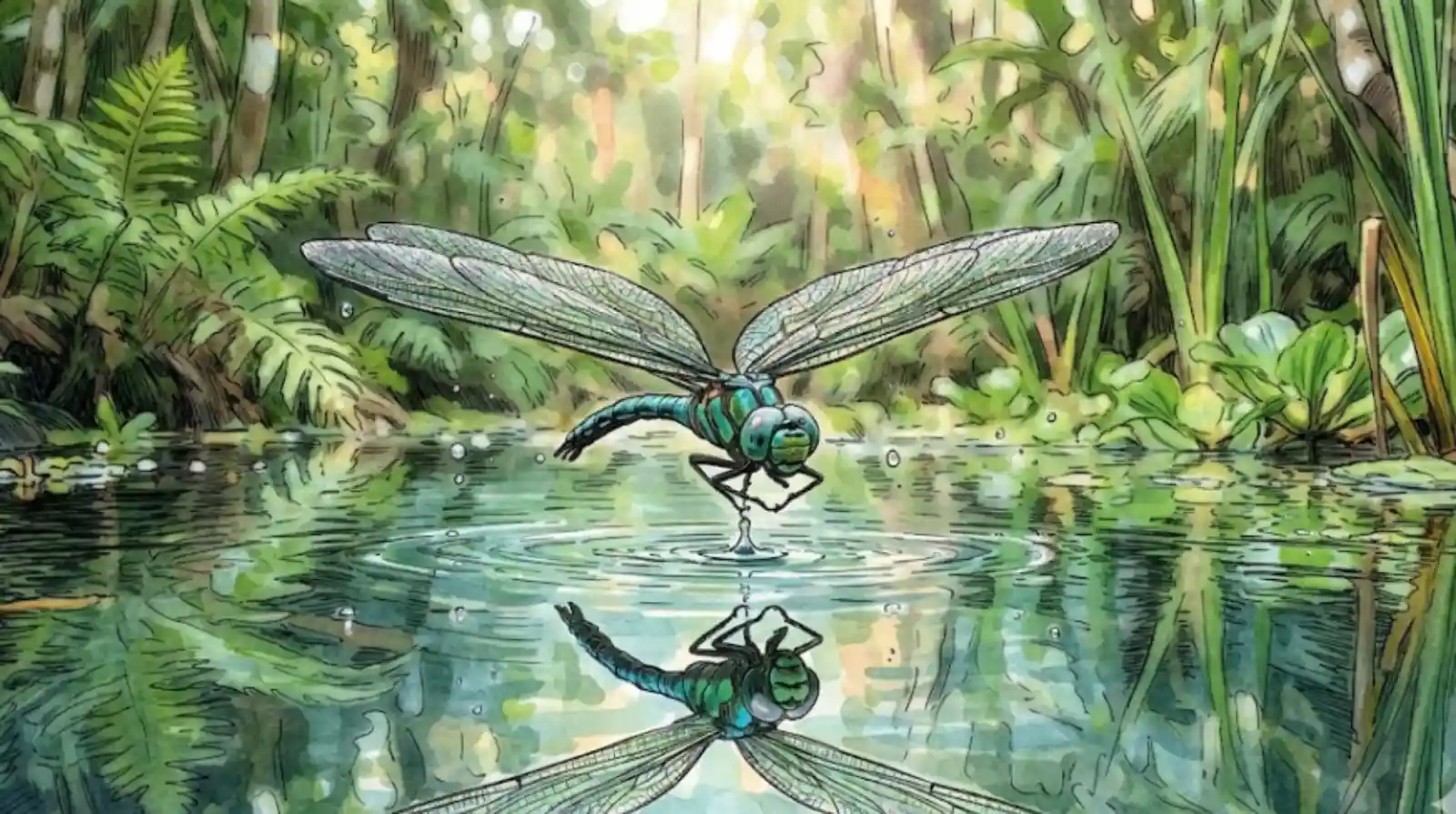
The dragonfly is one of the high points of biological engineering in Brazilian nature. It can fly backwards at the same speed and with the same precision it uses when moving forward, a skill almost no other group of insects has mastered. This is not an aesthetic detail or an isolated evolutionary curiosity. It is the result of a musculoskeletal system that allows individual control of each of its four wings. While most flying insects coordinate their wing pairs synchronously, members of the order Odonata change the angle, the frequency and the power of every single wing separately. That command of the air gives the animal an agility that challenges conventional aerodynamics, allowing sharp turns and static hovering inside the dense vegetation of tropical forests.
Four wings, four independent engines
The secret of that extraordinary mobility lies in the biomechanics of the thorax. The muscles that drive the wings connect directly to the base of each wing structure, which makes possible a fine adjustment that other insect orders cannot achieve. By tilting the wings at specific angles, the dragonfly generates lift and thrust in opposite directions at the same time. That versatility is essential for survival in closed vegetation, where the ability to pull back instantly from an obstacle or from a predator draws the line between life and death. In practice, each wing works as an autonomous engine responding to its own separate command.
The apparent fragility of those transparent wings hides remarkable strength. The veins that hold the membrane form geometric patterns that spread air pressure evenly and prevent fractures during high speed manoeuvres. Watching a dragonfly at work makes it clear that nature wastes no resources on useless ornament. Every detail, from the iridescence of the abdomen to the arrangement of the ommatidia, serves the larger purpose of keeping life going.
Eyes with almost no blind spot
Beyond acrobatic flight, the dragonfly carries a visual system close to omniscience inside its own microecosystem. Its compound eyes are made of thousands of individual units called ommatidia, which cover almost the entire head of the insect. That arrangement produces a field of view of nearly 360 degrees and removes, for practical purposes, any blind spot. For a predator, watching what happens above, below, ahead and behind at the same time is an overwhelming competitive advantage. It detects the slightest movement of prey, or the approach of a threat, without moving its body, staying in complete energy economy until the instant of the strike.
Dragonfly vision is also remarkably fast. It processes images at a rate far higher than the human eye. While people perceive movement as a continuous flow, the dragonfly sees the world as if it were running in slow motion, which makes it easier to catch quick insects in the middle of the air. That accelerated sense of time, added to its thirty thousand ommatidia per eye, makes it one of the living creatures most aware of the space around it.
More efficient than a lion
Dragonfly hunting efficiency is often documented as one of the highest in the whole animal kingdom, above large predators such as lions or sharks. While big cats succeed in around twenty per cent of their charges, some studies indicate that dragonflies capture their prey in more than ninety per cent of attempts. That lethal record combines panoramic vision with the ability to anticipate the path of the target. The insect does not fly to where the prey is, but to where the prey will be one second later, running an aerial interception calculation that demands extremely fast neural processing.
What engineering copies from the insect
Science recognises that this flight architecture inspired the development of drones and modern aerospace technology, such is the perfection of the natural mechanism. Independent control of each wing matters to anyone designing small vehicles that need to stop in the air, turn inside a minimal space and reverse without turning around. The pattern of the wing veins matters to anyone looking for structures that are light and resistant at the same time. And the way the insect anticipates the future position of a moving target, with a tiny brain and minimal energy consumption, matters to anyone writing autonomous navigation systems.
The lesson is not only about hardware. A dragonfly solves in real time a problem that engineers usually hand over to heavy computing: it estimates where a moving body will be, corrects its own trajectory in mid flight and closes the distance with a single decision. It does all of that with a nervous system that fits inside a head a few millimetres wide. For designers, that combination of speed, accuracy and frugality is the real prize, and it explains why the insect keeps returning to laboratory benches as a working model rather than as a museum specimen.
The exchange between biology and engineering also runs in the opposite direction. Every technical advance that starts from the animal depends on that animal still existing in its natural environment, which turns conservation into a practical condition for innovation and not merely a moral duty.
A thermometer for the health of the water
In the Amazon ecosystem, the presence of these air patrols signals environmental balance and healthy water bodies. Because their larvae develop in aquatic environments, the abundance of dragonflies reflects the purity of rivers and of the flooded forests known locally as igapós. Once they reach the adult stage, they take on the population control of many other insects, including mosquitoes that transmit disease. The flight of the dragonfly is, in that sense, a public service performed in the open air.
Conserving these insects necessarily means preserving riparian forests and the wetlands that make up the Amazon mosaic. Water pollution or the removal of edge vegetation interrupts the dragonfly life cycle and deprives the forest of its most efficient aerial controllers. Recognising the complexity of such a small creature is also a way of recognising the scale of the evolutionary processes that sustain the richest biome on the planet.
Seeing a dragonfly hover above a mirror of water is watching millions of years of genetic refinement focused on mechanical and visual perfection. The insect teaches that power does not lie in size alone, but in the capacity to adapt and to command space with intelligence and precision. To look at the world through the eyes and the wings of a dragonfly is to understand that much of the innovation technology chases today was already written by nature hundreds of millions of years ago.
Reporting: Anne Silva / Amazonia Mag. Source: Revista Amazônia.

Editor · Amazonia Mag
Anne Silva is the editor of Amazonia Mag, the English-language edition of Revista Amazônia. She curates, translates and adapts the outlet's science and environment coverage for an international audience, reporting on Amazon wildlife, flora, rivers, climate and research. Every story she edits is grounded in peer-reviewed studies, official data and on-the-ground reporting from the Revista Amazônia newsroom in Belém, Pará, Brazil. More by Anne Silva →