
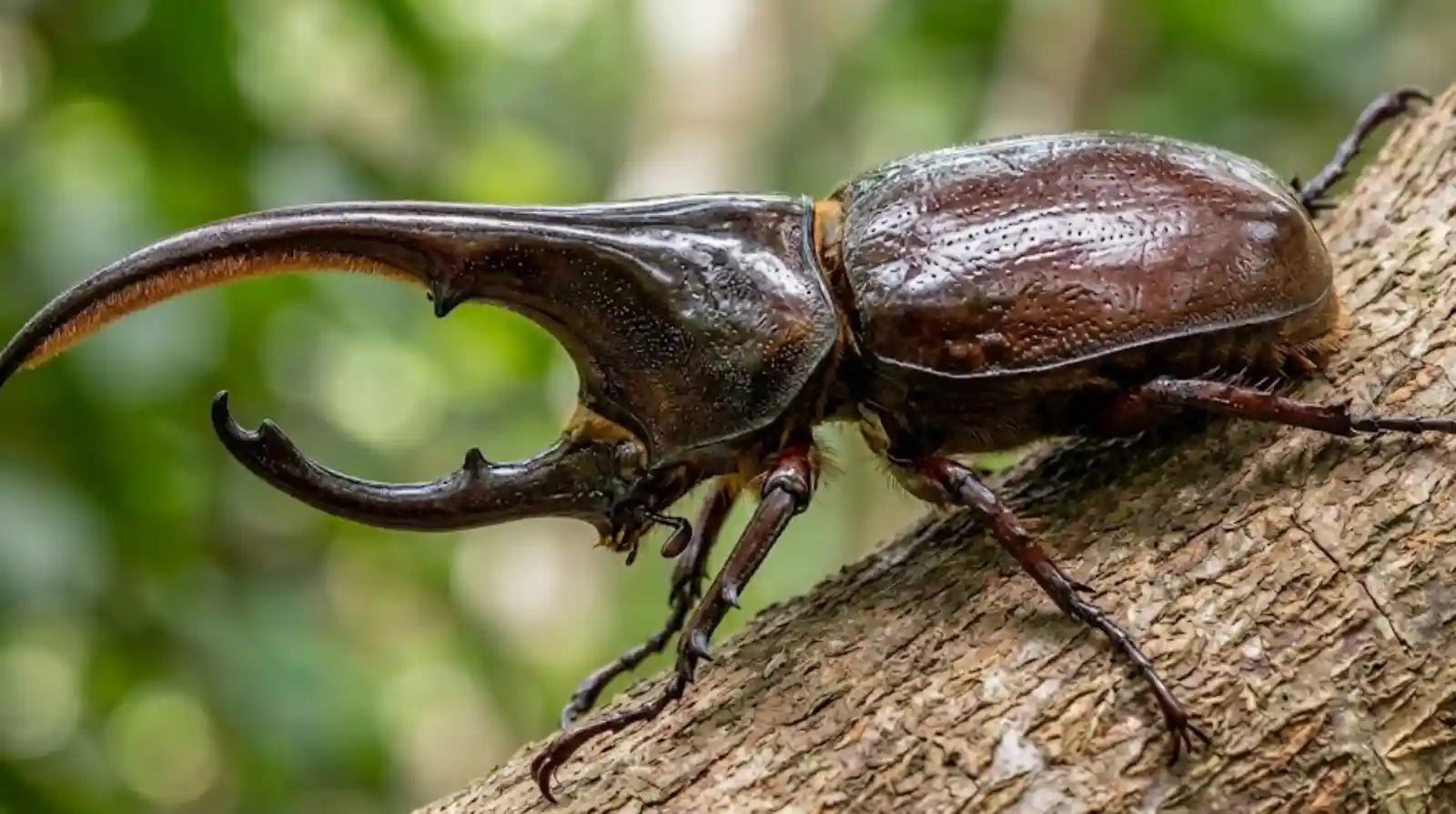
Deep inside the Amazon rainforest lives an animal that quietly overturns the human intuition about what strength really means. The rhinoceros beetle, known to science as Dynastes hercules, holds the greatest relative strength in proportion to body size of any animal on the planet. This is far more than a piece of trivia. The trait is essential to the survival of the species, and it explains much of its anatomy, its behaviour and even the role it plays in the forest around it. An elephant moves vastly more weight in absolute terms, yet the biomechanical efficiency of this insect, able to lift hundreds of times its own body mass, continues to fascinate entomologists and engineers alike.
That extraordinary power did not appear overnight. It is the product of millions of years of evolution, and it is bound tightly to the physics of the beetle’s exoskeletal structure. To understand how the strength is expressed, it helps to look first at the architecture of the body and only afterwards at the muscle that drives it.
The armour that explains the record
Unlike vertebrates, which support themselves with an internal skeleton, the rhinoceros beetle carries an external suit of armour built mainly from chitin and proteins. That shell does two jobs at once. It shields the internal organs from predators in the humid Amazon rainforest, and it also works as an extremely efficient load distribution system. The curved, reinforced shape of the exoskeleton reduces stress points when the insect is placed under pressure, so effort spreads across the structure instead of concentrating in a single weak region. Add to that a set of sturdy legs fitted with spines, which deliver the traction the animal needs to convert raw power into useful movement.
The comparison with large animals is where biology and physics meet most dramatically. A human being may look far stronger than an insect, but in proportional terms the rhinoceros beetle leaves any mammal behind. Part of the answer sits in the physical properties of chitin when it is examined at small scales, and part of it in the efficiency of muscular systems inside tiny bodies. What would be a structural handicap in a large frame becomes a mechanical advantage in a very small one.
The horn as an instrument of ritual combat
The iconic horn of the male, the feature that gave the animal its name, is its most recognisable trait and it is directly tied to how that proportional strength is applied. Research indicates the horn is not used for hunting. It appears instead in displays of vigour and in ritual disputes between males competing for females. Those contests are genuine tests of physical stamina. The male tries to grip his opponent, lift him clear of the surface and hurl him out of the arena, which may be a tree trunk or a contested source of food.
This form of sexual competition, driven by natural selection, favoured the growth of the horn and the muscular strength required to wield it at the same time. Weapon and muscle evolved together, because a large horn without the power to move it would be useless in a duel. Seen from that angle, the greatest relative strength on the planet is not an accident of nature. It is the visible trace of generations of males that won or lost a wrestling match on the bark of an Amazonian tree.
Years of patience before any strength
The life of this miniature giant does not begin with power. It begins with remarkable patience. The larvae may spend several years developing, feeding on decaying wood, which turns them into active agents of nutrient recycling and of the formation of fertile soil in the Amazon rainforest. That stage of the life cycle is often forgotten precisely because it unfolds out of sight, yet it is essential to the health of the ecosystem. It also demonstrates how much every species matters, regardless of its size or how visible it happens to be.
The sequence matters for understanding the adult animal too. The strength that impresses observers is the final chapter of a long, slow investment in body building, funded entirely by rotting timber on the forest floor. Remove the fallen wood and the beetle simply has no runway on which to become what it becomes.
A model for new materials and robots
Interest in the rhinoceros beetle stopped being purely biological a long time ago. Researchers study these structures hoping to design new materials and robots that imitate the efficiency of this small Amazonian giant. What they are after is not the shape but the principle: how a lightweight shell can withstand enormous loads, and how a set of legs can transmit force without wasting it along the way. Dynastes hercules is recognised as the strongest animal in proportional terms not because of the absolute weight it shifts, but because of the effectiveness of its natural engineering.
Protecting the forest means protecting the giant
Conservation of the species is inseparable from the preservation of the Amazon rainforest itself. Protecting large tracts of native forest keeps the insect’s life cycle running without interruption, from the decaying wood that feeds the larvae to the trunks where adults settle their contests. Its presence works as an indicator of environmental health: where the beetle thrives, the forest is still performing its basic functions.
Sustainable tourism initiatives and scientific research generate income for local communities while spreading knowledge about the importance of every species, including the smallest ones. The existence of a creature this physically impressive in the Amazon reinforces the wonder of Brazilian biodiversity and the need to act as dedicated guardians of that heritage.
With the greatest proportional strength on the planet, the rhinoceros beetle can lift hundreds of times its own weight, a biological feat that proves crucial both for sexual competition and for pollination in the Amazon rainforest. Looking closely at the power of an apparently ordinary insect is a reminder that the greatest wonders of nature often hide in the most unexpected details, and that our idea of what strength means in a living creature is worth revisiting.
Reporting: Anne Silva / Amazonia Mag. Source: Revista Amazônia.

Editor · Amazonia Mag
Anne Silva is the editor of Amazonia Mag, the English-language edition of Revista Amazônia. She curates, translates and adapts the outlet's science and environment coverage for an international audience, reporting on Amazon wildlife, flora, rivers, climate and research. Every story she edits is grounded in peer-reviewed studies, official data and on-the-ground reporting from the Revista Amazônia newsroom in Belém, Pará, Brazil. More by Anne Silva →