
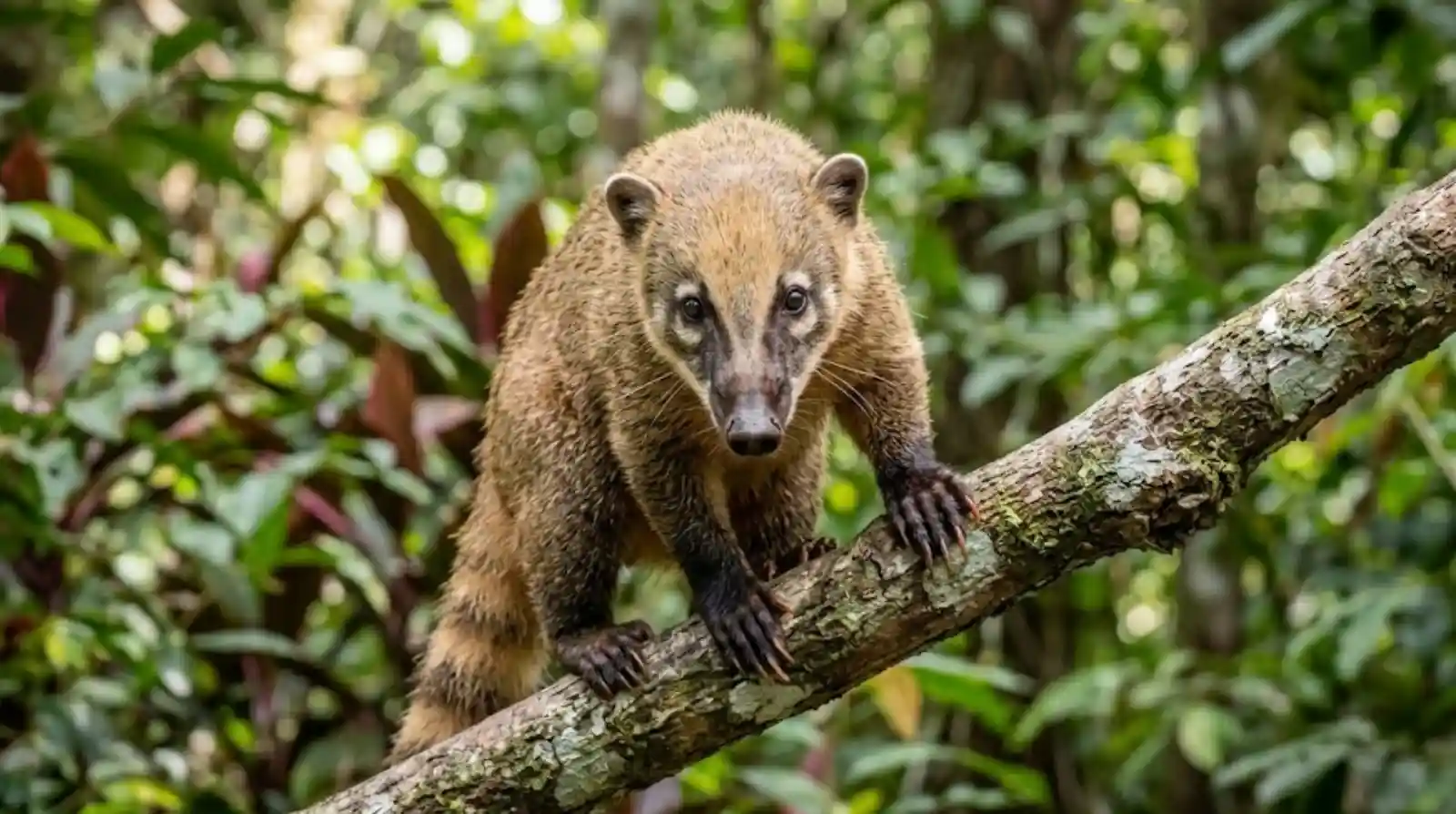
Wrists That Turn Where Others Cannot
The coati carries an anatomical rarity among the carnivores of the New World: its wrists bend and turn with unusual freedom, which lets the front paws rotate enough to grip objects precisely and to climb down a trunk head first. The dexterity is so refined that this close relative of the raccoon uses its extremities much the way a person uses hands, exploring the environment and reaching food. Most mammals keep their paws for locomotion. The coati turns them into multipurpose tools inside the dense Amazon rainforest.
The ability begins in the joints. Science recognises that the bone structure of the coati wrist allows a degree of supination, the rotation of the palm upward, that exceeds what other members of its biological family can manage. Combined with long, sharp and non retractable claws, that trait gives the animal a clear competitive advantage. When hard seeds or thick shelled fruits appear, including several small nuts typical of Amazonian flora, the coati simply does not give up.
Claws Used as Levers and Wedges
The routine is methodical rather than violent. The animal holds the food firmly with one or both front paws and works the claws as levers or wedges, prying and grating the shell until it reaches the pulp or the nutritious kernel inside. There is very little brute force involved. There is pressure applied at exactly the right point, a turn of the wrist and a great deal of patience. Fruit that resists a bird beak or a rodent bite eventually yields to a combination of anatomy and method.
That access to protected resources has a deep effect on the ecosystem around it. The coati opens fruit that many other animals cannot handle effectively, which secures a more varied diet across the seasons. Hard fruits that most frugivores would simply ignore are processed routinely by these procyonids, widening the menu precisely when easier food becomes scarce in the forest.
A Key to the Forest Pantry
The benefit does not stop with the animal itself. By breaking hard shells and later depositing the seeds far from where they were collected, coatis act as essential dispersers. Several plant species depend on exactly this kind of mechanical breaking of dormancy in order to germinate, and the hands of the coati do that work without intending to. Every fruit opened is, in practice, a seed with a better chance of becoming a tree.
A fruit that stays sealed is a seed that never travels and never sprouts. When the coati pries the shell apart, feeds on the pulp and moves on through the understorey, it carries plant life along its daily route and leaves it somewhere new, well away from the shade of the tree that produced it.
The Band, the Snout and the Forest Floor
Nasua nasua lives in bands made up mostly of females and their young, while adult males tend to be solitary and approach the group only during the breeding season. While most of the band forages on the ground, digging with the long snout and turning over leaf litter with the paws in search of insects, larvae and fallen fruit, some members take up position as sentinels on higher branches, watching for big cats and birds of prey.
That division of labour is what allows the hands to work in peace. Opening a hard fruit takes time, attention and a vulnerable posture, head down and body exposed. With lookouts watching the surroundings, each animal can concentrate on the fine task of prying, scraping and tasting. Collective safety and individual skill are, for the coati, two parts of the same mechanism.
Curiosity, Learning and Coexistence
The coati mind is not limited to natural food. These are extremely curious and adaptable animals, and they show a striking practical intelligence when facing new challenges. That behavioural plasticity partly explains why the species thrives in very different habitats, from primary forest to altered landscapes. The way they use their paws to force, twist or open objects that never belonged to their original environment illustrates continuous learning and adaptation.
The same virtue demands caution wherever people and coatis share space. The curiosity that opens a small hard nut also opens rubbish bags, poorly closed containers and even house doors. Leaving waste within reach of these animals changes their foraging routine and exposes them to conflict, accidents and disease. Keeping a respectful distance is a concrete way of protecting the very skill that makes them remarkable.
Small Hands, Large Ecological Role
Conserving the coati and its habitat matters for the health of the biomes it occupies, including the Amazon and the Cerrado. As seed dispersers and controllers of insect populations, they perform ecological functions that cannot easily be replaced. Sustainability initiatives that promote ecological corridors and the restoration of native forest benefit these creatures directly and, by extension, the whole system they belong to.
Wildlife watching tourism, when practised responsibly and without interfering with natural behaviour, generates value for local communities and encourages preservation. Watching a band at work reveals a quiet spectacle: coordinated movement, subtle signals between animals and the skilled use of the front paws to investigate every crack, every hollow and every fruit lying on the forest floor.
Biological studies indicate that opening hard fruit and then spreading the seeds across wide areas is fundamental to the regeneration of several tree species and sustains ecological balance over the long term. Recognising that sophistication in the paws of a small forest mammal may be reason enough to rethink our own relationship of handling and care towards the natural world around us.
Reporting: Anne Silva / Amazonia Mag. Source: Revista Amazônia.

Editor · Amazonia Mag
Anne Silva is the editor of Amazonia Mag, the English-language edition of Revista Amazônia. She curates, translates and adapts the outlet's science and environment coverage for an international audience, reporting on Amazon wildlife, flora, rivers, climate and research. Every story she edits is grounded in peer-reviewed studies, official data and on-the-ground reporting from the Revista Amazônia newsroom in Belém, Pará, Brazil. More by Anne Silva →