
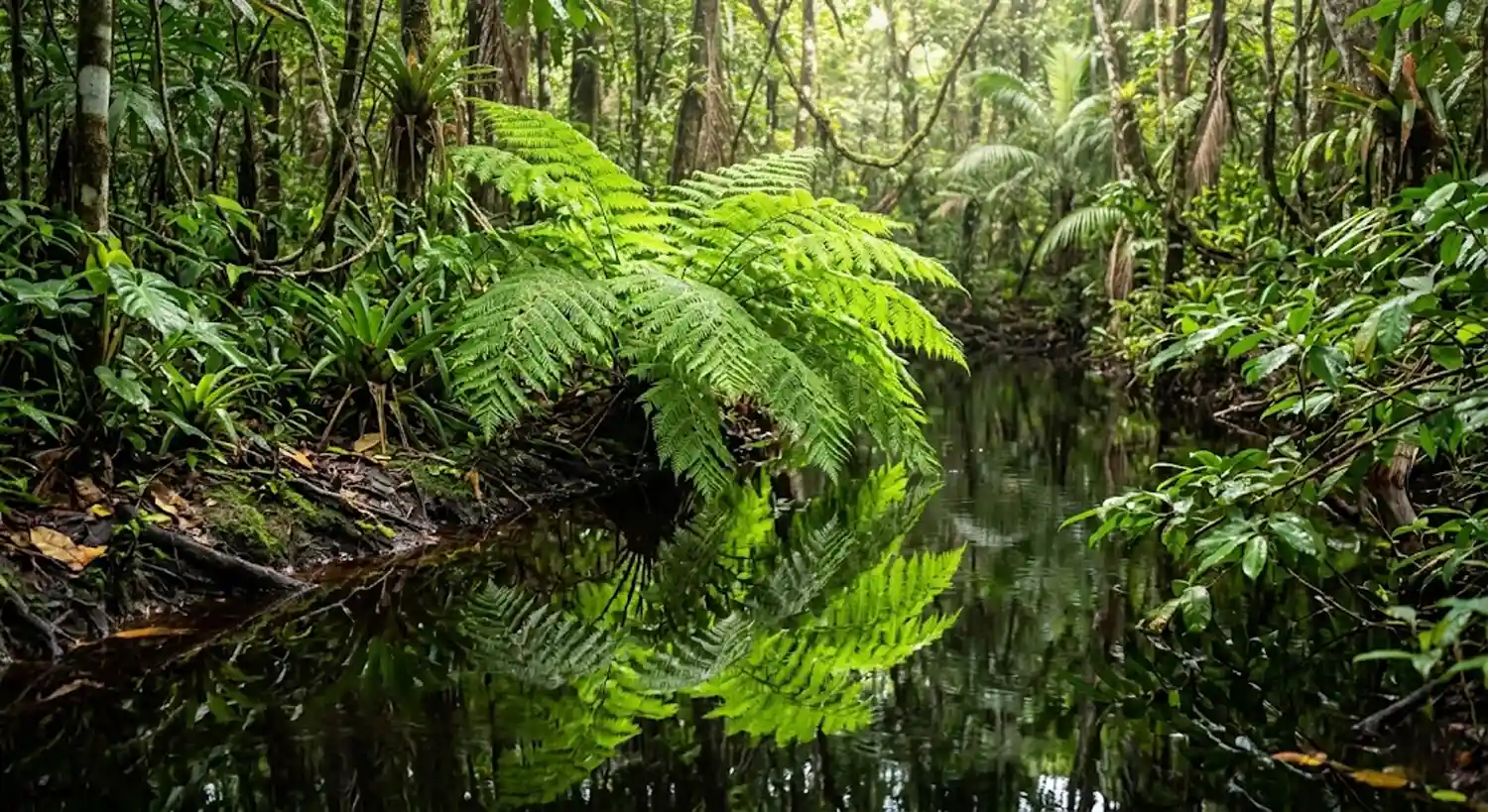
In the dark, slow waters that cut through the largest tropical forest on the planet, an ancient organism carries out a quiet act of cleaning. Brazilian researchers have found that a species of giant fern, abundant along the banks of Amazonian creeks known locally as igarapés, has the extraordinary ability to absorb and neutralise very high concentrations of arsenic and other critical contaminants. While the modern world spends fortunes developing artificial technologies to decontaminate rivers, lakes and tributaries, the forest itself already offers a living and highly efficient filter. It is a striking revelation that reshapes our understanding of natural resilience and opens new paths for the restoration of river basins around the world.
The botanical history of this plant reaches back hundreds of millions of years. Ferns and their relatives, grouped under the name Pteridophyta, are among the oldest vascular plants on Earth, and they survived several mass extinctions and extreme climatic shifts. That long evolutionary process gave them an uncommon genetic sturdiness, allowing them to develop survival mechanisms that still challenge contemporary biology. Across the vast Amazon, these plants not only found a perfect environment in which to thrive, thanks to high humidity and steady temperatures, but also established complex chemical interactions with a riverside ecosystem that is frequently hostile.
For decades, science underestimated the direct functional role of many of these species in the local hydrological and chemical balance. Attention was almost always directed at large trees and at the effect of the forest canopy on the rainfall cycle. Gradually, however, biologists and chemists began to look at the margins of the watercourses, where riparian vegetation forms a formidable protective barrier. There, the giant fern stands like an invisible guardian: it drives its vigorous roots into the damp bed and draws up not only the nutrients essential to its own growth, but also toxic elements that would destroy the vast majority of life forms known to traditional botany.
A scientific alliance in the heart of the forest
Collaboration between leading institutions has been decisive in decoding this green mystery. Rigorous studies conducted by multidisciplinary teams from the Federal University of Pará and the National Institute for Amazonian Research produced compelling data about this remarkable capacity. The scientists carried out numerous expeditions along rivers and tributaries affected by unrestrained human activity, collecting meticulous samples of water, soil and plant tissue. In laboratories equipped with spectrometry and advanced microscopy, the results of the analyses revealed a fascinating picture, full of genuine hope for the future of environmental engineering.
The process behind this biological phenomenon is scientifically classified as phytoremediation. This innovative and organic technique relies on living plants to clean up environments damaged by harmful residues. In practical terms, the plant behaves exactly like a powerful biological suction pump. Its roots absorb contaminated fluids from the surrounding environment, and the internal vascular system efficiently carries those liquids up to the large, leafy fronds, filtering impurities along a highly specialised cellular path. The result is a cleaning mechanism that runs continuously, without external energy and without industrial inputs.
But how can a living organism survive while taking in lethal, corrosive substances such as arsenic and mercury? The answer lies in a spectacular form of cellular intelligence. Unlike other wild species that quickly succumb to severe toxicity, this Amazonian giant developed the unusual ability to produce specific organic molecules that act as natural chelating agents. Those molecules wrap around and immobilise the atoms of heavy metals, instantly cancelling their destructive power at the cellular level. The plant then stores that inert material safely in isolated vacuoles inside its own leaves, sealing off the poison so that its vital metabolism remains intact.
That storage strategy is what separates a hyperaccumulating fern from an ordinary riverside plant. Instead of trying to block the entry of contaminants, the fern accepts them, disarms them chemically and locks them away in compartments that do not interfere with photosynthesis or with the transport of water and sugars. The toxic load stays in the fronds rather than in the water, and the plant continues to grow. Seen from the bank of an igarapé, nothing appears to happen at all: the fern simply looks green and healthy, while inside its tissues an intricate chemical defence works around the clock.
From mining scars to restoration corridors
This mechanism takes on enormous importance when set against the current preservation challenges in northern Brazil. The spread of irregular extractive activity has left deep chemical scars across vulnerable biomes. Faced with that complex situation, the encouraging prospect of using a plant that cleans water affected by mining, in a technically structured way, completely changes the paradigm of territorial recovery policy. Instead of depending solely on destructive mechanised dredging, specialists can now plan and cultivate extensive ecological restoration corridors built on the strategic, monitored planting of these hyperaccumulating ferns.
Experimental projects grounded in this knowledge are showing results that excite the entire community devoted to green development. In carefully assessed test areas, the simple dense presence of these ferns along the banks of tributaries measurably reduced levels of water contamination over surprisingly short periods. The water gradually recovers its clarity and the oxygenation levels that are essential for life. The most rewarding aspect for researchers is watching aquatic insects and small native fish return quickly to the purified habitat, a sign that the complex riverside food web is in rapid and open reconstruction.
Beyond healing environmental damage in an autonomous and organic way, this fundamental discovery is fuelling highly optimistic discussions about new and profitable bioeconomic models. Mature leaves, rich in heavy metals and saturated after months of growth, can be safely pruned by properly trained local cooperatives. Through an innovative industrial process known as phytomining, it becomes possible to extract and recycle those valuable industrial metals directly from the collected biological tissue. This pioneering circular economy turns a dangerous polluting liability into a lasting financial asset and creates vital opportunities for sustainable work in many Amazonian riverside communities.
Detailed genetic mapping of these species opens even broader and more ambitious horizons for global biotechnology. By examining in depth the physiology and distribution of the Amazonian ferns associated with heavy metals, botanists believe that the enzymatic keys behind this natural absorption could inspire innovative synthetic filters founded purely on biomimicry. Tropical biodiversity is confirmed once again, in modern history, as the richest, least explored and most sophisticated library on the planet in terms of molecular structural solutions, creatively outperforming the largest of corporate human laboratories.
The scale of this genetic revelation also reinforces an indispensable message about our deep biological interdependence. Every time a strip of native riverside vegetation is protected or properly replanted, we are not merely preserving the visual green of the forest landscape. We are safeguarding the uninterrupted operation of priceless biological factories that work tirelessly to purify the water resources supplying countless communities and sustaining the life of the surrounding wildlife. Protecting the complex habitat of these ferns is the same as defending the river basins that regulate continental rainfall and feed national prosperity in a clean way.
A living laboratory on the creek bank
Pteridophytes are ancient vascular plants without seeds. In the tropical forest, their remarkable genetic diversity hides purifying metabolic capacities. Studies indicate that specific genes in these ferns activate agile transport proteins responsible for isolating critical environmental toxins inside plant cells, turning aggressive chemical threats into perfectly inert material. The progress of these scientific and biotechnological projects constantly reinforces an undeniable premise about the global future: preserving Brazil’s rich biodiversity essentially means keeping the definitive technological keys needed to solve the greatest and most urgent ecological challenges of the century.
The liberating knowledge produced in university laboratories and institutes across northern Brazil has genuine potential to reshape ecological rules on a planetary scale. The adaptive, rebuilding capacity of the forest proves empirically that the definitive cures for our most serious structural crises often sprout from the very soil that was once harmed by a lack of systemic awareness. Looking at the green margins of Amazonian rivers with renewed fascination and respect means recognising immediately that supporting the conservation of this formidable native biological intelligence is the most constructive and revolutionary attitude available for securing a safe and habitable tomorrow for everyone.
Reporting: Anne Silva / Amazonia Mag. Source: research by the Federal University of Pará and the National Institute for Amazonian Research, with original reporting by Revista Amazônia.

Editor, English Edition — Amazonia Mag
Anne Silva is the editor of Amazonia Mag, the English-language edition of Revista Amazônia. She curates, translates and adapts the outlet's science and environment coverage for an international audience, reporting on Amazon wildlife, flora, rivers, climate and research. Every story she edits is grounded in peer-reviewed studies, official data and on-the-ground reporting from the Revista Amazônia newsroom in Belém, Pará, Brazil. More by Anne Silva →