
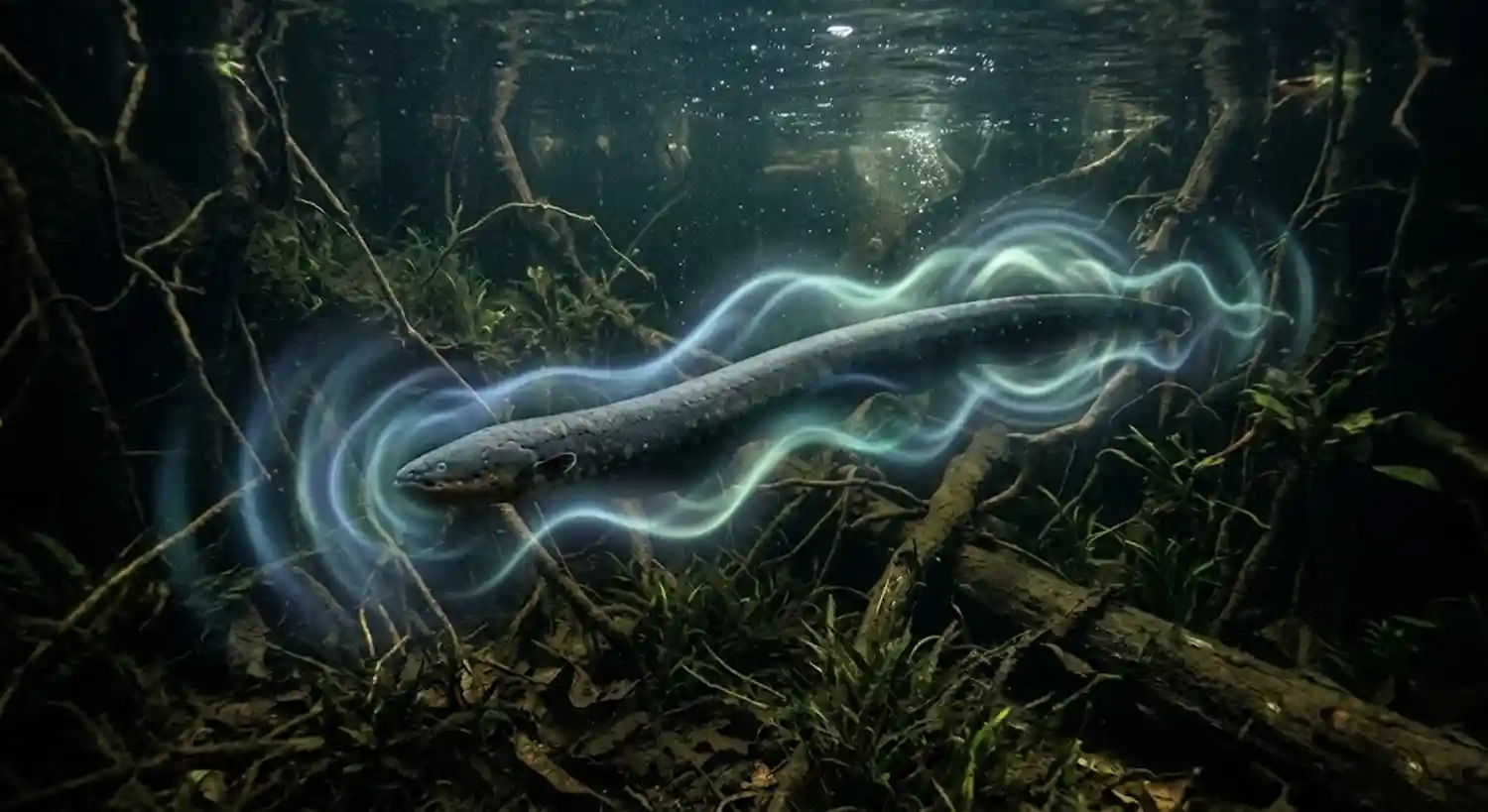
Deep in the Amazon basin lives an animal able to produce a discharge of eight hundred and sixty volts, the most powerful biological voltage ever recorded by science. What fascinates biologists today, however, is not only the shock that can paralyse prey in an instant. It is the silent murmuring these fish exchange beneath the surface. Recent research indicates that the electric eel’s discharges are not merely a hunting weapon: they form the basis of a complex biological vocabulary. Using pulses of extremely low voltage, the animal keeps up a continuous dialogue with its peers, searches for breeding partners and marks out submerged territory, operating as an invisible communication network flowing through the dense waters of the rainforest.
A sixth sense for lightless water
The setting of these findings is as demanding as it is remarkable. In northern Brazil, the aquatic ecosystem imposes relentless conditions on native species, above all through a chronic lack of visibility. It is precisely there, in the Rio Negro, that the electric fish displays its evolutionary mastery. The dark water, stained by the constant decomposition of millions of tannin rich leaves, renders eyesight almost useless for the region’s large predators.
To thrive in that theoretically hostile habitat, natural selection favoured the development of an extraordinary sixth sense. These animals do not merely see through precise electric fields: they feel, calculate and map the three dimensional world around them with millimetric accuracy. Every submerged root, every sediment bank and every living body moving nearby appears on a permanent electrical map that the fish refreshes without pause.
Three organs, thousands of miniature batteries
The anatomy behind that feat is a marvel of natural bioengineering. The animal’s elongated body houses three distinct electric organs, made up of thousands of highly specialised cells known as electrocytes. These microscopic structures work like miniature batteries, aligned along the length of the fish’s musculature. When the central nervous system sends the command, every one of those units fires simultaneously and in coordination, generating the electric field that made the genus Electrophorus famous.
In the study of bioelectricity among Amazonian fish, the decisive detail is modulation. The animal does not always discharge at the same intensity. Strong discharges serve to bring down elusive prey quickly, while weak discharges are kept almost continuously, simply to probe the surroundings and interact socially with other members of the group. It is that second mode, discreet and persistent, that scientists have learned to read.
Listening to an invisible conversation
Multidisciplinary teams installed arrays of submerged sensors on the muddy riverbed to capture those subtle signals and translate their ecological meaning. Field data showed that different individuals produce varied electrical clicks throughout the day, altering the frequency and amplitude of the waves according to the message they wish to transmit at that moment.
When two adult territorial males cross paths, an invisible dispute unfolds in rapid pulses of mutual warning, an exchange that in most cases spares both animals a costly physical confrontation. During the annual breeding season, by contrast, females and males tune their frequencies to establish a lasting biological connection. What sounds to human ears like pure silence turns out, once measured with instruments, to be a river full of conversation.
Hunting with a built in radar
Beyond social life, the hunting and navigation habits of these creatures verge on science fiction. By emitting a soft, uninterrupted electric field in a constant radius around its body, the fish creates an invisible detection zone. Any prey that enters that perimeter immediately distorts the lines of force generated by the living battery. Sensory pores distributed geometrically across the animal’s thick skin detect that distortion instantly.
Once the prey has been pinpointed among the twisted roots of the riverbed, the shift from passive radar to electric shock weapon happens within a few milliseconds. Fast moving targets are paralysed before they have time to react, with an efficiency no human made device has managed to match.
Clean water as a condition for language
For that natural spectacle to continue in the neotropical basins, the role of government protection agencies grows more urgent every year. The Brazilian Institute of Environment and Renewable Natural Resources, known as Ibama, works permanently in the region to curb environmental crimes that affect the stability of the water. Illegal mining and the clearing of riparian forest dump tonnes of sediment and heavy metals into the rivers, drastically altering the water’s natural electrical conductivity.
Specialists warn that such pollution can cause genuine static interference in the delicate electrocommunication system of the local fauna. A fish that can neither emit nor interpret its own signals loses its map, its language and its weapon all at once. Enforcement missions ensure the habitat keeps its original chemical and physical characteristics intact, a condition without which these sensitive species cannot survive in the long term.
The work of environmental authorities also covers the regulation of scientific research inside the biome. By coordinating environmental licences and cracking down on biopiracy, Ibama seeks to guarantee that knowledge generated by national wildlife benefits the country itself rather than being appropriated without legal authorisation. Continuous monitoring of aquatic populations inside federal conservation units supplies vital data for shaping effective public policy.
From the rainforest to the operating room
None of this biological adaptation escaped the attention of the global technology community devoted to bioinspiration. Mechatronic engineers and computer scientists are working with data gathered in the Amazon basin to design a new generation of autonomous aquatic technologies. The way the animal navigates in completely dark environments full of hidden obstacles has inspired prototypes of independent underwater vehicles fitted with sensors that mimic natural electroreception, allowing them to explore flooded caves or inspect submerged pipelines.
The applications reach the medical sector as well. The cellular structure of electrocytes is being studied and copied with the aim of developing energy sources fully biocompatible with the human organism. Researchers are designing tiny flexible batteries made of synthetic hydrogel that operate on the same principles as the river’s biological batteries. The ambition is to power cardiac pacemakers continuously and remove the need for periodic surgery simply to replace electronic parts.
That prospect underlines the incalculable value of keeping the tropical forest standing. Every creature that vanishes from the biodiversity map takes with it millions of years of research carried out free of charge by nature itself. The progress of studies linking wildlife to the academic frontier points to a path where the knowledge economy and deep ecology advance side by side, and where tomorrow’s solutions live in today’s clean rivers.
Defending the dark watercourses of the northern Amazon is therefore far more than an ecological slogan: it is a condition of survival and, at the same time, the foundation of the technological innovation that may heal humanity tomorrow. Protecting those basins amounts to shielding the most powerful open air laboratory on Earth, so that the electric voices of the Amazon keep teaching us for generations to come.
Reporting: Anne Silva / Amazonia Mag. Source: revistaamazonia.com.br

Editor, English Edition — Amazonia Mag
Anne Silva is the editor of Amazonia Mag, the English-language edition of Revista Amazônia. She curates, translates and adapts the outlet's science and environment coverage for an international audience, reporting on Amazon wildlife, flora, rivers, climate and research. Every story she edits is grounded in peer-reviewed studies, official data and on-the-ground reporting from the Revista Amazônia newsroom in Belém, Pará, Brazil. More by Anne Silva →