
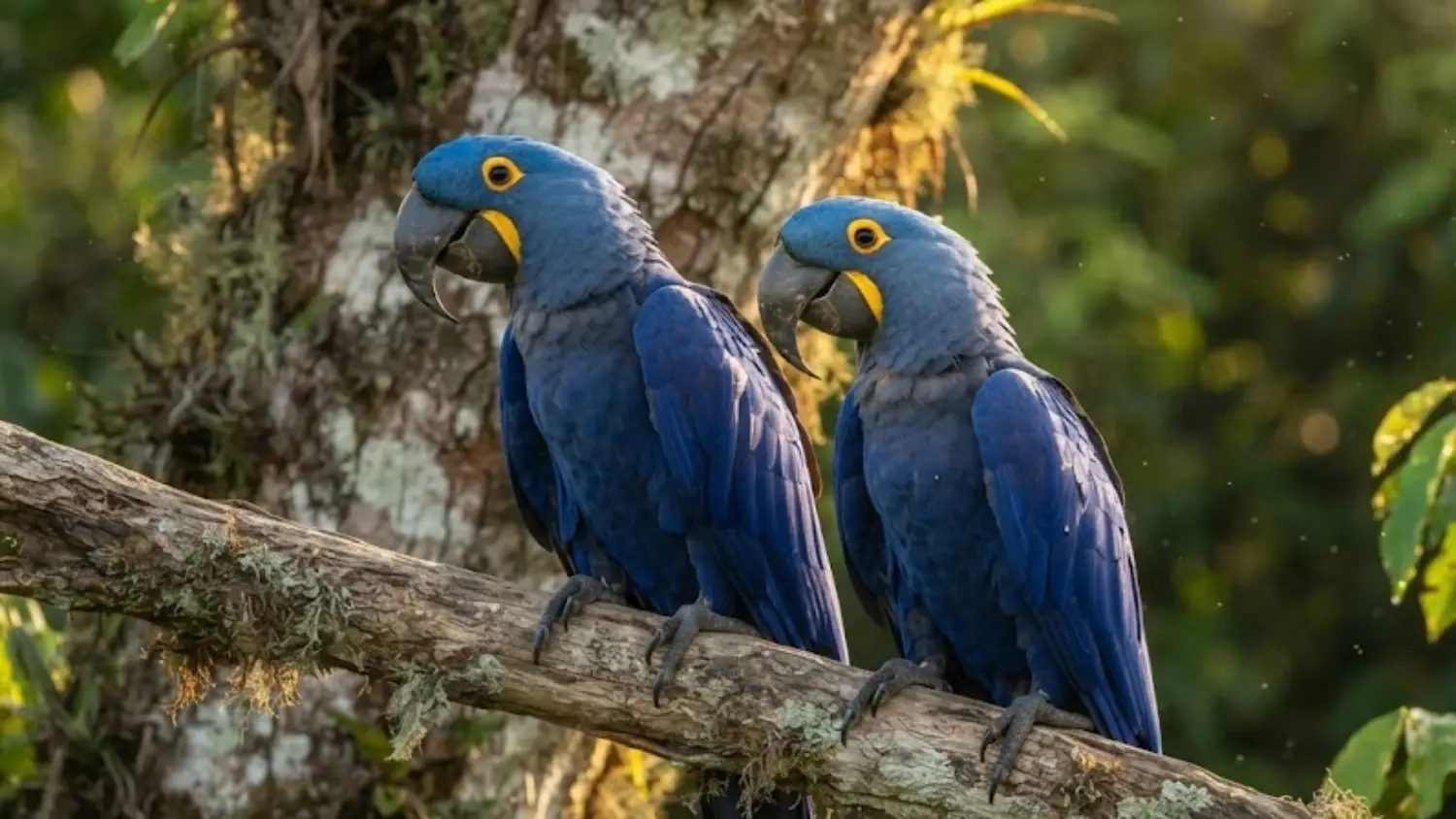
High in the canopy of the largest tropical forest on the planet, wildlife reveals emotional ties and social behaviours so intricate that they routinely unsettle what we assume about animal sensitivity. The hyacinth macaw, Anodorhynchus hyacinthinus, known in Brazil as arara azul, is celebrated worldwide for its spectacular cobalt plumage and for being the largest flying parrot in existence. Yet the trait that most surprises researchers and observers is neither its size nor its colour. It is something far harder to measure: these birds form pairs that hold to an unshakeable fidelity across the whole of their lives.
That lasting union is not merely a strategy for reproductive success. It also involves a deep emotional bond, to the point that losing a partner can trigger reactions of intense grief, driving the surviving bird to refuse food and waste away alone. Every pair crossing the green canopy also plays a fundamental role in maintaining biodiversity and in dispersing seeds that are crucial to forest regeneration. Protecting one bird, in this case, means protecting an entire ecological process.
A bond that does not end with loss
Grief is one of the phenomena that most impresses those who follow these birds in the field. When one member of a pair disappears, the other does not immediately seek a new companion or return to its usual feeding routine. The absence shows up as apathy, isolation and a steady decline in physical condition. Such behaviour, difficult to explain through reproductive instinct alone, suggests that the tie between the two individuals sits at the centre of the animal’s life rather than merely on its breeding calendar.
Avian ethology helps explain why. Detailed study of bird behaviour shows that lifelong pairing in large species is directly linked to the need for intense cooperation in defending territory and in raising chicks over long periods. This is not human romanticism projected onto wildlife. It is a social architecture that evolution built because it works, season after season, in an environment that does not forgive improvisation.
Synchrony, mutual recognition and shared duties
For the hyacinth macaw specifically, the division of duties between male and female during incubation and chick feeding demands an extremely high level of behavioural synchrony and mutual recognition. One guards while the other feeds, one returns as the other needs to leave, and that rhythm holds for months on end. Any mismatch compromises the chick’s survival, which explains why coordination between the two adults is so finely tuned.
Biologists who monitor these parrots stress that the strong emotional dependence between partners evolved as a mechanism of social cohesion, one that maximises safety and reproductive success in demanding tropical environments. Every individual surviving in dense forest represents a valuable link in the evolutionary machinery that sustains the rich biological fabric of the South American continent.
Seen this way, the pair is the real unit of survival, not the individual bird. A macaw that has lost its partner has lost not only company but half of the working system that kept eggs warm, chicks fed and rivals away from the nest. That is one reason the collapse observed in bereaved birds looks so complete to anyone watching from the ground.
A birth rate with no room for loss
The reproductive biology of this magnificent bird is defined by an extremely low birth rate. Females usually lay only one or two eggs per season and, in many cases, raise just a single chick through to independence. That slow pace makes the species particularly vulnerable to environmental change and to the shortage of suitable nesting sites in the mature trees of the Amazon basin.
The arithmetic is unforgiving. A pair that loses its nest in one season cannot make up the difference with a second, larger clutch. Every season counts, and every lost tree can amount to a generation that never takes flight. That is why threats which look isolated, such as the felling of a single old trunk, carry consequences out of all proportion for the wider population.
Nests that depend on century-old trees
Strict dependence on natural cavities in large trunks, especially those found in the manduvi tree, confines laying areas to specific regions that require rigorous protection against deforestation and illegal logging. Not just any tree or any hollow will do: the cavity needs dimensions, height and stability that appear only after decades of growth. Conserving these arboreal refuges is what guarantees that future generations of birds will keep colouring the region’s skies with their unmistakable presence.
Conservation that strengthens the local economy
The combined effort to protect the natural habitats of the hyacinth macaw shows that preserving wildlife walks hand in hand with strengthening the regional bioeconomy and wildlife watching tourism. Participatory monitoring and sustainable management projects carried out in partnership with local communities prove that it is entirely feasible to reconcile environmental conservation with the socioeconomic development of the families living around nesting areas.
Keeping the forest standing and adding value to sociobiodiversity products are fundamental conditions for protecting species that need vast territories and centuries-old trees to complete their life cycles. Ecotourism built around birdwatching, together with responsible forest management, generates lasting financial incentives that benefit traditional communities and sharply reduce pressure on wild nests. When the economic value of living wildlife is recognised by regional and international markets, a powerful incentive emerges to conserve continuous habitat where the birds can thrive freely.
Securing the territorial integrity of the ecological corridors where these animals feed and breed safeguards the stability of entire ecosystems and consolidates an ethical commitment to Brazilian wildlife that cannot be postponed. Corridors matter because a protected nesting tree is of little use if the feeding areas around it have been fragmented beyond reach.
What a pair of macaws leaves us thinking about
Watching the mutual devotion and the elegance of hyacinth macaws in the heart of the forest is an invitation to rethink our place in the world and our shared responsibility for protecting wildlife. Once we understand that every emotional tie in nature is the outcome of a long journey of adaptation and ecological balance, it becomes clear that preserving the Amazon goes well beyond biological conservation: it is an essential act of respect for the wisdom of life on Earth.
Reporting: Anne Silva / Amazonia Mag. Source: Revista Amazônia.

Editor, English Edition — Amazonia Mag
Anne Silva is the editor of Amazonia Mag, the English-language edition of Revista Amazônia. She curates, translates and adapts the outlet's science and environment coverage for an international audience, reporting on Amazon wildlife, flora, rivers, climate and research. Every story she edits is grounded in peer-reviewed studies, official data and on-the-ground reporting from the Revista Amazônia newsroom in Belém, Pará, Brazil. More by Anne Silva →