
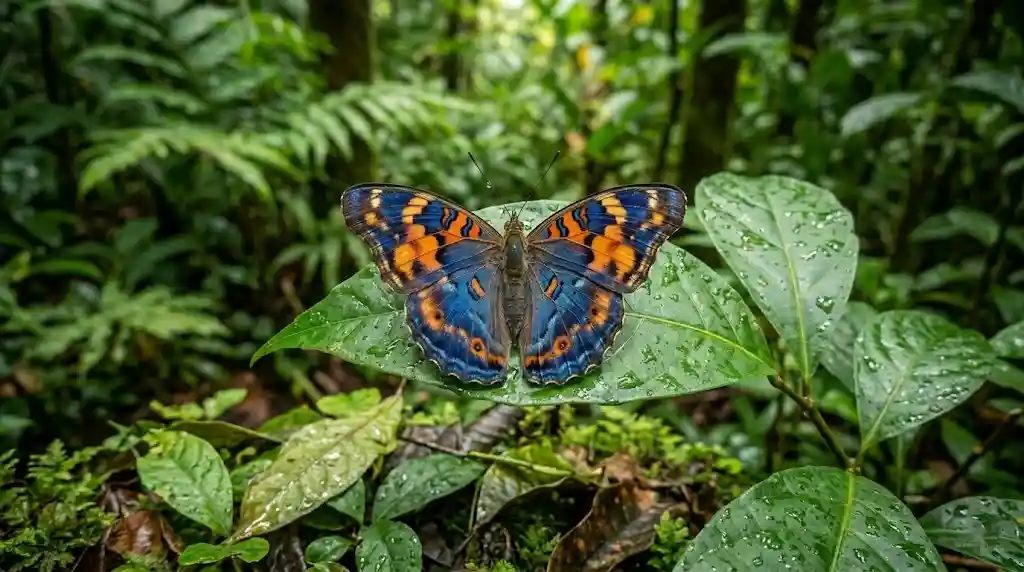
A single butterfly species in the Amazon can register temperature shifts that even the most accurate digital thermometers take years to confirm as a statistical trend. Recent research carried out in the heart of the world’s largest tropical forest shows that populations of butterflies and moths are going through drastic fluctuations that work as an early warning system for environmental imbalance. With short life cycles and a striking sensitivity to heat, these insects have become the most efficient biological sentinels available for understanding how global warming is redrawing life beneath the forest canopy.
A methodological choice, not an aesthetic one
Using the insects of the order Lepidoptera as climate indicator species is not a matter of taste. It is a strict methodological requirement. Unlike large mammals, which can travel long distances to escape heat or drought, butterflies are tightly bound to local microclimates and to the specific host plants their caterpillars depend on. When rainfall patterns shift or air humidity drops below historical levels, caterpillar survival rates collapse almost immediately. That collapse opens a population gap that scientists can measure with precision, and the gap itself becomes a real time map of the health of the Amazon ecosystem.
Scale is what makes the signal so valuable. A bird or a primate may take several seasons to show the effects of an unusual year, because their generations are long and their ability to move buffers the impact. A butterfly, by contrast, completes its cycle in weeks. A severe dry spell therefore translates almost at once into a generation that is smaller, paler, or simply missing. Read through these wings, the forest answers long before the answer shows up in the historical series produced by instruments.
Wings that record environmental stress
Field expeditions in conservation areas show that Amazon biodiversity research has focused on two concrete traits: wing coloration and wing size. Certain butterfly communities are displaying subtle morphological changes that help them cope with increased solar radiation and with the shortage of nectar during prolonged droughts. This is adaptation accelerated by environmental pressure, visible over a span of years rather than centuries.
To document it, researchers rely on capture nets and photographic monitoring, cataloguing thousands of individuals every month. That material is then compared with records gathered two decades ago by Revista Amazônia, which allows a clear reading of how species have evolved in the face of successive crises. The comparison between old and recent series is, in practice, the backbone of the method. Without that archive there would be no way to tell an ordinary fluctuation apart from a genuine trend.
The sentinel effect
Butterflies are considered ideal bioindicators for three main reasons. The first is taxonomic: their classification is well established, which makes identification in the field feasible even for small teams. The second is ecological: they occupy different niches, from the damp forest floor to the highest canopy, so a single sampling effort covers several layers of the forest at once. The third is physiological: they respond quickly to chemical changes in the environment, including rising carbon dioxide.
The size of the universe under study gives a sense of the challenge. More than 7,000 butterfly species are estimated to live in the Amazon Basin, and a large share of them still await formal scientific description. Every field campaign therefore serves two purposes at the same time: it takes the pulse of the climate and it expands the inventory of a fauna that remains, to a great extent, unknown.
Climate refuges and public policy
What the data reveal about the future is both a warning and an opportunity. Variation in butterfly populations indicates that some parts of the forest are losing their capacity for thermal self regulation faster than previously assumed. That is the uncomfortable side of the finding. The other side is that the same monitoring effort makes it possible to identify what researchers call climate refuges: stretches of forest that remain stable and can serve as sanctuaries for the preservation of species at risk.
That map carries practical consequences. Knowing where the forest still holds its thermal stability helps decide which areas deserve priority protection and which ones need urgent restoration, a direct input for the environmental policies that global leaders will discuss in Belém. Science stops being an abstract diagnosis and becomes a criterion for allocating resources.
From a single species to the whole system
Combining scientific knowledge with the observation of local fauna changes the way conservation is understood. The point is not only to save an isolated species, but to grasp that butterflies are the visible gear of an invisible and complex climate machine. The methodology applied today in Brazil is being exported to other tropical biomes, consolidating Brazilian science as a reference in the study of bioindicators.
The reach of that protection extends far beyond the forest itself. Safeguarding the habitat of these insects also secures the continuity of the rains that supply agribusiness and cities across the South American continent. The water that falls on farmland thousands of kilometres away begins its journey in the same humid, shaded environment where a caterpillar either survives the season or does not.
The fleeting beauty of a wing beating in the forest is, in truth, the vital pulse of a planet trying desperately to keep its balance. Each count, each photograph and each catalogued specimen adds one more line to a record that no thermometer could ever write on its own.
Reporting: Anne Silva / Amazonia Mag. Source: Revista Amazônia, original Portuguese edition.

Editor, English Edition — Amazonia Mag
Anne Silva is the editor of Amazonia Mag, the English-language edition of Revista Amazônia. She curates, translates and adapts the outlet's science and environment coverage for an international audience, reporting on Amazon wildlife, flora, rivers, climate and research. Every story she edits is grounded in peer-reviewed studies, official data and on-the-ground reporting from the Revista Amazônia newsroom in Belém, Pará, Brazil. More by Anne Silva →