
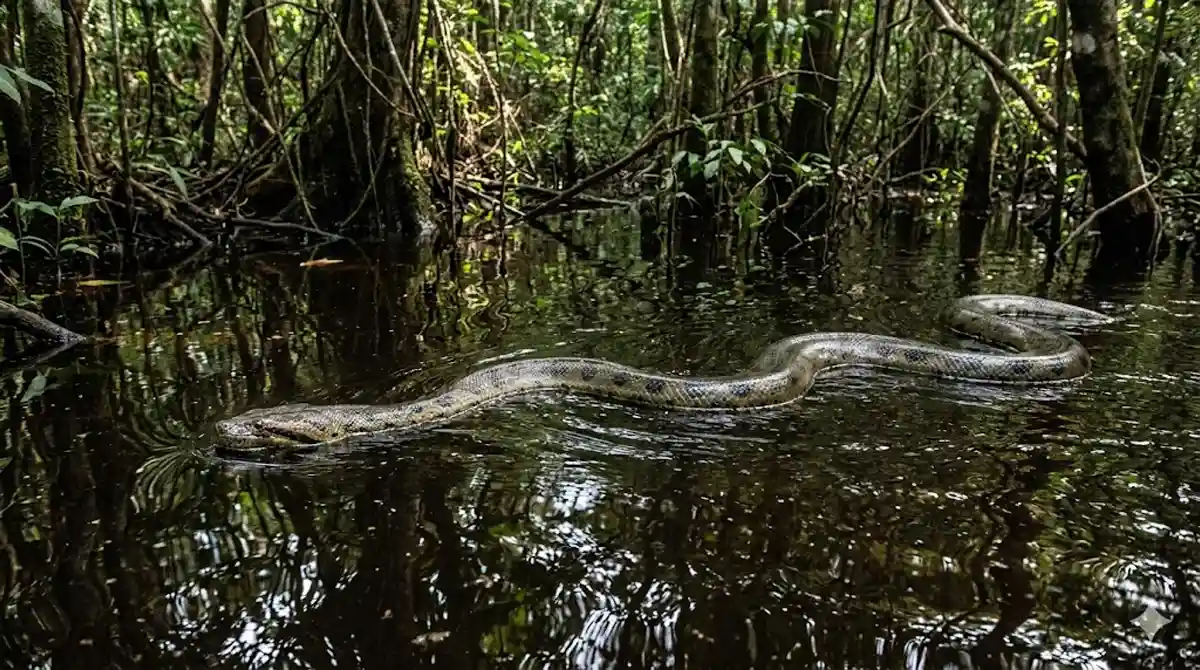
A single female green anaconda can exceed seven metres in length and weigh more than two hundred kilos, which makes her the largest snake on the planet in terms of body mass. Yet the figure that truly changes how biologists see this animal is not its monumental size, but its ability to process nutrients between the terrestrial and the aquatic world. In balanced floodplain ecosystems, the biomass controlled by these reptiles is understood to be decisive in preventing opportunistic species from taking over the river channels, and it allows microscopic life and large fish to coexist in the same water.
The Amazon anaconda is not merely a celebrated resident of the largest river basin on Earth. She works as a kind of silent environmental engineer. As one of the most important aquatic snakes in Brazil, she holds the position of Amazonian apex predator, which means that above her there are practically no natural enemies once she reaches adulthood, with the occasional exception of large black caimans or the jaguar. That place at the top of the food pyramid gives her the responsibility of regulating prey populations that, left unchecked, could collapse local vegetation and water quality alike.
The cascade effect of predation
To understand why the anaconda matters, we need to look at what scientists call a trophic cascade. When the snake hunts capybaras, smaller caimans, water birds and large fish, she prevents those populations from growing in a disorderly way. If capybaras, for instance, had no predators, they would graze the riverside vegetation so aggressively that the banks would suffer accelerated erosion. By keeping the number of herbivores under control, the anaconda indirectly protects the tree roots that hold the banks in place and provide shelter for the spawning of hundreds of fish species.
Contrary to what common sense suggests, the anaconda does not eat every day. Her metabolism is extremely slow and extremely efficient. After a large meal the animal may spend weeks or even months at rest, processing the protein and returning nutrients to the ecosystem through its waste. That nutrient cycle is vital to the fertility of the region white and black waters, because it feeds the phytoplankton that forms the base of the entire aquatic food chain.
The detail matters because it exposes a counterintuitive logic. The predator that popular imagination paints as insatiable is in practice a frugal manager of energy: every captured prey becomes weeks of slow metabolism, and every digestive cycle ends up fertilising the water around the animal. Two distinct ecological functions therefore live inside the same body, population control and the transport of nutrients from solid ground into the pulse of the flood, and no other species in the system performs that pair of roles in quite the same way.
Myths and the scientific truth
Brazilian popular culture, rich in legends such as the Cobra Grande or Boiúna, has often painted the anaconda as a man eating monster. That folkloric view, however important it is to cultural identity, created a stigma that damages conservation. In reality, anaconda attacks on human beings are extremely rare and almost always happen as a defensive reaction to an invasion of territory or to inadequate handling. The anaconda is by nature a shy animal that prefers escape to confrontation.
Another common myth holds that these snakes are venomous. Like every species in the Boidae family, anacondas have no venom glands and no fangs able to inject toxins. They rely on muscular strength for constriction. Their backward curving teeth serve only to hold the prey in place while the muscular body does the work of interrupting the blood flow of the target. Understanding that biology is the first step towards replacing fear with scientific respect.
What happens when the anaconda disappears
The absence of apex predators in an Amazonian region is a clear sign of environmental degradation. When the anaconda vanishes from a stretch of river, the ecosystem falls out of balance immediately. Field observers note the explosive increase of small caimans and rodents, which then compete unfairly for resources with other species. On top of that, the genetic health of prey animals declines, because the anaconda tends to capture slower, older or sick individuals, performing a natural selection that keeps the hunted populations vigorous.
Habitat fragmentation caused by major infrastructure works and mercury contamination from illegal mining are the greatest current threats. As a top predator, the anaconda suffers from bioaccumulation. That means the toxins present in small fish concentrate at far higher levels inside the body of the snake, affecting its reproductive capacity and its longevity. Preserving the anaconda is therefore a way of preserving the chemical purity of Amazonian waters.
Seen from that angle, the animal doubles as a living indicator. A river stretch that still holds healthy adult anacondas is telling researchers something about the fish beneath the surface, about the vegetation on the banks and about the substances circulating through the whole chain. A river stretch that has lost them is telling a different story, and usually a shorter one, because the disappearance of the top of the pyramid rarely happens on its own.
Conservation strategies and the road ahead
At present the conservation status of the green anaconda (Eunectes murinus) is listed as «Least Concern» by the International Union for Conservation of Nature, but that classification can be misleading when specific regional contexts are taken into account. In areas of agricultural expansion and deforestation, local populations are disappearing quickly. Satellite monitoring and telemetry have helped Brazilian researchers understand the migratory routes these animals follow during floods and droughts, which in turn allows the design of more effective ecological corridors.
Environmental education in riverside communities remains the most powerful tool available. When someone living on the riverbank understands that the anaconda near the house is the guarantee of abundant fish in the future, a relationship of conflict turns into coexistence. Contemplative ecotourism projects, in which visitors pay to observe these animals in their natural habitat, are also proving to be a viable economic alternative to predatory hunting or to killing out of fear.
The Amazon anaconda embodies the strength and resilience of the forest. She is not the villain of a thriller, but a guardian of the waters who, with every sinuous movement, keeps the pulse of life beating in the heart of Brazil. Protecting the aquatic snakes of Brazil means making sure the rivers remain the arteries of a green continent that still has a great deal to teach us about balance and survival. The survival of the species is, in the end, a direct reflection of our own capacity to live alongside what is vast and wild without needing to dominate or destroy it.
Reporting: Anne Silva / Amazonia Mag. Source: Revista Amazônia, revistaamazonia.com.br

Editor, English Edition — Amazonia Mag
Anne Silva is the editor of Amazonia Mag, the English-language edition of Revista Amazônia. She curates, translates and adapts the outlet's science and environment coverage for an international audience, reporting on Amazon wildlife, flora, rivers, climate and research. Every story she edits is grounded in peer-reviewed studies, official data and on-the-ground reporting from the Revista Amazônia newsroom in Belém, Pará, Brazil. More by Anne Silva →