
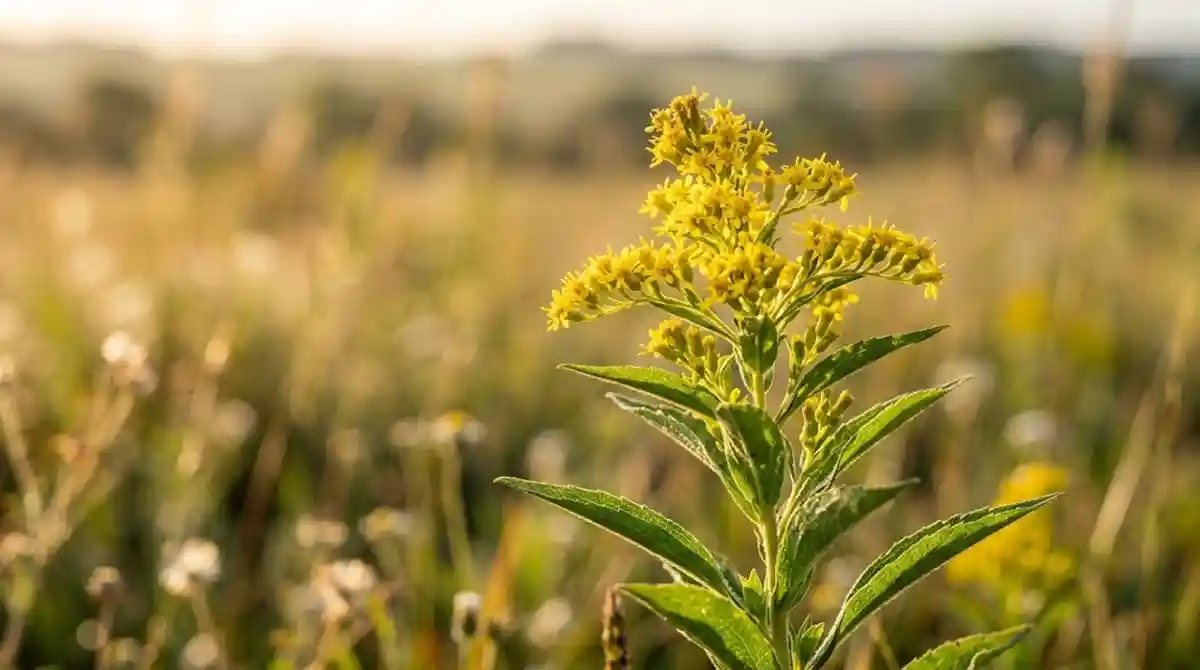
Joining traditional knowledge about a medicinal plant with the precision of nanoscience is no longer a distant promise: it is now a laboratory procedure. A new Brazilian study uses the water extract of Brazilian arnica, the species Solidago microglossa, to produce silver nanoparticles without the aggressive reagents that dominate industrial practice. The result is a cleaner manufacturing route for a material already present in advanced wound dressings and in hospital equipment around the world.
Silver nanoparticles are prized for one relentless quality: they fight fungi, viruses and bacteria with an efficiency few materials can match. That reputation explains why they are built into dressings, hospital surfaces and high performance medical devices. The problem was never the end result, but the path taken to reach it. The traditional manufacturing method carries a heavy environmental cost, because it generates hazardous byproducts that can trigger cell death and build up in ecosystems.
A clean route for a problematic material
That environmental liability is exactly what pushed researchers at the School of Pharmaceutical Sciences of Ribeirão Preto, the FCFRP unit of the University of São Paulo, to look for an alternative. Instead of fine tuning the conventional process, the team decided to replace its central piece: the reducing agent. In nanoparticle chemistry, that agent is responsible for turning metal ions into stable particles, and it is also the point where solvents that pollute soil and water usually enter the equation.
The answer came from Brazilian biodiversity. The water extract of arnica plays the part of a natural reducing agent in a procedure known as green synthesis. The plant does the work that once required aggressive reagents, and it does so in a water based medium, with no need for polluting solvents. Removing those compounds is not a cosmetic detail: it takes out of the process precisely the byproducts that later become a disposal problem for industry.
Paulo Augusto Marques Chagas, a postdoctoral researcher at USP and one of the names leading the project, sums up the goal as integral sustainability. According to him, the strategy makes it possible to obtain materials with high level functional properties while using far less energy than conventional industrial processes. That is an unusual combination, because reducing environmental impact normally comes at the price of weaker performance or a more expensive process.
The contrast with traditional industry becomes clear when the full cycle is considered. Where the conventional route produces waste that demands constant treatment and monitoring, the green route uses a plant input and aims to guarantee that production stays healthy from beginning to end. The plant stops being merely a symbol of popular knowledge and takes on a technical function inside the process, with a defined and verifiable task in the reactor.
There is also a scientific logic behind the choice. Plant extracts carry compounds able to donate electrons, and it is that chemical behaviour, not folklore, that makes them useful in nanoparticle synthesis. By selecting a species that grows widely in Brazilian fields, the team combined availability with function, turning an abundant local resource into an industrial input rather than importing a specialised chemical for the same job.
From academic bench to owned technology
The project grew out of collaboration between research groups gathered at the Environmental Control Laboratory, coordinated by professor Mônica Lopes Aguiar at the Federal University of São Carlos, known as UFSCar. What began as academic research into recycled materials gradually took the shape of applied technology, reaching a point that remains rare in Brazilian science: results with disruptive market potential and declared industrial interest.
The clearest sign of that shift is legal. The team has already filed a patent application for the process, a step meant to secure exclusive rights over the technique and to open the way for agreements with industry. At the same time, the scientists are finishing an academic paper detailing one specific application of these nanoparticles: their incorporation into nanofibres designed for air filtration.
Filters and masks with stronger antibacterial protection
That application is the one most likely to reach everyday life quickly. Filters and masks made from nanofibres loaded with silver would offer antibacterial protection superior to current models, combining biological safety and environmental awareness in a single product. It is a market that gained visibility in recent years and that keeps demanding materials able to retain particles without compromising breathing or the comfort of the person wearing them.
The advance also speaks to regulation. In Brazil, the use of nanomaterials in health products falls under the guidelines of the National Health Surveillance Agency, known as Anvisa, which defines the parameters for applying these technologies on national territory. Any product derived from the research will have to follow that path before reaching hospitals, pharmacies and production lines.
Four points sum up the innovation. Sustainability, through the direct use of Brazilian biodiversity as a process input. Safety, through the elimination of harmful chemical solvents. Technology, with planned application in air filters and medical devices. And a pending patent, meant to secure exclusivity over the technique developed. Together, these elements describe research that does not stop at the scientific paper and that points toward industrial production.
What remains, in the end, is an image that captures the work well: a plant common in Brazilian fields, associated for generations with relief from bruises and pain, now takes on a second vocation inside a nanotechnology laboratory. Traditional knowledge was not replaced by science, it was absorbed by it, and the outcome is a process that delivers the same familiar material through a route the natural world can actually withstand.
Reporting: Anne Silva / Amazonia Mag. Source: School of Pharmaceutical Sciences of Ribeirão Preto (FCFRP-USP) and the Environmental Control Laboratory at UFSCar.

Editor, English Edition — Amazonia Mag
Anne Silva is the editor of Amazonia Mag, the English-language edition of Revista Amazônia. She curates, translates and adapts the outlet's science and environment coverage for an international audience, reporting on Amazon wildlife, flora, rivers, climate and research. Every story she edits is grounded in peer-reviewed studies, official data and on-the-ground reporting from the Revista Amazônia newsroom in Belém, Pará, Brazil. More by Anne Silva →