
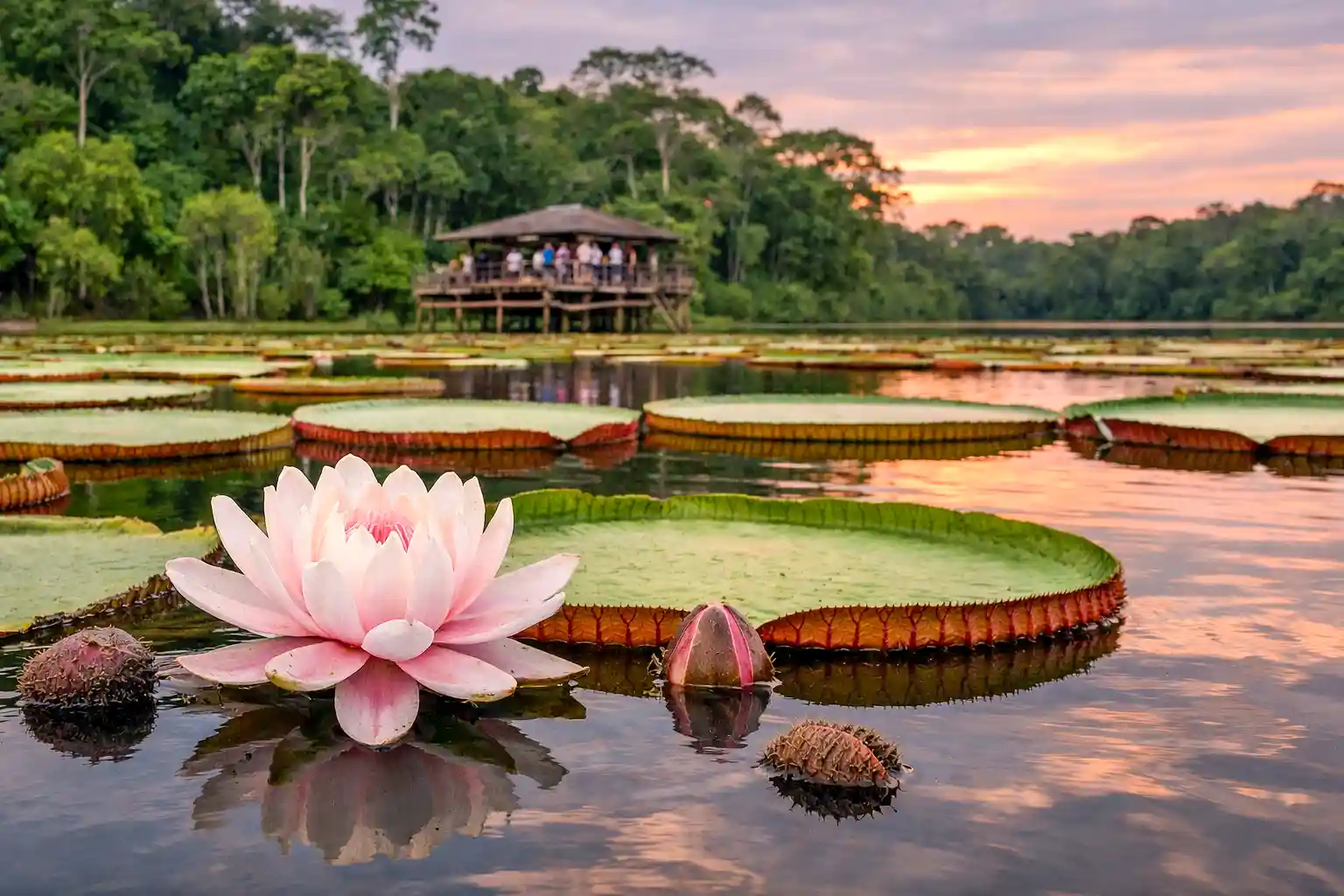
A single flower can reach up to 40 centimetres across and stay open for only one or two nights a year. That detail, almost impossible to put on a calendar, is enough to send travellers from different parts of the world on long journeys into the heart of the Amazon with a single goal: to be standing at the water at the exact moment the spectacle happens.
The Amazonian giant water lily, one of the most iconic plants in the region, is not only a symbol of biodiversity. It is also a quiet engine of ecotourism in Para. Its short flowering cycle, tightly synchronised with very specific environmental conditions, turns lakes and creeks into natural stages where science, culture and economics meet.
A plant built for water
The species belongs to the genus Victoria and carries circular leaves that can exceed two metres in diameter. That surface, held together by a framework of ribs, supports small animals and even the weight of a child. Still, it is the flower that steals the scene. As night falls it opens white and releases an intense perfume meant to attract pollinating beetles. The following day it changes colour, turning pink before closing for good.
The phenomenon combines evolutionary strategy and visual beauty, and riverside communities, particularly in Para, have been putting it to sustainable use. Regions such as the Marajo archipelago and areas near Santarem and Belem report growing numbers of visitors who want to see Amazonian flowers in their purest state.
The river writes the calendar
The natural calendar of the giant water lily shifts with the movement of the water. During the flood season, the flooded environments offer ideal conditions for the plant to develop. When the waters recede, the shrinking mirrors of water limit its spread. That hydrological cycle is decisive in defining the best time to visit, which in several parts of Para usually falls between the months of May and September.
Local guides have specialised in interpreting the phenomenon for tourists. The point is not simply to see the flower, but to understand its ecological role. The giant water lily works as an indicator of environmental quality, sensitive to changes in the water and in the surrounding vegetation. Its presence reveals relatively well preserved ecosystems, while its absence can signal degradation.
Beyond the giant water lily, other Amazonian aquatic flowers are also gaining ground in nature tourism. Species such as water hyacinth and mururu, although far more common, create lush landscapes when they bloom at scale. In certain periods, rivers and lakes are covered in lilac and blue tones, composing scenes that look like living paintings.
Community tourism and how the income spreads
Those collective blooms attract photographers, researchers and travellers in search of authentic experiences. The growing interest strengthens community tourism initiatives, in which local residents work as guides, boat operators and hosts. The model spreads income more fairly and encourages the conservation of natural environments.
In riverside communities of the Lower Amazon, for instance, entire families take part in receiving visitors. From preparing traditional meals to steering boats along water trails, every activity feeds the local economy. Tourism built around Amazonian flowers has proved a viable alternative to predatory activities such as illegal logging and overfishing.
Researchers stress that valuing biodiversity through ecotourism in Para can produce positive long term effects. Once the forest is seen as a sustainable economic asset, communities become far more committed to protecting it. The result is a virtuous cycle in which conservation and development move forward together.
A flower that is also a story
The giant water lily carries strong cultural weight as well. Present in Indigenous legends, it is often linked to transformation and enchantment. One of the best known stories tells of a young Indigenous woman in love with the moon, who turns her into the flower after she throws herself into the water. That imagery reinforces the value of the plant not only as a tourist attraction but as an element of regional identity.
International interest in the Amazonian giant water lily is nothing new either. Since the nineteenth century, when specimens were taken to European botanical gardens, the plant has inspired fascination. Today, with the rise of social media and the search for natural destinations, that interest has intensified and placed the Amazon in the spotlight as a global ecotourism destination.
Growing without breaking the balance
Specialists warn, however, that planning is essential. Any increase in visitor numbers has to come with control measures and environmental education. Approaching the plants inappropriately, dumping waste and using motorised boats in sensitive areas can compromise the balance of these ecosystems.
Sustainable management initiatives are already under way in some regions. In protected areas, access is limited and guided by trained professionals. Elsewhere, communities set their own rules to make sure visits do not exceed what the environment can absorb. Those practices are essential if tourism is to remain a conservation tool rather than a threat.
Scientific research is another relevant dimension. Studying Amazonian aquatic flowers helps explain complex ecological processes such as pollination, adaptation to flooded environments and responses to climate change. The giant water lily, for example, has been the subject of research on biomimetics, inspiring solutions in engineering and design.
The relationship between science and tourism can be strengthened through environmental education. Programmes that involve visitors in observation and interpretation raise awareness of the importance of biodiversity, turning the tourist experience into a process of learning and engagement.
In the context of climate change, preserving aquatic ecosystems becomes even more important. Changes in rainfall patterns and in river dynamics can directly affect the flowering of the giant water lily and of other species. Monitoring those effects is essential to adapt conservation strategies and to guarantee the continuity of the tourism that depends on them.
From Belem to the rivers of the interior
The Amazon, with its vast network of rivers, offers unique conditions for aquatic plants to develop. That diversity is a heritage that needs to be valued and protected. Tourism, when properly planned, can be a powerful ally in that process.
In Belem, environmental education initiatives in urban parks are beginning to highlight the importance of aquatic flora. Spaces such as Mangal das Garcas let visitors have a first encounter with the giant water lily, sparking interest in more immersive experiences in the interior of the state.
Connecting urban areas with riverside regions can widen the reach of ecotourism in Para. By linking visitors to different contexts of Amazonian biodiversity, the region builds a fuller and more compelling narrative, which strengthens its image as a sustainable tourism destination.
Local entrepreneurs have been innovating in the experiences they offer as well. Sunset trips to watch the giant water lily open, stays in floating houses and specialised photography routes are among the options gaining popularity. Those initiatives add value to the visit and keep tourists in the region for longer.
The economic impact of this movement is already visible. Communities that once depended exclusively on fishing or subsistence agriculture now find in tourism a complementary source of income. That helps improve quality of life and reduces pressure on natural resources.
At the same time, it is essential to guarantee that the benefits are shared fairly. Active participation by communities in managing tourism is a key factor in the success of these initiatives. Collaborative models involving local associations and partnerships with non governmental organisations have proved effective.
Valuing Amazonian flowers also opens space to promote regional products. Handicrafts, food and cultural expressions gain visibility, enriching the visitor experience and strengthening the local economy at the same time.
Globally, the search for sustainable destinations is likely to keep growing. The Amazon, with its incomparable biodiversity, has the potential to establish itself as a benchmark in ecotourism. The giant water lily, with its singular beauty and ephemeral cycle, is one of the emblems of that vocation.
Preserving that heritage demands collective commitment. Governments, communities, researchers and tourists all have complementary roles in building a development model that respects the limits of nature. The standing forest, with its rivers and its flowers, is the foundation of that future.
Every new bloom of the giant water lily renews the chance to show the world that the Amazon is more than a biome: it is a living system of relationships that sustains cultures, economies and dreams. In the silence of the water, where a flower opens for just a few hours, lies the proof that nature does not follow human haste, and that real value lies in knowing how to preserve what cannot be recreated.
Reporting: Anne Silva / Amazonia Mag. Source: Revista Amazônia, original report in Portuguese.

Editor, English Edition — Amazonia Mag
Anne Silva is the editor of Amazonia Mag, the English-language edition of Revista Amazônia. She curates, translates and adapts the outlet's science and environment coverage for an international audience, reporting on Amazon wildlife, flora, rivers, climate and research. Every story she edits is grounded in peer-reviewed studies, official data and on-the-ground reporting from the Revista Amazônia newsroom in Belém, Pará, Brazil. More by Anne Silva →