
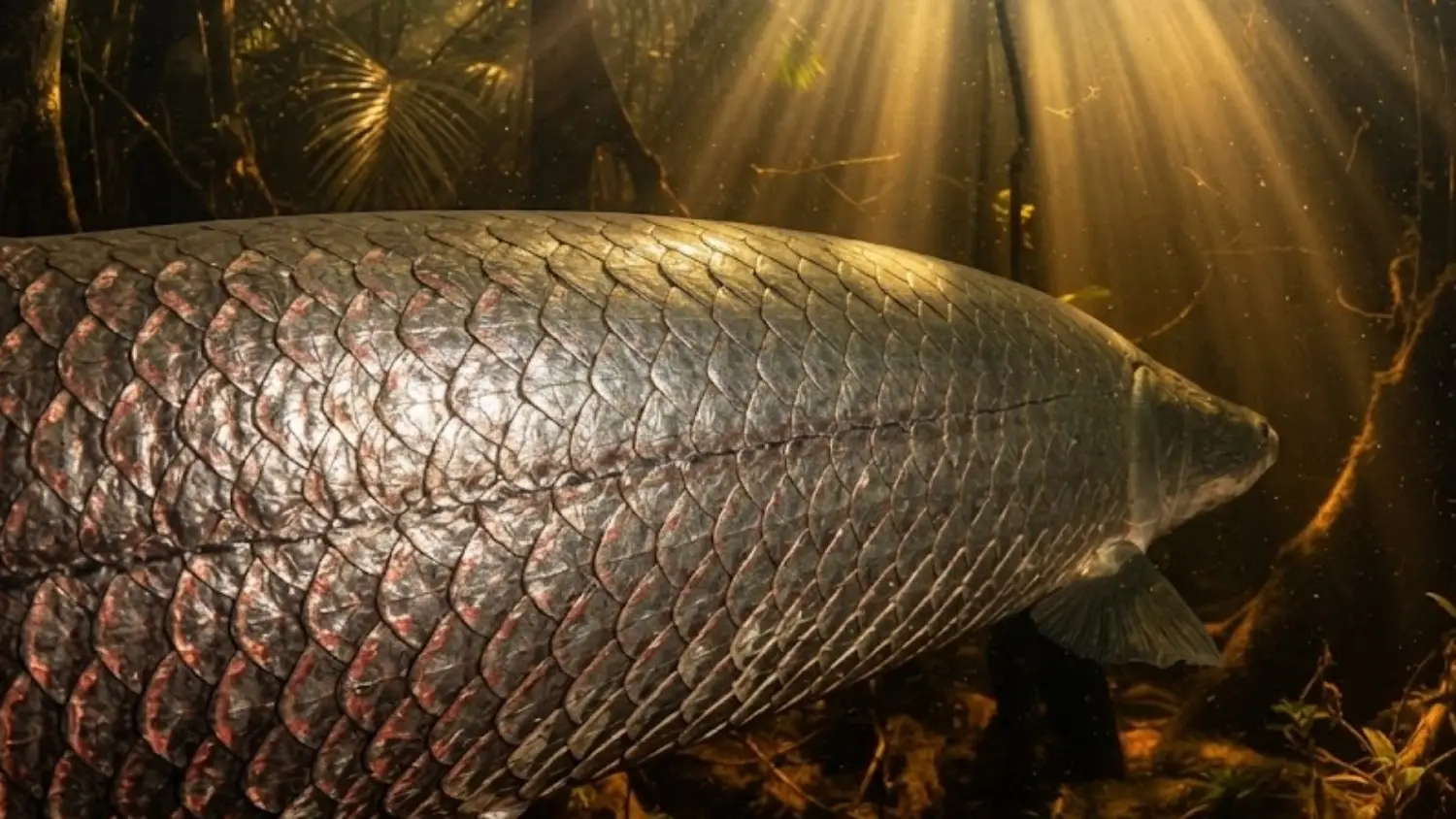
In the deep, powerful rivers that shape the largest rainforest on Earth, natural evolution has engineered biological solutions so refined that they now serve as a direct blueprint for high-strength synthetic materials in advanced laboratories around the world. The pirarucu (Arapaima gigas), recognized as one of the largest freshwater scaled fish on the planet, carries across its colossal body a fascinating natural armor able to withstand the fierce attacks and bites of piranha shoals in Amazonian waters. Each scale of this magnificent animal combines an extremely hard mineralized outer layer with a highly flexible inner base rich in collagen, forming a two-layer structure that dissipates the energy of intense impacts without suffering catastrophic fractures. This unique anatomical arrangement protects the native predator and, at the same time, sparks the interest of engineers and scientists devoted to developing new protective technologies.
A two-layer natural armor
The engineering behind this natural defense relies on a gradient of structural stiffness that behaves much like an advanced ceramic bonded to an elastic polymer, absorbing and deflecting the mechanical force of sudden shocks in exemplary fashion. When a predator tries to bite the fish along its flank, the rigid outer layer prevents perforation while the flexible inner matrix of collagen fibers deforms in a controlled way, spreading the kinetic energy across the surrounding surface. This defensive strategy allows the animal to move with complete safety through the contested waters of the river basin, keeping its physical integrity even in the face of constant threats in the wild. Understanding the mechanics of these scales opens doors to significant advances in the manufacture of safety materials and high-performance protective equipment.
From the river to the laboratory: biomimicry in action
The detailed study of the microscopic structure of pirarucu scales has inspired materials-science researchers to create innovative synthetic composites aimed at aviation and advanced personal protection. Aeronautical engineers and bioinspiration specialists use the impact-absorption principles found in the fish’s biology to design lighter and more flexible bulletproof vests, along with resistant coatings for spacecraft and commercial aircraft. This transfer of technological knowledge shows how careful observation of Amazonian biodiversity can solve complex problems of contemporary society without resorting to destructive artificial methods.
The secret lies in the gradual transition between the rigid and the flexible: instead of an abrupt boundary between two materials, the scale presents a progressive change that prevents cracks from forming at the interface, precisely the point where human-made armor tends to fail. Reproducing that smooth transition is one of the greatest challenges and, at the same time, one of the greatest promises of materials science inspired by the Amazon. Traditional composites often join a hard shell and a soft backing at a single sharp seam, and it is exactly along that seam that they crack under repeated blows, whereas the fish spreads the change across many microscopic steps that keep the whole scale working as one continuous, resilient piece.
Valuing the evolutionary intelligence present in wild species builds a solid bridge between cutting-edge scientific research and environmental preservation. By replicating the architecture of the scales in the laboratory, biomimetic materials promise to combine lightness, flexibility and strength in a single body, something difficult to achieve with conventional designs. This approach reveals that the rainforest is not merely a reservoir of resources, but also a library of natural patents refined over millions of years, available to anyone willing to observe it with care and respect.
Community management and bioeconomy
Preserving natural pirarucu populations and encouraging sustainable management in riverside communities are fundamental pillars for conserving aquatic biodiversity and strengthening the regional bioeconomy. Through rigorous population-control systems and community fishing quotas grounded in ecological science, it becomes fully feasible to reconcile traditional consumption with the lasting protection of the species in the rivers of the Amazon. Every successful management initiative proves that conserving natural resources generates direct and durable economic benefits for local families, adding value to the forest and its inhabitants.
Guaranteeing the protection of river ecosystems and the proper management of native species is an indispensable condition for ensuring the sustainability of local production chains in the Amazon basin. Encouraging responsible consumption of pirarucu managed in floodplain lakes strengthens the economy of traditional communities, turning local residents into active guardians of the waterways against illegal fishing and environmental degradation. When the economic value of living, well-managed wildlife surpasses the profit of predatory activities, a powerful incentive emerges to preserve entire aquatic habitats over the long term.
Observing the ingenuity of the pirarucu’s biological armor invites us to rethink our place in the world and our shared responsibility in protecting terrestrial and aquatic ecosystems. When we understand that every detail of nature results from a millennial journey of harmony and evolutionary adaptation, we realize that preserving the Amazon goes far beyond environmental conservation: it also means ensuring that future generations still have access to the solutions life has already invented.
Reporting: Anne Silva / Amazonia Mag. Source: Revista Amazônia.

Editor, English Edition — Amazonia Mag
Anne Silva is the editor of Amazonia Mag, the English-language edition of Revista Amazônia. She curates, translates and adapts the outlet's science and environment coverage for an international audience, reporting on Amazon wildlife, flora, rivers, climate and research. Every story she edits is grounded in peer-reviewed studies, official data and on-the-ground reporting from the Revista Amazônia newsroom in Belém, Pará, Brazil. More by Anne Silva →