
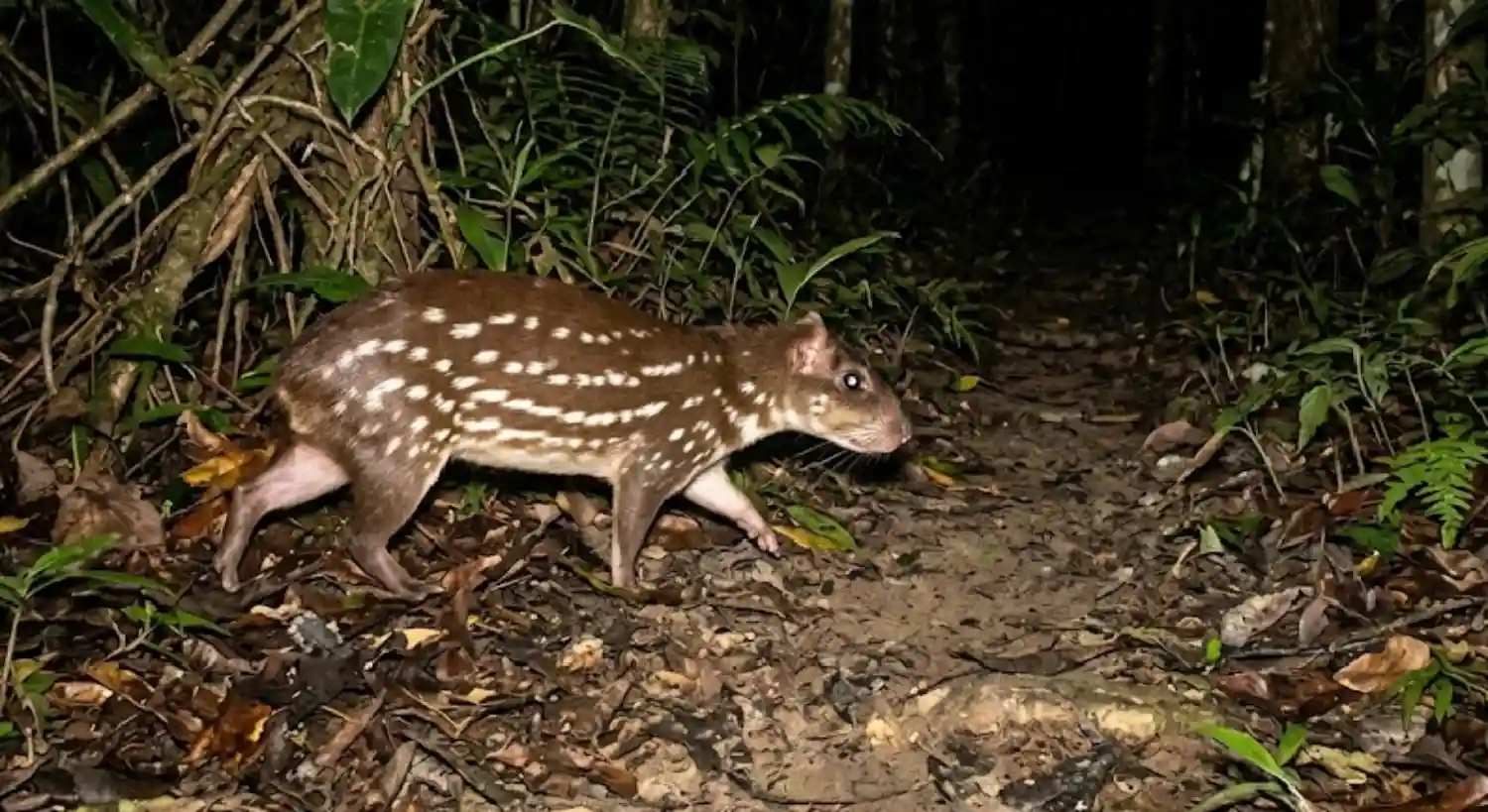
Deep in the shadows of the tropical forest lives an animal that communicates almost without being seen. The paca, known to science as Cuniculus paca, has cheeks that work like genuine resonance chambers, an anatomical trait that lets this rodent produce deep, powerful sounds, similar to snores, to communicate or to drive away rivals without any need for direct physical contact in the darkness. That biological detail, as surprising as it is little known, captures the complexity of one of the most emblematic and, at the same time, most mysterious mammals of Brazilian wildlife. A dweller of tropical forests with a strong presence across the Amazon, the paca draws attention both for its singular biology and for its cultural and economic weight in the lives of local communities.
From a biological standpoint, the paca is the second largest rodent in Brazil, outsized only by the capybara (Hydrochoerus hydrochaeris). An adult can weigh between six and twelve kilograms and shows a robust body, short and powerful legs, and short reddish brown fur. Against that background stand rows of white lateral spots that act as effective camouflage against the diffuse light filtering through the forest canopy, breaking up the animal’s outline among the shifting shadows and reflections of the vegetation.
A nocturnal and solitary life
Its habits are mostly nocturnal and solitary. During the day, the paca stays sheltered in deep burrows, usually dug into riverbanks, beneath the roots of large trees or inside hollow fallen trunks. According to research on the behavior of the species, these burrows often have more than one exit, an escape strategy designed against natural predators such as the jaguar (Panthera onca) and the boa (Boa constrictor). When night falls, the animal emerges to forage and reveals one of its most remarkable skills.
The paca is a superb architect of routes. Unlike other mammals that wander at random, it uses fixed and well marked trails through the low vegetation to move between its burrows and its feeding grounds. Studies indicate that the animal itself maintains and clears these paths, which allows fast and silent movement in the face of any threat. The rodent memorizes the exact location of every obstacle and every bend within its territory, trusting that spatial memory and its sharp senses far more than its limited vision beneath the dark canopy of the forest.
A planter of forests
The paca’s diet is fundamentally frugivorous. It feeds on a wide variety of fallen fruits, seeds, tubers and, on occasion, leaves. The fruits of palms such as acai, bacaba and tucuma are among its favorites. Because of this feeding habit, the paca plays a crucial ecological role as a seed disperser. By gathering fruits and frequently burying seeds to eat them later in places far from the parent tree, it actively contributes to the natural regeneration of the forest. Many of those seeds end up germinating, which is why many ecologists regard the paca as a true planter of forests.
Even so, the relationship between the paca and human populations in the Amazon is complex and marked by heavy hunting pressure. Its meat is highly prized, considered by many to be the tastiest among the region’s game animals thanks to its high fat content and tender texture. That appreciation turns the paca into a constant target both for subsistence hunting, practiced by riverine and Indigenous communities for their own consumption, and for illegal commercial hunting aimed at supplying markets and restaurants in urban centers.
The weight of hunting
Subsistence hunting is an ancestral practice, guaranteed by law to traditional populations in Brazil as a way of ensuring food security. However, according to wildlife monitoring research, hunting pressure on the paca has risen significantly in several regions and often exceeds the natural replacement capacity of the rodent’s populations. The paca has a relatively low reproductive rate, with long pregnancies that last about 114 days and that usually result in a single offspring per litter, once or twice a year.
This dynamic makes the species vulnerable to overexploitation. The sharp decline of paca populations in certain areas not only threatens the future food security of the communities that depend on the animal, but also produces ecological imbalances, given its role as a seed disperser and as prey for large predators. Every paca that vanishes leaves a gap that the forest is slow to fill, and the effects ripple outward through the web of life it helps to sustain.
Sustainable management as a path forward
Faced with this picture, the sustainable management of wildlife emerges as an indispensable tool for reconciling the conservation of the species with the needs of local populations. Studies indicate that community based management, in which the community itself sets the rules of use, such as hunting quotas, refuge areas where hunting is forbidden and closed seasons during the breeding period, yields promising results for keeping paca populations at healthy levels.
Beyond management in the wild, the breeding of pacas in captivity, regulated by Ibama, arises as an alternative to ease the pressure on wild populations and meet the commercial demand for meat. Legalized and controlled production offers a product with traceability and sanitary safety, and it generates income for rural producers. Nevertheless, the activity still faces technical and economic challenges, such as the high cost of feed and the demands of suitable facilities for an animal with digging habits and a wary temperament.
Protecting the paca in the Amazon calls for an approach on several fronts. It must include a rigorous fight against illegal commercial hunting and the trafficking of wild animals, which feed a lucrative market that is devastating for biodiversity. At the same time, it requires strengthening public policies that support sustainable community management, valuing traditional knowledge and ensuring that local communities are the leading actors in managing the natural resources on which they depend.
The paca is far more than a giant rodent or a source of protein: it is a vital part of the intricate machinery of the tropical forest. Its silent steps along the nocturnal trails, its deep voice echoing in the darkness and its constant interaction with the flora shape the Amazon in ways we often fail to notice. To reflect on the existence of the paca is to reflect on the future of the forest itself, and to ensure that this animal keeps walking its secret paths is a commitment to sustainability and to the biological wealth that makes the Amazon unique in the world.
Reporting: Anne Silva / Amazonia Mag. Source: revistaamazonia.com.br.

Editor, English Edition — Amazonia Mag
Anne Silva is the editor of Amazonia Mag, the English-language edition of Revista Amazônia. She curates, translates and adapts the outlet's science and environment coverage for an international audience, reporting on Amazon wildlife, flora, rivers, climate and research. Every story she edits is grounded in peer-reviewed studies, official data and on-the-ground reporting from the Revista Amazônia newsroom in Belém, Pará, Brazil. More by Anne Silva →