
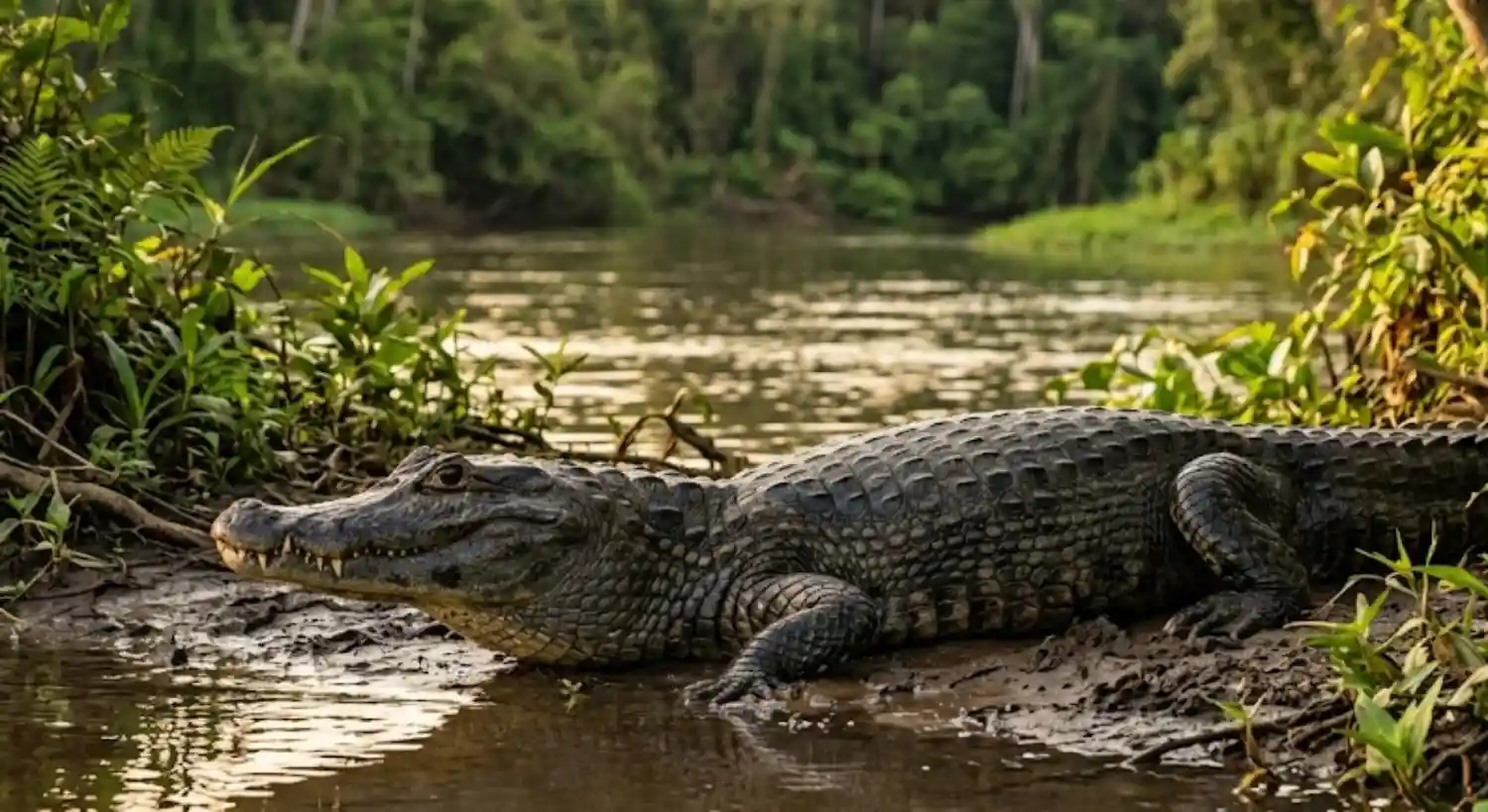
In the rivers and lagoons of the Amazon basin lives a reptile that carries a heavyweight title. The black caiman, known in Brazil as jacaré-açu and described by science as Melanosuchus niger, is the largest freshwater predator on the entire American continent. Adult individuals can exceed four meters in length and reach hundreds of kilograms, sitting firmly at the top of the food chain in the region’s aquatic ecosystems. This giant pairs an extreme bite force with highly developed sensory organs, a combination that lets it seize everything from fish and birds to the large mammals that wander to the water’s edge to drink.
The presence of this large reptile in waterways and lagoons is far more than a detail of the landscape. It secures the maintenance and natural flow of the flooded environments of the Amazon. As a dominant predator, the black caiman keeps in check the populations of many fish species, including piranhas and medium-sized carnivorous fish, preventing them from throwing the aquatic fauna out of balance. Its habit of moving between dry land and water also aids the circulation of nutrients through the organic matter of the lakes, linking two worlds that at first glance appear separate.
An Anatomy Shaped by Water
The body structure of the black caiman shows anatomical adaptations geared toward efficiency in the water and during the hunt. The bony plates beneath its dark skin, known as osteoderms, act as natural armor and, at the same time, help regulate body temperature by absorbing solar radiation. During the day, the animal lies exposed to the sun along the banks to store heat and speed up its metabolism, an apparent rest that in fact fuels long stretches of intense muscular activity through the night.
The reptile’s sight and smell operate with precision even in murky water or in the near-total absence of light. Sensory receptors set in the scales around the jaw pick up small variations in pressure and vibrations across the surface of the water, signaling the presence and the exact position of nearby prey. That perception system makes a well-aimed strike possible before the victim even notices the predator drawing close, a decisive advantage in the darkness of the Amazon night.
The Strategy of a Patient Hunter
The feeding strategy of the black caiman rests on immobilization and on the brute force of its jaws. The cylindrical, conical teeth are not built to tear or chew flesh but to grip prey firmly, leaving no room for escape. Once contact is made, the reptile uses its own weight and performs rolling movements in the water to disorient and pin down the other animal before swallowing it whole.
The animal’s ectothermic metabolism allows a highly efficient management of energy, so it can spend long periods at rest without the need to feed every day. That economy of calories proves essential for surviving the seasonal shifts of the Amazon, when river levels rise or fall dramatically and reshape the distribution of prey across the aquatic territory.
The Cycle of Reproduction
The reproduction of the species depends directly on changes in water level and on the availability of plant material on the forest floor. The female builds mound-shaped nests using soil, dry leaf litter, and branches gathered near the bodies of water. The decomposition of the organic matter within that structure generates the heat needed to incubate the eggs through the months of embryonic development.
The temperature held inside the nest determines the sex of the hatchlings that emerge at the end of the incubation period. Females stay close to the site to guard the eggs against monkeys, coatis, and birds of prey. When the young begin to call out from inside their shells, the mother opens the nest and gently carries the newborns in her mouth to the safety of the shallow waters.
An Unexpected Ally in the Dry Season
During periods of severe drought, when Amazon lakes lose volume and break apart into small isolated pools, the black caiman plays an important role in the survival of other species. By digging and moving along the muddy bottom, the reptile keeps deeper, more open pools that prevent the total drying of the water bed. These hollows retain water for longer and serve as a temporary refuge for fish, amphibians, and small invertebrates.
Beyond keeping those water points open, the concentration of the reptile in such areas draws in land animals that come to drink, keeping the food web active even in phases of water scarcity. The constant stirring of the bottom churns up sediments and nutrients and stops the water from stagnating completely before the return of the seasonal rains.
Conservation and Habitat
The distribution of the black caiman is tied to the preservation of the great rivers, the fluvial channels, and the intact floodplain forests of South America. The species requires habitats with low human intervention to establish its nesting sites and to maintain continuous hunting territories. Protecting these aquatic environments ensures that populations of large reptiles keep carrying out their ecological role without interruption.
Observing the behavior and population dynamics of this great predator provides relevant scientific data on the environmental quality of the river basin. The stability of black caiman populations signals the abundance of fishing resources and the integrity of the riverbank vegetation, working as a living thermometer for the health of the river.
The Balance of the Rivers
The continuous presence of the black caiman in Amazon waters illustrates how the top of the food chain sustains the functioning of the ecosystems around it. Securing the integrity of the rivers and preserving the habitat of this reptile is fundamental for the natural dynamics of the water to remain active. Understanding the biology of the largest freshwater predator on the continent is an indispensable step toward the conservation of Brazilian biodiversity, and toward a future in which the caiman and the river continue to depend on each other.
Reporting: Anne Silva / Amazonia Mag. Source: revistaamazonia.com.br

Editor, English Edition — Amazonia Mag
Anne Silva is the editor of Amazonia Mag, the English-language edition of Revista Amazônia. She curates, translates and adapts the outlet's science and environment coverage for an international audience, reporting on Amazon wildlife, flora, rivers, climate and research. Every story she edits is grounded in peer-reviewed studies, official data and on-the-ground reporting from the Revista Amazônia newsroom in Belém, Pará, Brazil. More by Anne Silva →