
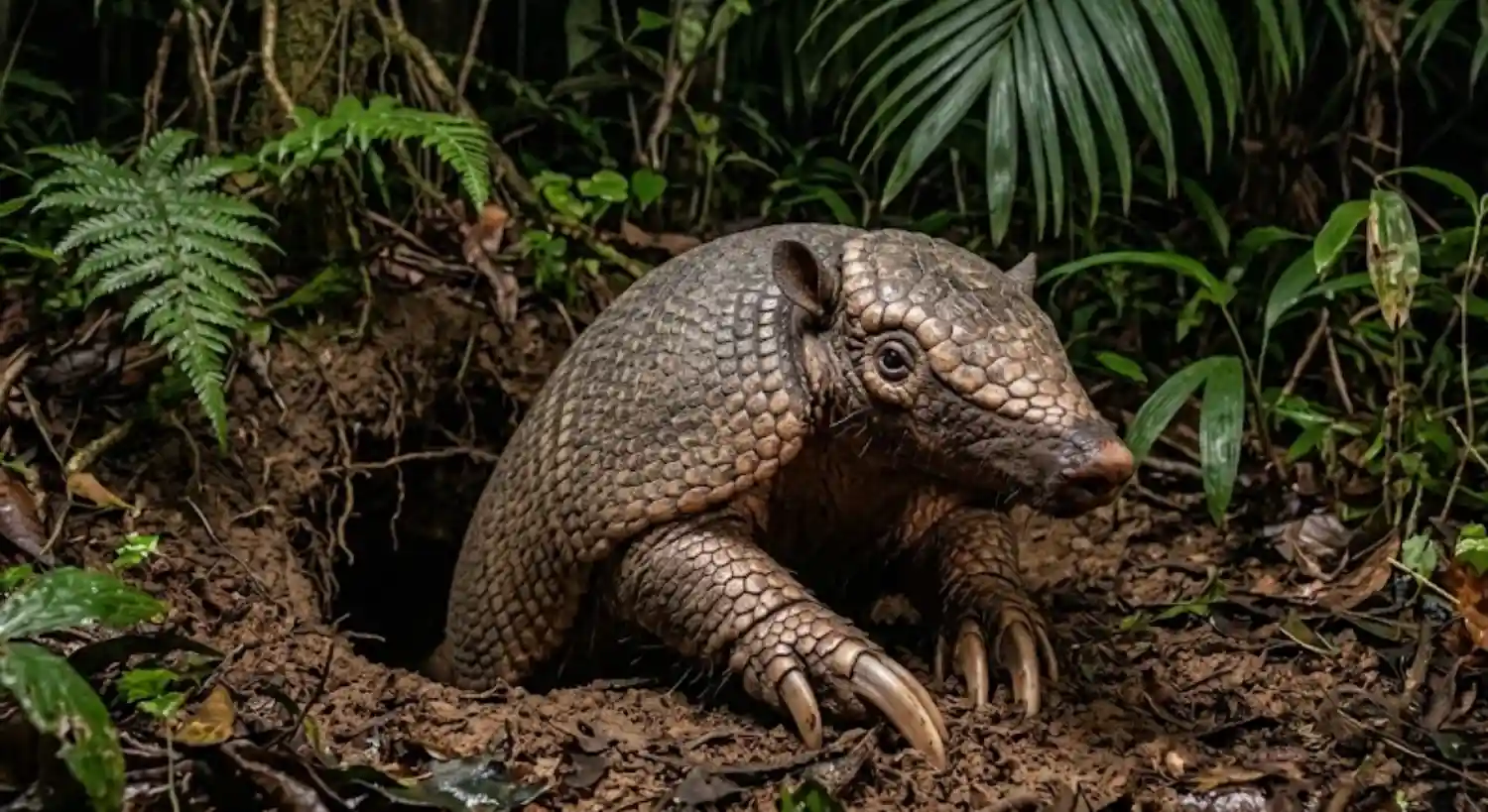
The giant armadillo holds the title of largest species in the armadillo family anywhere on the planet, and it works as one of the leading ecosystem engineers of the South American tropical forests. The animal can exceed a metre and a half in total length and weigh more than sixty kilos, and it carries curved claws that reach twenty centimetres. Those specialised anatomical structures behave like mechanical shovels, capable of breaking compacted soils and rigid termite mounds within minutes, opening deep tunnels that completely redefine the microhabitat around them inside the Amazon biome.
The excavations carried out by Priodontes maximus do not serve only the individual feeding and resting needs of the animal itself. When it abandons a burrow to look for new resources in another part of the forest, the species leaves behind a finished and protected underground structure. Camera traps installed at the entrances of those cavities record dozens of vertebrate species using the galleries to regulate body temperature, to shelter from predators and to rest safely during the day or through the night.
The mechanics of a living excavator
The ability of the giant armadillo to drill into the ground comes from the muscular power of its front limbs combined with the anatomical shape of its claws. The animal props itself on its hind legs and on a robust tail while it uses the central claws to remove large volumes of earth at a surprisingly fast rate. A single burrow can be more than forty centimetres wide and extend several metres below the surface, until it reaches layers where soil temperature and humidity remain constant.
That stabilised underground microclimate turns the burrow into an environment suited to the survival of species that have no biological capacity to dig a shelter of their own. During spells of intense heat or during tropical storms, temperature variation inside the armadillo cavities stays considerably lower than in the open forest outside. That stability reduces the thermal stress of small and medium sized mammals, reptiles and amphibians that live in the region.
A multifunctional underground lodging
The list of visitors to the burrows dug by the giant armadillo runs from small rodents and marsupials all the way to large mammals of the neotropical fauna. Species such as bush dogs, tayras, ocelots, giant anteaters and peccaries use the site as temporary refuge against predators, or as a place to raise their young, both in open woodland and in stretches of dense vegetation. Reptiles such as land tortoises and several snakes also frequent the galleries in search of safe shelter through long periods of inactivity.
The reuse of those cavities creates a mobile network of refuges scattered across the forest. Because the giant armadillo changes shelter often, both to avoid the build up of parasites and to follow the availability of termites and ants in the region, new underground entrances become available continuously to the local animal community. The disappearance of the digger from a given area interrupts that supply of shelters and indirectly affects the regional distribution of many other wild populations.
Nocturnal habits and a specialised diet
The giant armadillo shows strictly nocturnal and solitary behaviour, and it stays hidden inside its excavations during the hottest hours of the day. As night falls, the mammal emerges to travel long distances across the forest floor in search of social insect colonies. Its diet is predominantly myrmecophagous, built on the continuous consumption of termites and underground ants that are pulled directly from deep nests of soil and decomposing wood.
To capture thousands of insects in a few hours, the species relies on a long, sticky tongue and on a dentition reduced to small cylindrical structures with no enamel. A sharp sense of smell compensates for the animal’s limited vision and allows it to detect termite nests sitting tens of centimetres below the leaf litter. Breaking open those termite mounds releases nutrients stored in the soil and speeds up the decomposition of organic matter across the biome.
Rarity and scientific monitoring
Although its geographic range covers a large part of South America, the population density of the giant armadillo is naturally low in every biome where it occurs. A single individual needs extensive home ranges to obtain the food resources demanded by its body size. Because it lives at reduced densities and keeps nocturnal, underground habits, a direct sighting of the species in the field is an extremely uncommon event, both for researchers and for the people who live in the forest.
The study of the biology and ecology of this mammal advanced considerably over recent decades thanks to the expanded use of remote monitoring technology. Motion sensors and infrared cameras positioned in front of the entrances of active and inactive burrows make it possible to map the flow of animals that use the underground ecosystem. The data show that the ecological influence of the giant armadillo stretches across tens of kilometres around its foraging territory.
That monitoring effort also changed the way conservation work approaches the species. Instead of depending on rare direct encounters, researchers can now follow the life of a burrow over long stretches of time, watching which animals arrive, how long they stay and how the cavity is passed from one occupant to the next. Each active burrow becomes a natural observation post, and the record of visitors gathered at a single entrance says a great deal about the health of the surrounding forest block.
The role in forest balance
By turning over and aerating the soil while it searches for food and builds tunnels, the giant armadillo contributes to nutrient cycling and to the infiltration of water into the deeper layers of the ground. Moving large volumes of substrate loosens the surface layer and helps the germination of seeds that fall from the canopy trees, which supports the natural renewal of vegetation and the maintenance of forest structure.
The presence of the largest armadillo in the world inside a forest area works as a direct indicator of the quality and integrity of the local ecosystem. Because it requires wide stretches of continuous land, with suitable soils and an abundance of prey, the survival of the animal is tied to the conservation of connected forest blocks. It acts as a silent pillar in the architecture of biodiversity, linking life at the surface to the ecosystem that unfolds underground.
Preserving a work of natural engineering
The architecture of the giant armadillo burrow shows how the evolution of a single species can build support networks for hundreds of other life forms in the tropical forest. Making sure this great digger keeps moving across Amazonian soil means keeping open a network of underground shelters that is essential to the dynamics and balance of the ecosystem. Protecting the architect of the forest means preserving the very structure that sustains the diversity of lives under the shade of the trees.
Reporting: Anne Silva / Amazonia Mag. Source: Revista Amazônia.

Editor · Amazonia Mag
Anne Silva is the editor of Amazonia Mag, the English-language edition of Revista Amazônia. She curates, translates and adapts the outlet's science and environment coverage for an international audience, reporting on Amazon wildlife, flora, rivers, climate and research. Every story she edits is grounded in peer-reviewed studies, official data and on-the-ground reporting from the Revista Amazônia newsroom in Belém, Pará, Brazil. More by Anne Silva →