
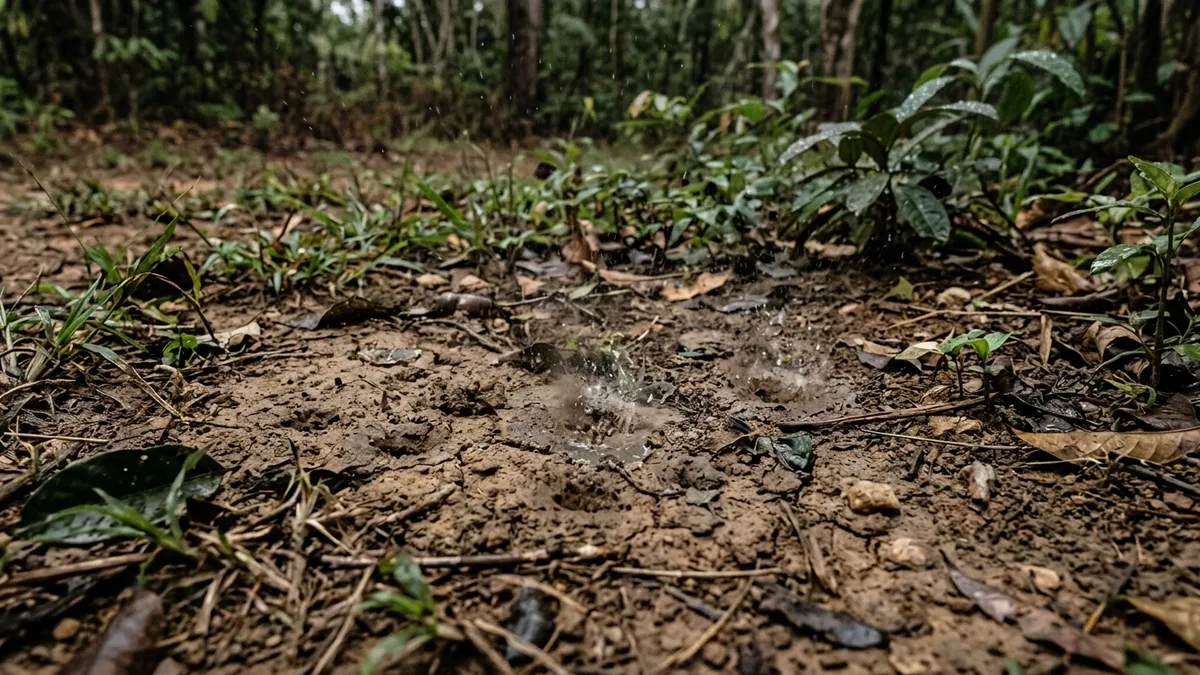
It only takes the first rain after several dry days for the air to change its smell. A large share of that odor comes from geosmin, an organic compound produced by soil microorganisms, above all by actinobacteria. These organisms form filaments and live attached to mineral particles, organic matter and plant remains. When water reaches the ground, geosmin can break loose and travel into the air, where people perceive it as the smell of wet earth.
The smell starts with microorganisms that survive in dry soil and use water to spread their spores.
The odor appears when water hits the soil
An everyday scene like this does not mean that every rain produces exactly the same smell, or that geosmin is the only substance involved. Oils released by plants, compounds in organic matter and other molecules in the soil can also take part in the mixture. Even so, geosmin is the best-known marker of this aroma. The name comes from Greek and means, broadly, the smell of the earth. Its presence explains why the odor can appear within moments of the start of the rain, even before the ground is completely soaked.
The human nose detects a tiny amount
Human sensitivity to geosmin is unusual. In water, the detection threshold is usually described as a few nanograms per liter, often close to 5 nanograms per liter, although it varies between people, environmental conditions and measurement methods. A nanogram is one billionth of a gram. That means an extremely low concentration can already be enough for the brain to recognize the odor, even when the substance makes up no relevant share of the mass of the environment.
Recognition also depends on how the compound reaches the nose. Rain causes tiny collisions with the soil and can form aerosols, very fine droplets that carry volatile molecules into the layer of air near the surface. Wind, temperature, humidity and the type of terrain change the intensity that people perceive. The sense of smell does not measure quantity with precision, but it identifies a chemical pattern. For this reason, a person can smell it strongly at one spot and barely notice it a few yards farther on, even during the same rain.
Why the first shower after a dry spell is the strongest
After a stretch without rain, the soil goes through physical and biological changes. The surface dries out, particles and plant remains stay piled up, and the compounds produced by microorganisms can remain trapped in pores, mineral grains and organic matter. When water returns, it sets part of that material in motion. The combination of buildup, the impact of the drops and the formation of aerosols helps explain why the aroma is usually most obvious at the start of the rainy season or after a drought.
The intensity, however, does not rise automatically just because the dry interval was long. Heavy rain can change how molecules are carried, while a very slow drizzle may release fewer aerosols. The soil matters too. Ground rich in organic matter, areas covered with leaves and urban surfaces all give different chemical mixtures. Geosmin can be easier to notice when the air is cool and moist, but temperature and wind quickly change how it disperses. The smell, therefore, results from the interaction among microorganisms, water, surface and atmosphere.
A scent that may help the microbe spread
The production of geosmin is not just a sensory detail for humans. In actinobacteria, the compound is linked to structures that help the microorganism persist in the environment and release spores when conditions are favorable. Rain can carry these particles, while the odor attracts organisms able to come into contact with them. Insects and other small animals may help move the spores between patches of soil, although the exact importance of this interaction varies among species and environments.
This hypothesis helps explain why a compound that mammals can sense may also have an ecological function for the organisms that make it. The smell was not created for the human nose, and our ability to detect it is a consequence of an especially high olfactory sensitivity.
Known smell, careful measurement
To confirm the presence and concentration of geosmin, researchers must collect samples and analyze the compounds with laboratory techniques. The sense of smell can signal that a molecule associated with the smell of rain is there, but it cannot identify its chemical origin on its own. Perception is also shaped by olfactory adaptation, age, earlier exposure and individual differences. For that reason, the approximate figure of 5 nanograms per liter should be understood as a reference for sensitivity, not as a universal boundary that holds for every person.
In Brazil, the phenomenon can be noticed in forest and rural soils as well as in gardens, parks and urban lots, although each environment has a different composition. When the rain reveals the odor hidden in the ground, it makes a continuous microscopic activity perceptible. The nose recognizes in a few moments what the soil has stored up over days, and this common experience turns an almost invisible molecule into a sign of life in the environment.
Reporting: Natália Santos / Amazonia Mag

Editor · Amazonia Mag
Anne Silva is the editor of Amazonia Mag, the English-language edition of Revista Amazônia. She curates, translates and adapts the outlet's science and environment coverage for an international audience, reporting on Amazon wildlife, flora, rivers, climate and research. Every story she edits is grounded in peer-reviewed studies, official data and on-the-ground reporting from the Revista Amazônia newsroom in Belém, Pará, Brazil. More by Anne Silva →