
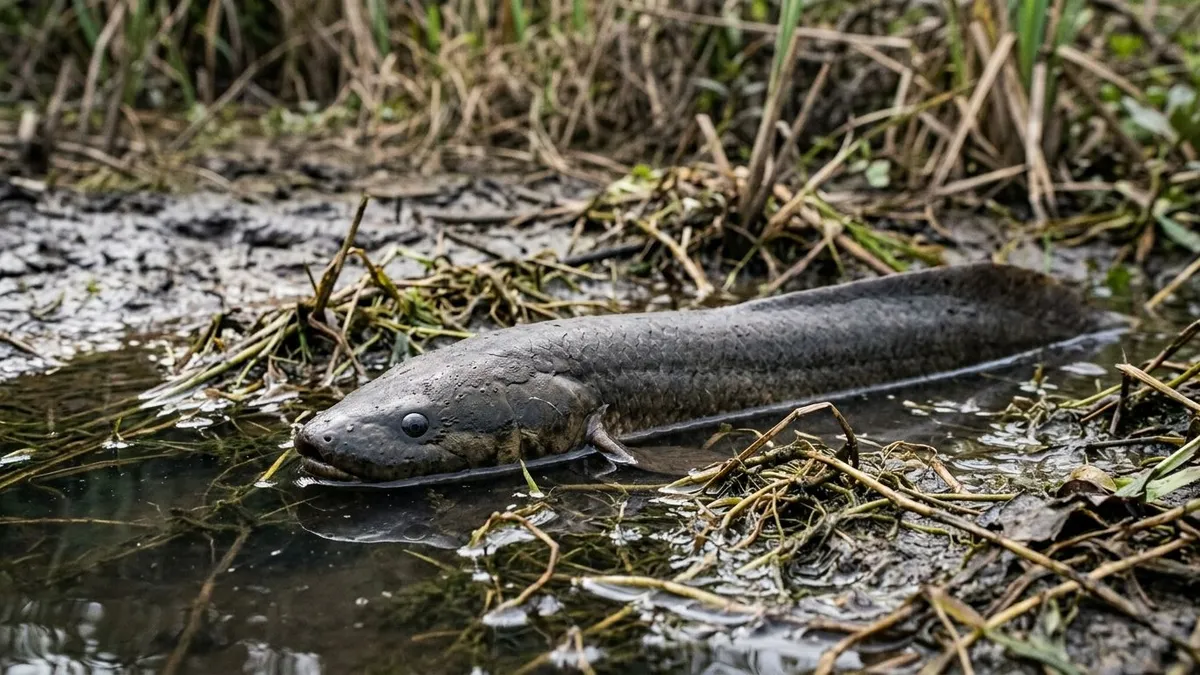
The apple snail, known in Brazil as aruá, combines gills with a lung cavity to draw oxygen from both water and air. While it stays submerged, the gills take part in gas exchange. When the water loses oxygen or recedes, the animal reaches the surface through a siphon and breathes with its lung.
This mechanism lets the snail stay active in environments subject to seasonal drought. The same dependence on shallow, temporary waters shapes its reproduction: the apple snail lays its eggs outside the open water, in a protected spot, which lowers the exposure of the clutch to aquatic predators. Breathing and reproduction work together while the lake changes.
How the apple snail combines gills and a lung
The gills of the apple snail work as surfaces for gas exchange inside the water. Dissolved oxygen passes into the blood, while carbon dioxide moves in the opposite direction. This system is enough when the water holds an adequate amount of oxygen and flows over the gill structures during breathing.
The lung cavity adds another possibility. On reaching the surface, the animal takes in atmospheric air and exchanges gases inside that structure. The combination does not remove the role of the gills, but it allows the snail to alternate or combine the two forms of breathing according to conditions in the environment. In warm, shallow or still water, this ability lowers the dependence on dissolved oxygen alone.
The siphon keeps a line open to the air
The siphon works as a passage that lets the apple snail reach the surface without fully leaving the protected area where it sits. Instead of depending only on the water around its body, the animal keeps a connection with the atmosphere, a condition needed to supply the lung when dissolved oxygen becomes insufficient.
This behavior is especially important in ponds and flooded areas that shrink during dry periods. The water can grow warmer and concentrate decaying organic matter, processes that reduce the oxygen available. By using the siphon to take in air, the apple snail keeps breathing even when gill breathing no longer fully meets the needs of its body.
When the water level drops, the distance between the bottom and the atmosphere gets shorter, but the conditions for aquatic breathing can get worse. The apple snail answers that change by bringing air into the lung cavity. Air ventilation takes a central role, while the gills stay tied to aquatic life whenever there is still water around the body.
This solution makes it possible to occupy environments that suffer strong swings in water volume. The animal does not have to leave the area right away or depend on a deep lake throughout the dry season. Its survival is tied to the ability to combine the two respiratory systems and to keep access to the surface through the siphon, rather than treating the shortage of oxygen as a final barrier.
Laying eggs outside the open water protects the clutch
The reproduction of the apple snail is also tied to the features of drought-prone environments. The eggs are laid outside the open water, in a protected area, which keeps them away from the space directly used by aquatic predators. This position lowers the exposure of the future offspring during a period when the available water may be concentrated in small stretches.
The reproductive mechanism takes advantage of a spot that stays connected to the flooded environment. The eggs sit in a condition that is less reachable for animals that hunt for food inside the lake. The strategy does not mean reproduction stops depending on water, but it moves the laying to a place where the risk of aquatic predation is lower and development can go on with more protection.
Breathing and reproduction answer the same environment
In the apple snail, air breathing and the choice of a laying site can be understood as responses to the same kind of environmental pressure. Temporary ponds offer food and shelter, but they also show quick swings in depth, temperature and oxygen. The animal uses its lung when the water becomes poor in oxygen, and it uses a protected area to reduce the risk to its eggs.
This combination raises the chance of staying in the environment during the shift between flood and drought. The gills sustain aquatic life, the siphon guarantees contact with the atmosphere and laying outside the open water protects the new generation. Each mechanism acts at one stage, but all of them depend on the same capacity to follow the physical change of the lake without breaking the life cycle.
The apple snail links lake water to surface air
The behavior of the apple snail changes how it uses the space of the lake. It can remain near the bottom and, at the same time, keep periodic access to the surface. This movement creates a functional link between water, sediment and air, three parts of the environment that change in different ways during the dry season.
By surviving in flooded areas that other animals could not endure, the apple snail takes part in the food dynamics of those places and keeps a population able to return to flooded areas when the water rises. Its presence shows that the biodiversity of a temporary lake does not depend only on depth. It also depends on adaptations that allow breathing, reproducing and waiting for the environment to recover at different levels of the water column.
The apple snail makes visible a rule of seasonal environments: surviving does not mean resisting a single difficulty, but combining responses to problems that arrive at the same time. The animal breathes in water and in air, reaches the surface through a siphon and moves its laying away from aquatic predators. When the lake shrinks, these solutions preserve more than an individual. They keep a lineage tied to the rhythm of floods and droughts, a reminder that life in flooded areas also depends on the transitions from one state to another.
Reporting: Natália Santos / Amazonia Mag

Editor · Amazonia Mag
Anne Silva is the editor of Amazonia Mag, the English-language edition of Revista Amazônia. She curates, translates and adapts the outlet's science and environment coverage for an international audience, reporting on Amazon wildlife, flora, rivers, climate and research. Every story she edits is grounded in peer-reviewed studies, official data and on-the-ground reporting from the Revista Amazônia newsroom in Belém, Pará, Brazil. More by Anne Silva →