
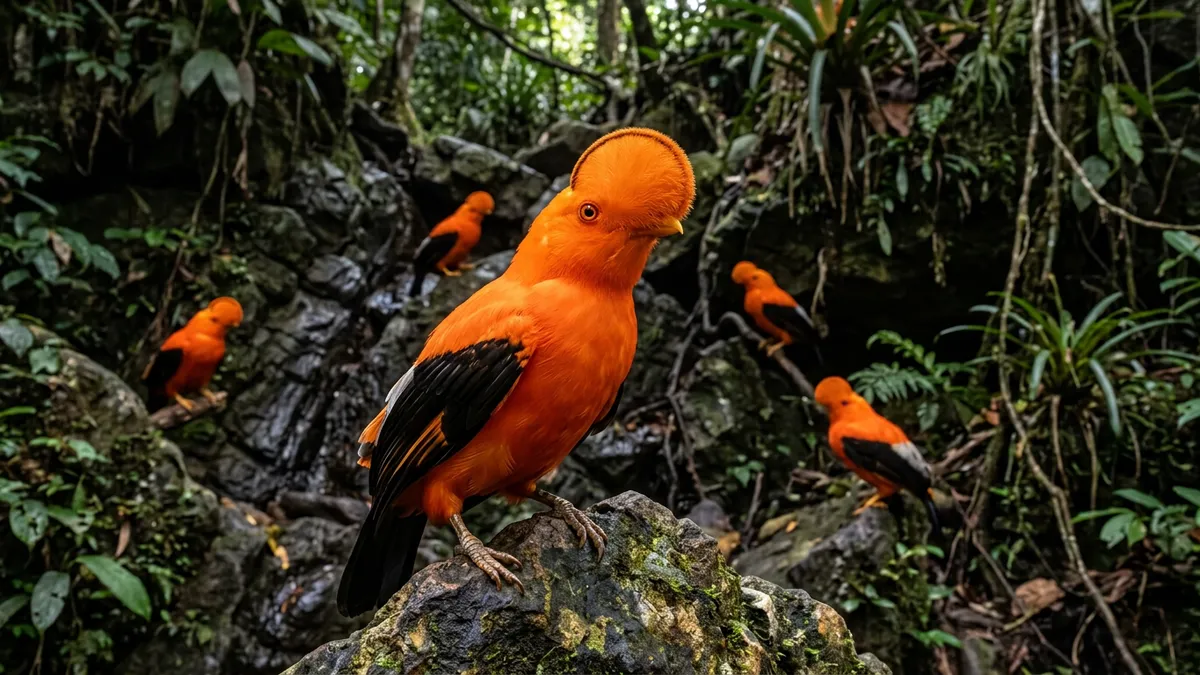
In the rocky areas of the Amazon, reproduction in the Guianan cock-of-the-rock depends on an organized contest among males and, in the end, on a choice made by the female.
The bird gathers several males in a single courtship arena, where they compete for positions within a hierarchy and display in front of visiting females. Breeding is not simply a matter of one male being present. It is a collective competition in which the female watches the participants and picks her partner.
The most visible feature of this behavior is a disc-shaped crest that can cover the bill. The nest, meanwhile, is built on rock walls, which ties the males’ contest to a very specific setting inside the Amazon forest. The arena organizes the choice, and the stone wall provides the protected place for breeding.
How the courtship arena of the cock-of-the-rock works
The courtship arena is a shared space used by many males at the same time. Instead of each individual trying to attract a female from an isolated territory, the males meet at a common spot and present themselves to one another and to the females that arrive. This concentration makes the contest easy to see and creates a sequence of interactions among the males, with some positions more favorable than others inside the group.
The arena works because of a hierarchy. Some males hold prominent positions, while others stay in secondary areas and have to compete for room before they can move forward. The arena is therefore more than a meeting place. It acts as a comparison system in which a female can look at several individuals in the same setting and choose among them. Collective competition also cuts down the need to search for each male separately through the forest.
The disc-shaped crest is part of the display
The crest of the cock-of-the-rock is shaped like a disc and extends over the region of the bill. Because it takes up such an obvious part of the head, it becomes a central piece of the appearance each male presents in the arena. When males take their places in front of rivals or a female, the crest helps make their presence noticeable in the middle of the contest.
This structure should not be treated as a mere ornament with no role in behavior. In an arena where visual comparison among males matters, the shape of the crest becomes part of each individual’s identity and of how the others read him. A female does not come across bodies hidden among the vegetation. She sees males gathered together, each carrying a very conspicuous structure on the head, in a space used precisely for reproductive display.
A hierarchy gives order to the contest
A crowd of males in one spot could produce nothing but disorderly clashes, yet the arena shows a hierarchy. The position each individual holds influences how visible he is and how much access he has to the display space. Better placed males take part in the contest under different conditions from those who stay at the edges or must wait for a chance to move up.
That hierarchy also lets the competition go on over time without turning every encounter into a permanent fight. The males recognize the established order and react to attempts to take over space. The social structure of the arena creates a kind of queue of reproductive opportunities, although the final decision remains in the hands of the female. A male’s position comes from his interactions with rivals, but it does not automatically guarantee mating.
Why the female’s choice changes the outcome
The presence of the female changes the meaning of the whole contest. The males may gather, take their places and show their crests, but the reproductive decision depends on what she observes. The arena lets her compare individuals that are close together, placed in the same scenery and arranged in a visible hierarchy. This mechanism concentrates selection in one specific place.
For the female, choosing among many males can offer a way to evaluate traits before accepting a partner. The process also prevents plain dominance over other males from being mistaken for a guarantee of reproduction. An individual can hold a high position in the arena and still depend on the female’s preference. Collective courtship therefore separates two stages: the contest among males and the choice made by the partner.
A nest on a rock wall completes the strategy
After the contest in the arena, reproduction is tied to another element of the environment: the rock wall. The nest is placed on a stone wall, which puts the breeding site on a vertical surface that is hard to reach for many land animals. The rock becomes part of the species’ strategy, not as the backdrop of the courtship but as the support for the nest.
The separation between arena and nest shows that different phases of the breeding cycle depend on different conditions. The arena has to allow males to gather and be compared. The rock wall has to offer a suitable base for the nest. The Amazon forest provides both settings when rocky areas appear inside the territory the species occupies. Reproduction results from the combination of social behavior and a precise choice of the place that will shelter the nest.
This link to the landscape also helps explain why protecting the species depends on keeping several elements in the same biome. Forest alone does not describe every condition the bird needs. There must also be places where males can gather and rock walls able to receive the nest. Protecting a bird, in this case, means preserving not only trees but also the spaces of contest, courtship and nesting that sustain its life cycle.
In the arena of the cock-of-the-rock, reproduction is not a casual meeting between two individuals. It depends on a landscape able to bring males together, on a hierarchy that organizes the contest, on a crest that takes part in the display and on a female who decides. The rock wall adds another layer to this system and reminds us that animal behavior grows out of the relationship among body, society and environment. Where these elements stay connected, the forest keeps not only species but also the spaces where their choices can keep happening.
Reporting: Natália Santos / Amazonia Mag

Editor · Amazonia Mag
Anne Silva is the editor of Amazonia Mag, the English-language edition of Revista Amazônia. She curates, translates and adapts the outlet's science and environment coverage for an international audience, reporting on Amazon wildlife, flora, rivers, climate and research. Every story she edits is grounded in peer-reviewed studies, official data and on-the-ground reporting from the Revista Amazônia newsroom in Belém, Pará, Brazil. More by Anne Silva →