
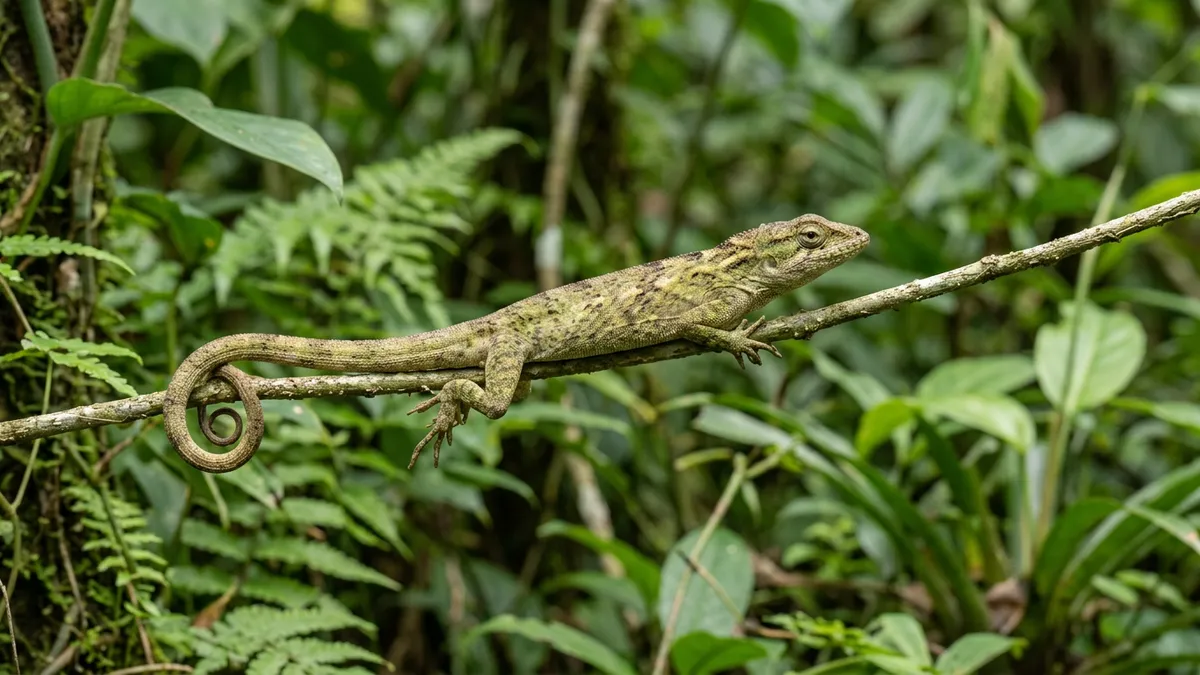
The monkey lizard of the genus Polychrus, called papa-vento in Brazil, changes color because its chromatophores respond to temperature, to light and to social situation. The change does not work as an automatic copy of the background the animal sits on. It follows physical conditions and warning signals, altering the lizard’s appearance according to the moment.
As it moves, the lizard walks slowly and sways its body like a leaf pushed by the wind. Its prehensile tail helps hold it up, its eyes can move independently, and it captures prey with a short lunge at insects. Body control, vision and color change come together in a single pattern of behavior.
Color follows the physical environment and the state of alert
Chromatophores are pigment-bearing cells or structures able to change the look of the skin. In this lizard, their response is tied to temperature, to light and to social situation. That means color should not be read as a fixed design or as a simple outward feature. It is part of a system that follows the conditions the animal is facing.
When temperature varies, the working of the body calls for adjustments as well. Lighting changes how a coloration is perceived, while the presence of another individual, or a situation of alert, adds a social component to the response. The lizard, therefore, does not have a single obligatory appearance. Its skin can express different states depending on the stimuli it receives.
The change of color begins with the perception of stimuli in the environment. Temperature and light supply physical information, and the social situation adds signals tied to the presence or actions of other animals. This information influences how the chromatophores work, and they alter the observable appearance of the skin.
The mechanism does not depend on the lizard consciously choosing a color to match each surface. The response is bodily and regulated by stimuli. That is why crediting the animal with a deliberate imitation of the background reduces the accuracy of the explanation. What is seen is a modification tied to the state of the organism and to its context, not an instant painting of the surroundings.
A prehensile tail supports movement among branches
A prehensile tail is a structure able to help with support. By bracing itself on vegetation, the lizard can use the tail as an additional point of contact, keeping the body steadier as it moves. This function fits the slow, controlled way of walking described for the animal.
The support of the tail also helps explain why each movement looks calculated. Instead of advancing quickly, the lizard distributes its weight and follows the vegetation with sways of the body. Gripping does not turn the tail into a tool for attack. In this behavior its main job is to help with balance while the lizard moves and watches.
The sway imitates a leaf in the wind
The monkey lizard walks slowly and rocks like a leaf under the wind. This pattern makes its movement less abrupt and folds the animal into the motion of the vegetation. The resemblance lies in the way it moves, not necessarily in a color change meant to reproduce the background.
The behavior demands coordination among legs, trunk, tail and vision. The lizard moves forward without losing control of its body, keeping the ability to watch its surroundings. The slowness also favors approaching insects, which may not react right away to a predator that advances with small oscillations. The sway, then, takes part both in locomotion and in the approach to prey.
Independent eyes widen control of the surroundings
The eyes of the monkey lizard can move independently. This lets the animal point each eye at a different part of its visual field, without having to turn its whole body each time its interest shifts. For a lizard that travels slowly, this ability cuts down on unnecessary movement.
While one eye follows the vegetation or a possible threat, the other can stay on the area where food might be found. Independent vision does not mean the animal has unlimited attention, but it gives flexibility for monitoring the surroundings. With its tail braced and its body swaying, the monkey lizard combines stability and perception before it acts.
A short lunge turns watching into capture
The hunt happens with a short lunge at insects. The animal does not need a long chase when it manages to get close without abrupt movements. The slow advance, the leaf-like sway and the visual watching prepare a quick strike from a small distance.
This kind of capture depends on timing. The lizard has to locate the insect, keep control of its body and move forward precisely. The prehensile tail contributes to stability, while the independent eyes help track the surroundings. After the lunge, the relationship with insects gains ecological importance, because the lizard acts as a predator within the community where it lives.
The monkey lizard shows that a change of color does not have to be explained as an attempt to vanish into the background. Its chromatophores respond to temperature, to light and to social relations, while the body combines a prehensile tail, independent eyes and movements that recall a leaf in the wind. The short lunge completes the set. Watching the animal closely moves the focus from an isolated look to the sequence of bodily decisions that sustains its life, a reminder that nature tends to work through integration, not through a single trick.
Reporting: Natália Santos / Amazonia Mag

Editor · Amazonia Mag
Anne Silva is the editor of Amazonia Mag, the English-language edition of Revista Amazônia. She curates, translates and adapts the outlet's science and environment coverage for an international audience, reporting on Amazon wildlife, flora, rivers, climate and research. Every story she edits is grounded in peer-reviewed studies, official data and on-the-ground reporting from the Revista Amazônia newsroom in Belém, Pará, Brazil. More by Anne Silva →